On 9 August 2026, the first community mill in Bhatwada, Achham, was inaugurated and put to work. It is a small machine, but getting it there took many people working together.
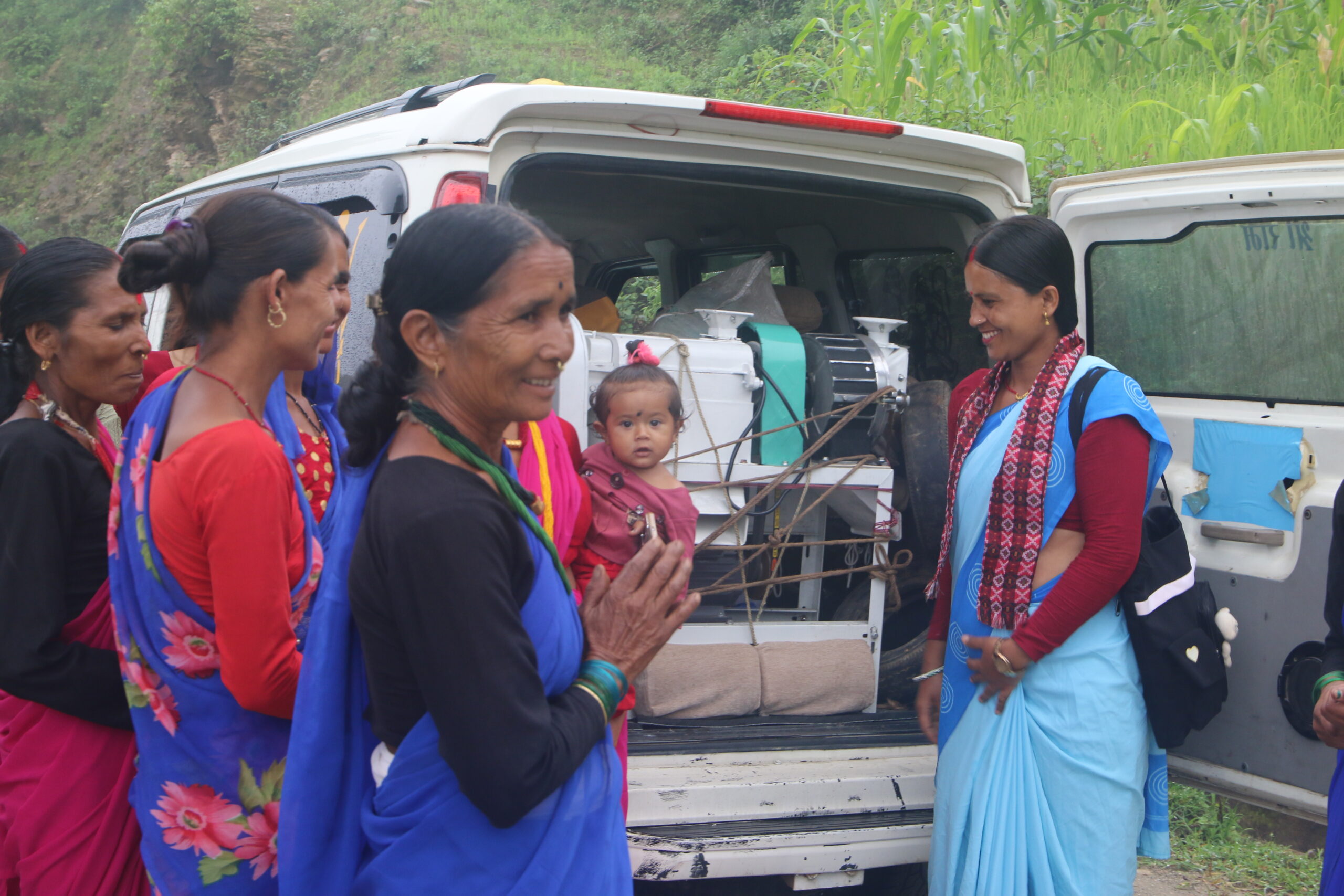
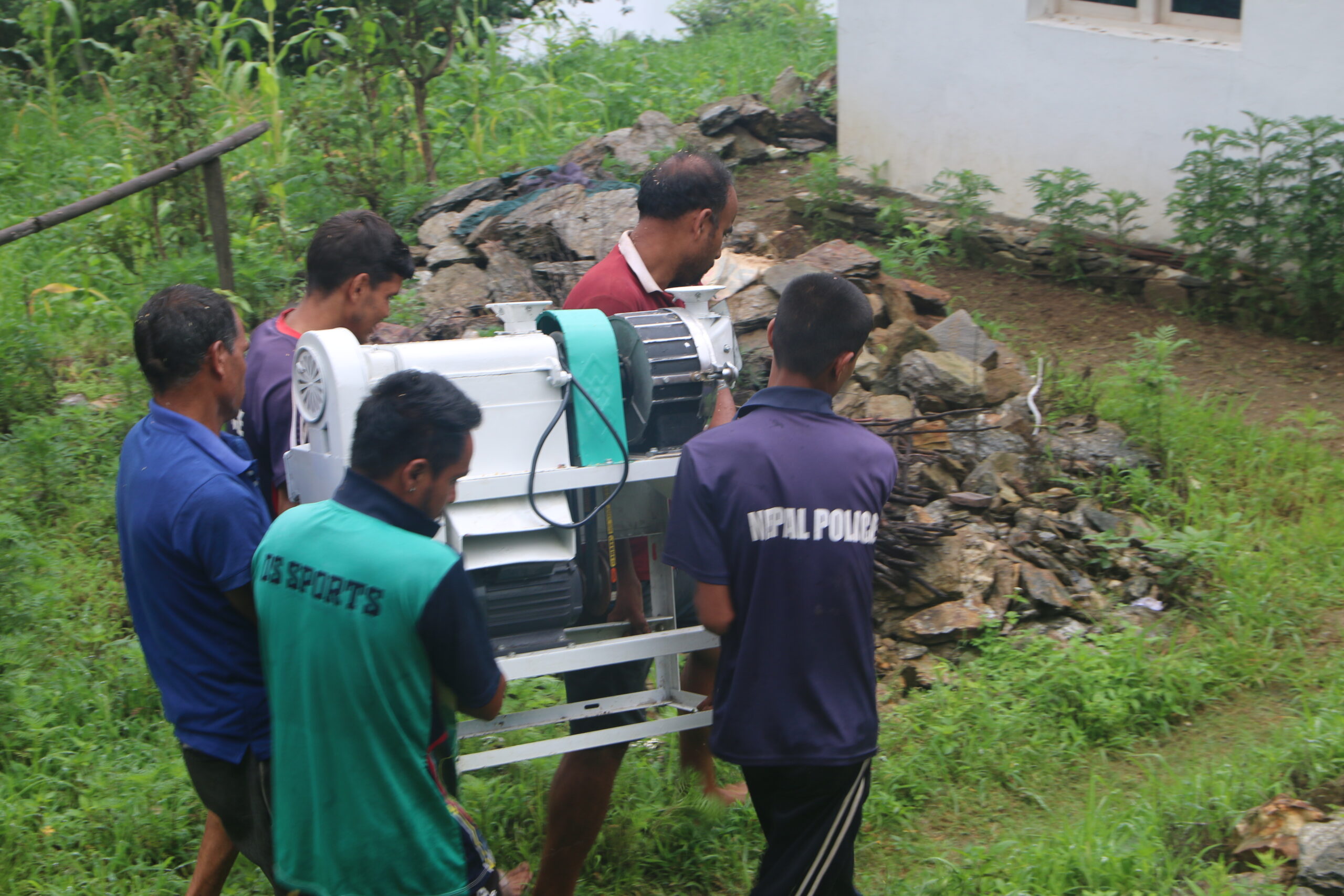
When the mill arrived, the women of the community came to welcome it. Local men unloaded it and carried it from the vehicle to the place prepared for it. The women had already been involved in deciding where it should go and how the community would use it.
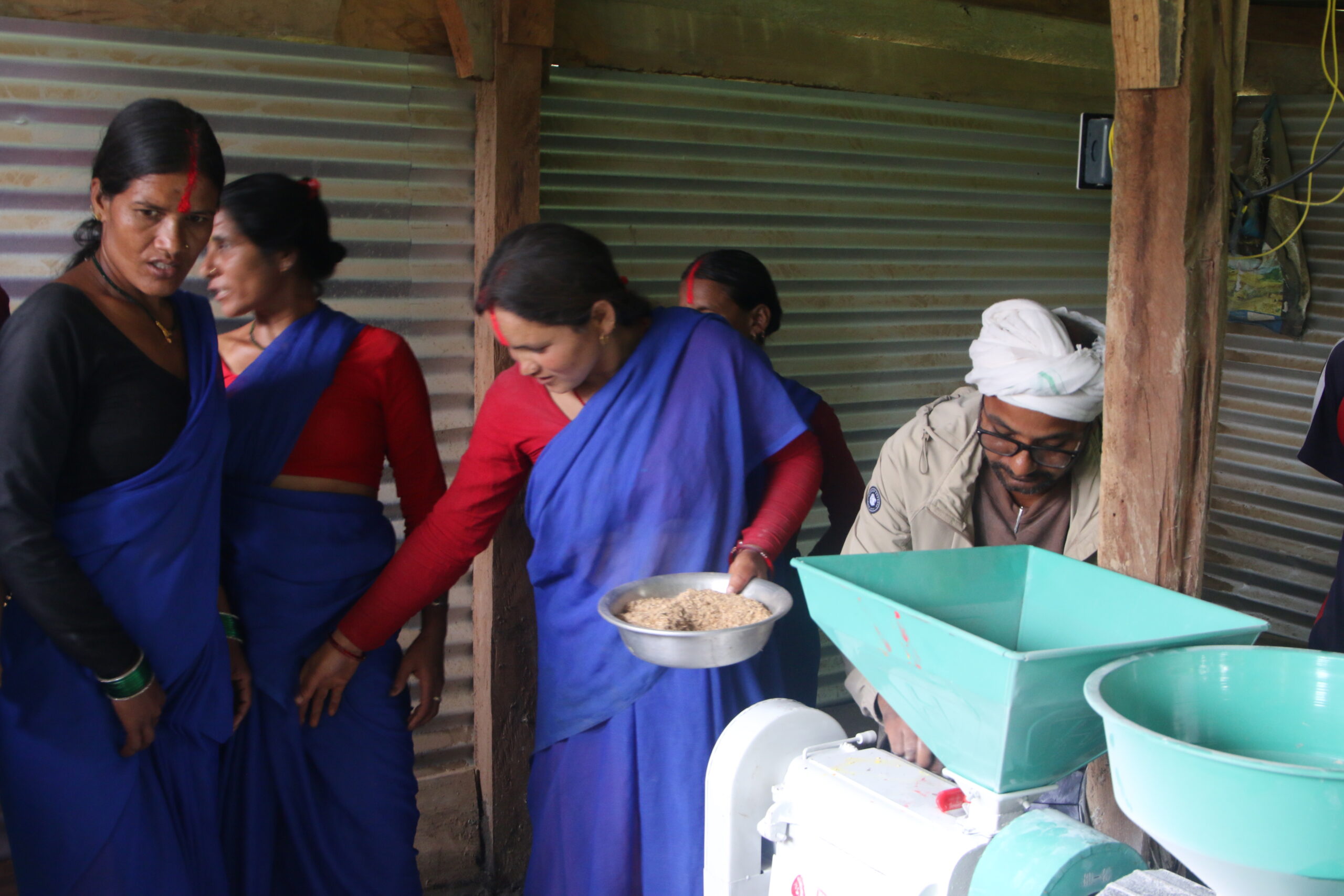
The space and electrical connection were prepared, and the machine was installed. At the inauguration, the mill was switched on and the women began to process grain with it. Those first moments are in the photographs.
Until now, processing grain meant doing a lot of work by hand or travelling to another mill. Having one close to home can save time and effort. We will learn with the women how it works in everyday use; it is too early to put a number on the hours saved.
The first mill was made possible by the support received through the MiGranoDeArena matchfunding campaign. Thank you to everyone who contributed, and to the women and the local team who have worked to make it useful for the community.
At be artsy, we work on menstrual health and education, but women’s autonomy also depends on what happens in daily life. This mill is one concrete way to make that daily work a little lighter.
be artsy has received a €6,000 grant from Dipsalut for the project Rato Baltin – Promoting menstrual health in Western Nepal. Stop menstrual evictions.
The project achieved a very high score according to the call’s evaluation criteria, recognising its quality and impact on promoting menstrual health and dignity in rural areas of Western Nepal.
At be artsy, we deeply appreciate Dipsalut’s trust and are proud to continue working along this path to build a fairer and healthier future for all.
In the Rato Baltin project, we keep working hard. This year, we’ve been tight on resources, but we’ve been able to follow up with the girls who received menstrual cups last year, with great results.
We are now in our sixth municipality, Binayak, in Achham, one of the most populated areas! Ruby Cup has donated 1,000 colorful menstrual cups, which will surely surprise our trainers, like Kamala, who leads the project, and Manisha and Rohina, who have been with us since 2019.
We need more support to continue working in the villages of this new municipality.
If you want to contribute (only Spain) via Bizum: 01177.
But please email us to info@beartsy.org con with your details, to deduct it in your Income Tax!
If you prefer to contribute by regular bank transfer (but again email us with your details for the deduction!): be artsy Association: Banco Sabadell – IBAN: ES23 0081 0900 8200 0430 1934 – BIC: BSABESBB
Una exposició d’art a Ripoll – també es pot fer la tramitació d’una adquisició online, i enviament per UPS) – dóna suport als projectes de be artsy. Algunes dels lectors d’aquest article ja coneixeu l’entitat. Veieu al final de l’article: dades bàsiques de l’exposició. Un cop acabada l’exposició, es podran adquirir online amb enviament segur per UPS (a través del correu electrònic admin@sylvaner.cat). Anirem afegint algunes fotos d’obres d’art disponibles per la seva adquisició.
Un col·laborador voluntari d’aquesta associació, molt petit col·leccionista d’obra gràfica original – litografies, gravats – i de pòsters d’art acreditats i d’edició limitada, ha decidit exposar part d’aquesta petita col·lecció a Ripoll, i donar una part de la recaptació a l’associació.
Les obres surten sense preu. Però tampoc es tracta d’una subhasta. La primera oferta raonable que es faci per una peça serà acceptada, totes les ofertes seran considerades i s’oferirà informació, documentació, de manera personalitzada (admin@sylvaner.cat)
L’exposició mostra obra gràfica original -litografies i altres – d’artistes com Miquel Barceló, Joan Hernández Pijoan, Perico Pastor, Joan Miró, Maria Girona, Antoni Tàpies, Eduardo Arranz-Bravo, i pòsters d’edició limitada y acreditats d’Albert Ràfols Casamada, Lola Anglada, Montserrat Gudiol, Tàpies, Josep Guinovart, J-J. Tharrats, Josep Subirachs, Keith Haring, Marc Rothko, Paul Klee, Eduardo Chillida… entre altres artistes. La majoria tenen o bé certificat de compra en subhasta o acreditació de compra en subhasta.
Tot i ser una petita associació, està registrada com a organització no lucrativa pel Desenvolupament, i també d’Utilitat Pública, així que les donacions desgraven de l’IRPF. Pràcticament són només els donants particulars els que sostenen els projectes, tot i comptar en ocasions d’ajudes d’entitats privades.
Dades bàsiques:
Art – Exposició d’obra gràfica original, i pòsters d’edició limitada
Procedents d’una petita col·lecció. Del 10 de gener al 5 de febrer de 2024. A La Qperativa, Plaça Gran, 23, Ripoll (Girona). De dilluns a divendres, de 9h a 21h. Dissabtes, de 9h a 22h. Diumenge tancat.
Per veure detalls de l’exposició i el seu funcionament: sylvaner.cat. Ni a l’exposició, ni a la web sylvaner,cat, ni en aquesta galeria, estan totes les obres disponibles. Demana informació a admin@sylvaner.cat! També es pot parlar de fer la tramitació d’una adquisició online. Algunes de les obres disponibles:
Joan Miró (1893 – 1983): litografies originals. Primer, ‘Omnium Cultural’ (póster litogràfic editat per la prestigiosa editorial d’art Polígrafa) 73 x 54 cm. 2: Litografia originale VI. Al revers: Joan Miró: Litografia originale VI / Graphis Art, Livorno / Toninelli Modern Art, Milà. Tot i que pertany a la sèrie Miró Lithographe-III (1964 – 1969), en aquesta ocasió, en una edició limitada de 1972, a Itàlia, aquesta litografia evoca la sèrie de l’artista ‘Animals surrealistes’. Referenciada al Catàleg Raonat: Litografia Miró-III, 1964-1969, p. 30 (i en altres Catàlegs). 33 x 53 cm. Sobre paper blanc d’alta qualitat (250 g). La primera litografia té certificat de compra; la segona, acreditació de compra (en subhastes).
Joan Hernandez Pijoan. Premi Nacional d’Arts Plàstiques el 1981, l’artista (1931-2005) va crear un Quadern d’Artista amb disset gouaches originals. D’aquest Quadern es va fer una carpeta d’artsta, limitada, de reprografies sobre paper ‘old mill’ blanc. La seva tècnica pictòrica, molt meditada i continguda, mostra en aquest conjunt d’obres una gran austeritat que dota els treballs d’una qualitat poètica extrema. Es venen individualment o bé la totalitat de la carpeta. Els fulls estan doblats, i cada obra és una part del full desplegat, o el full desplegat complet, i estan impreses per les dues cares. Un dells té certificat de compra en subhasta, en qualsevol cas totes poden ser acreditades. Full doblat: 40 x 30,5 cm.
Joan Hernandez Pijoan. Premi Nacional d’Arts Plàstiques el 1981, l’artista (1931-2005) va crear un Quadern d’Artista amb disset gouaches originals. D’aquest Quadern es va fer una carpeta d’artsta, limitada, de reprografies sobre paper ‘old mill’ blanc. La seva tècnica pictòrica, molt meditada i continguda, mostra en aquest conjunt d’obres una gran austeritat que dota els treballs d’una qualitat poètica extrema. Es venen individualment o bé la totalitat de la carpeta. Els fulls estan doblats, i cada obra és una part del full desplegat, o el full desplegat complet, i estan impreses per les dues cares. Un dells té certificat de compra en subhasta, en qualsevol cas totes poden ser acreditades. Full doblat: 40 x 30,5 cm.
untitled
untitled
untitleg (Carpeta d’artista)
Pablo Picasso (1881 – 1973) va il·lustrar amb litografies el llibre ‘Lisístrata’, d’Aristòfanes, comèdia representada l’any 411 aC. En el marc de la ‘vella comèdia’, va tenir un èxit extraordinari. Les litografies es poden adquirir individualment, tot i que el conjunt mostra les dos cares de la situació causada pel personatge ‘Lisístrata’, amb la seva idea (convèncer la resta de gregues d’iniciar una vaga de sexe per tal de forçar els homes a negociar la pau, una estratègia que encendria la batalla entre sexes), per acabar amb la Guerra del Peloponès (Atenes i aliats, contra Esparta i aliats). Una mostra a la protagonista, parlant a les dones i soldats, i l’altra mostra l’altra cara, la d’ambaixadors i pensador, imaginant com acabar amb el conflicte creat per Lisístrata. S’acompanyen amb els corresponents Certificats de compra en subhasta.
‘Lisístrata’, d’Aristòfanes
Miquel Barceló (1957). Reprografies a pàgina completa procedents d’una petita carpeta vinculada al llibre (3 volums) ‘La Divina Comèdia’, carpeta en edició limitada, per presentar el llibre. Sobre paper Acadèmia de Frabriano de 200 gr. A partir de les aquarel·les originals de l’artista usades per l’edició del llibre. 29 x 21 cm. Al revers tenen una altra il·lustració, o bé un poema extret del llibre. Un d’ells té certificat de compra en subhasta, en qualsevol cas totes poden ser acreditades. Es venen individualment o el conjunt de les il·lustracions de la carpeta.
Miquel Barceló (1957). Reprografies a pàgina completa procedents d’una petita carpeta vinculada al llibre (3 volums) ‘La Divina Comèdia’, carpeta en edició limitada, per presentar el llibre. Sobre paper Acadèmia de Frabriano de 200 gr. A partir de les aquarel·les originals de l’artista usades per l’edició del llibre. 29 x 21 cm. Al revers tenen una altra il·lustració, o bé un poema extret del llibre. Un dells té certificat de compra en subhasta, en qualsevol cas totes poden ser acreditades. Es venen individualment o el conjunt de les il·lustracions de la carpeta.
We have updated our Transparency page on our website to share the results with donors, associates, and partners.
As you know, our project fights against chhaupadi and promotes reproductive health, menstrual hygiene, and education in areas of Nepal where extreme taboos affecting girls and women persist.
According to the evaluation, the project achieved significant results last year, and we directly benefited over 19,000 individuals through workshops on menstrual health, sexual education, and the distribution of menstrual kits and cups. We have also undertaken other initiatives to increase the visibility of the project.
The objectives of the Rato Baltin project are to educate about reproductive health, menstrual management, and sexual education. On top of that, we introduced the use of menstrual cups in different social spheres, and reduce the school absenteeism of girls in selected remote communities in western Nepal.
We also focus on ensuring menstrual dignity and long-term program sustainability.
Throughout 2022, various activities were carried out to achieve these objectives.
We provided menstrual health and sexual education training for boys and girls, focused on the use of menstrual cups in schools and for women under forty, with a 97.5% acceptance rate.
We provided training on menopause for women’s groups in villages and conducted awareness sessions on hygiene and protection against Covid-19.
Furthermore, we, as well, collected data from menstrual cup users and carried out other actions such as training on sunflower and banana cultivation, as well as soap and incense production. You can read the evaluation.
The results obtained drive the Rato Baltin project towards its goals, ensuring menstrual health and dignity for women in Nepal. Thanks to associates, partners and donors!!
01177. But please email us to info@beartsy.org con with your details, to deduct it in your Income Tax!
If you prefer to contribute by regular bank transfer (but again email us with your details for the deduction!):
be artsy Association: Banco Sabadell – IBAN: ES23 0081 0900 8200 0430 1934 – BIC: BSABESBB
We are very happy to share the last news on our organization! Thanks to the contributions of our members, of donors… the girls were able to finish successfully, during these first two months of the 2023, their Rato Baltin training, by now in two different schools within the municipality of Turmakhand.
In case you don’t actually know us, we started with a very specific purpose: fighting to eradicate the extreme violence that entails the practice of the Chhaupadi, a Hindu superstition deeply rooted in the country, for girls and women in Nepal, by supplying tools, resources, information and training..
Some of you are already aware that the Rato Baltin training is a very complete program on menstrual health and empowerment for women, focused on helping young women to enjoy a better menstrual health and, at the same time, increase their confidence and self-esteem. With this training, girls and boys learn about female and male anatomy, menstrual hygiene, the use of the menstrual cups, and much more.
We are very happy to say that, especially thanks to the support of particulars, and some contribution of other NGOs, we can explain that with that support (which we still need), we have been able to do a follow-up of the users of the menstrual cups from last year, and we have received many positive comments on the impact that the menstrual cups have had in the life of these girls and women. The menstrual cups are a sustainable and affordable alternative to the conventional menstrual hygiene products, and we could continue supplying those to the women in these remote areas of Nepal.
Also, more news: we shall soon start a new school in a new municipality: Chaurpati! We try to expand our scope in order to reach more women in the area! We want to continue supplying relevant education and resources to the young women in this community. If you have any question, or you wish to have more information about our work, do not hesitate in contacting us.
So, if you want, you can continue helping us, we need as much support as possible to go ahead.
Just make a one-off donation. Become a member! Or a donor!
By Clara Garcia i Ortés, Josep Marín
Translation: Tere Salinero. Photos de be artsy
01177. But please email us to info@beartsy.org con with your details, to deduct it in your Income Tax! If you prefer to contribute by regular bank transfer (but again email us with your details for the deduction!): be artsy Association: Banco Sabadell – IBAN: ES23 0081 0900 8200 0430 1934 – BIC: BSABESBB
We work against the extreme discrimination suffered by many girls and women in Nepal. We can talk about extreme violence, too. We also educate their communities, also boys and men. Our projects – with Rato Baltin, as the principal – has its continuity in danger. We need you to continue.
We have educated, protected and feed more than 43,000 people – most of them women and girls – since 2017. We have been educating and empowering women and girls in Nepal for more than 6 years. Will you help us continue? That is why we launched this urgent need for help to be able to continue with the project. We share the link to Migranodearena -crowdfunding, from €5 to…- that we need to be able to continue with the project.
Please help us to ensure the continuity of the project in Nepal from January 2023.
With your support, the project will not have to close and the network and the work done in these almost 7 years will not be lost.
Please donate now and continue to help women in remote western Nepal. Thank you very much!
We spoke with Kamala, one of the first girls to attend our workshops in Mangalsen. Namaste, Kamala. After some time in which, for organizational reasons, we did not update our website with new reports and news, we love to resume the news section with this interview. Kamala is a mentor, and the new Achham Team Manager.
Kamala, can you tell me a little about your life?
Namaste, my name is Kamala Bhandari, I live in Mangalsen Municipality 6, Tesinge. There are 6 people in the family. I am working in the Rato Baltin Project because since my childhood I have wanted to eradicate the misconducts and superstitions of the society.
Kamala, what was your life like before participating in the Rato Baltin Project?
Before working in the project, I didn’t know anything about menstrual health management, I had never spoken about it in front of anyone, and I was unaware about the outside environment, other than my own.
What was your emotional state before starting the Project?
Before starting the project, my emotional state was very weak, I was ignorant, I didn’t know anything about menstrual health management since I participate in some training related to that.
Kamala, now that you are part of the Project, what is your life like? Has your gaze changed towards your future?
My life has changed a lot since I am part of the project. This project has been able to bring lots of changes in me and in my community. Yes, my gaze has changed towards my future, before I knew nothing about life, and now I have more knowledge. I can work on this project and change my society, the village and my future.
And now we ask Clara, co-founder and director of the Project: What surprised you the most about Kamala since she joined the Project?
Although Kamala appears in the image we used to present the 2019 project, from the first row of girls, I knew well only Manisha. I met Kamala during the ToT (we name like this some activities of the project) and especially the day we told the mentors who were training, if any of them wanted to continue studying and their family could not afford it, and they had already told them that they could not do it, they should contact us. We will study their cases. He came to ask for the scholarship, crying. Since she started in the Turmakhand group she has grown as an independent person. She went from being an insecure girl, to being a girl who filled the room with her presence. Kamala is fun, sensitive, hard-working and full of love and respect for others.
Kamala is the second girl, left. The one picture in our flyers.
The second wave of the COVID-19 pandemic plunged Nepal into a deadly health crisis. Existent health infrastructures were insufficient to cater to the increasing number of infections, and many patients were turned down from hospital treatment. Demands for essential medical
equipment and infrastructures such as oxygen cylinders, hospital beds, ventilators along with safety gear could not be met due to their lack of availability. This supply-demand gap created a massive health catastrophe and led to many avoidable deaths.
After the fact that in 2020 the main project of be artsy, Rato Baltin (Red Bucket), had to be left in a kind of stand-by (although our local mentors did continue working, and we kept in touch with the people and associates in Nepal and in the area of Achham) because of the start of the pandemics, in 2021, in February, we started with renewed energies. For example, we started the Happy Women Training Centre for widows and disadvantaged women, in agreement with the village of Mangalsen. We supplied cloth to sew face masks, we also purchased and distributed them. But the second wave of the Covid-19 did strike the country quite strongly.
It was at that moment when the collaborative financing Oxygen for Nepal came to be, the one we are introducing to you in this report
Thanks to individual donors, and the economic and supportive contributions of the NGOs “Amics del Nepal”, “Petit Món”, “Camina Nepal” and some more, we made €18,000
for this task, which we detail in the report. After this impasse, and the financial contribution applied as per the objectives of this specific project, our projects Rato Baltin, Edufem, Happy Women (the Achham women made more than 10,000 masks, more than 200 reusable sanitary
pads and 1,900 bags for menstrual cups), the Mask Up Campaign in Kathmandu donating natural cotton masks to elderly people homes and orphanages in collaboration with Nature Craft, the donation of Ruby Cup menstrual cups to female nurses and doctors that were working against the pandemic, all have continued.
Our evaluation of the whole set of projects of be artsy 2021 has come up with 11,812 (direct) beneficiaries. But let’s see in detail what has the Oxygen for Nepal project meant.
Translation by Tere Salinero. Photos by Creasion Nepal & beartsy
Contributions make a difference. The philanthropic organization Rotary Club Barcelona Millennium has given us resources – € 600 – to support our main project, Rato Baltin, and fight against Chhaupadi, a practice banned since some years by the government of Nepal. But it still persists in the country, especially in rural and remote areas such as the west, in the Achham district. All funds go toward our efforts to secure the basic rights of girls and women in western Nepal, where we have been working since 2017 on the ground to eliminate the inhumane practice of Chhhaupadi that is subjected to women when they have their periods.
We have more and better materials for the menstrual and sexual education workshops for girls, women, and training in the use of the menstrual cup now. A menstrual cup is a sustainable tool that helps girls and women feel clean and safe, as Chhaupadi, rooted in Nepal, causes them to believe that they are impure. We also do workshops for boys and men, as in order for the stigma to change, the entire community must better understand what menstruation is.
Here are some photographs that further show our gratitude to Rotary Club Barcelona Millennium for believing in the project and contributing. Thank you!
Translation by Clara G.O. with annotations by Shruti Gautam