Tag: breakthesilence

  • My 2019 experience in Achham, the far west region of Nepal

    My 2019 experience in Achham, the far west region of Nepal

    Testimonial write by Simran Adhikari, intern and volunteer during 2019, program officer in be artsy’ Nepal headquarter since then, and founder of Be Artsy Nepal:

    As a fresh graduate, I was searching for opportunities to showcase my skills and abilities by volunteering and working for social change.  I got a chance to know Clara G.O. through an international journalist and joined Rato Baltin project by an NGO called be artsy as a volunteer starting March 7, 2019.

    Working on this project made me aware of the harsh menstrual restrictions and also about chhaupadi faced by the girls and women in Achham. Getting to learn about chhaupadi so closely also stroke my mind about the menstrual restrictions which also exist in the urban areas where more educated people live, and girls and women are still restricted to enter their kitchens and also temples. The only difference is that it is much safer in the city.

    During my follow-up visit in November for 15 days, I got a chance to go to Achham for evaluation and got introduced to the team. I became more aware of the harsh reality of the community. I travelled to the village of Sanfebagar named Khalsen and Dhakari (Hichma, Dhakari, Dhungachalna) for the follow-up of the schoolgirls and women using the menstrual cups. In Dhungachalna, I also got an opportunity to talk to the mayor of Sanfebagar, who donated funds for the Rato Baltin project. Due to trust to the local partner, the money was all seized by the local partner of that year. At the same time, along with Clara, while managing the team, I interacted with a female teacher continuing Chhaupadi after her delivery. During the interaction, she told me that she has been following this practice because of her fear to God, and fear of society. Even though she is a teacher, she still could not change her beliefs which made me depressed and worried about her 2 months old daughter.

    A landscape. Achham, Nepal

    Similarly, at the same time, I got another chance to talk to the mayor of Sanfebagar about the money taken by Samabikas Nepal and misused in the destruction of Chhaugoth at Sanfebagar Municipality. I called him from the office number, but I believe that the number was blocked by him. The second time I called him with another number, he picked up the phone.

    The details about our conversation

    Me: Hello sir, Good afternoon! I am a volunteer of be artsy’  Rato Baltin project (he recognized the project name). Sir, I am talking on behalf of Clara as a translator, anything I am telling you is Clara asking you don’t mind if it sounds harsh.
    Mayor: Yes, please tell.
    Me: Sir, the money you have been giving in the name of Rato Baltin project has been captured by Samabikas Nepal. The purpose of the project is not to destroy the chhaugoths. This money has been misused by the local partner and has not been meeting our objectives. Whereas, SamaBikas Nepal is not in communication with Rato Baltin project.
    Mayor: Look! I gave the money to Rato Baltin, now it’s not my thing. You should talk to SamaBikas Nepal and move cooperatively. I am a mayor and have a lot of things to do. Don’t call me and ask about small things, now you have to coordinate with the local partner.
    Me: Sir I get that, but we could see the money is being misused, and we are trying to contact SamaBikas Nepal, they never pick up the call. The money has been used to destroy chhaugoths which is causing more deaths of girls and women. This is not our way for the change!
    Mayor: Listen, we are planning to destroy chhaugoths, until and unless we don’t do that people are not going to leave this tradition.
    Me: This is a tradition which has been followed by infinite generations. And at once destroying chhaugoths does people get awaken and stop this practice? Many NGO’s and INGO’s have been working in this sector for many years. They are not able to bring change over time, can this decision of yours bring change instantly? Who will be responsible if the females die after the destruction of chhaugoths? Can you take the responsibility of girls who dies because of the destruction of the menstrual huts?
    Mayor: I don’t know other things, but I am into destroying chhaugoths. Maybe we give one hour or two days notice to people before destroying them. If we don’t do this, then the practice never ends. During this period if ‘one or two girls die then it is not my problem. They die due to their own reason. We are destroying chhaugoths and allowing them to live inside their house. If because of it they die, it’s their personal matter’.
    Me: How can you tell this, sir? You being a leader of the area, it is your responsibility to take care of the females and protect them! We can know how many girls die after this step-through media.
    Mayor: This is our decision, and we are doing this. No one can stop me from this revolution. And if you are giving me the threat of media, then I am not afraid of the media (cuts the phone!).

    Girls with our Ruby Cup menstrual cups in a menstrual education workshop


    …I got traumatized because of his words and knowing his mind-set. After that conversation, I could only see the girls in Achham having a dark future because of the cruel mind set of the people here. Yes, revolution brings change, but this kind of selfish revolution will kill many innocent faces.

    Similarly, Clara and I were there with the local ward leader disseminating information about the film projection and check if he could manage the hall for film projection. I was talking about social change and how hard it is to change the mindset of people. The local ward leader told us to distribute money, if not much, at least 10 Rupees per person and the hall for the film will be full. I told him- ‘We are here for projecting film for the purpose of changing people’s mind-set and their perception. We don’t want people to come here for the greed of money, but we want them to come here for the real change’.

    The overall field trip was a learning experience, while listening to people with patience, analysing the people’s mind set and bring innovative ideas for change. However, this whole experience also made me realize about the harsh reality which was totally unexpected for me.

    Text and photos by Simran Adhikari, Program officer in be artsy' Nepal headquarter. And founder of Be Artsy Nepal
    Correction / translation by Shweta Manandhar / Tere Salinero.

    For just €1.80 a day you can change the future of a girl and prevent her from being forced to marry at 14 years old!

    There are several ways in which you can get involved and sponsor a girl in Achham:

    Teaming Group: 1 euro a month – become part of Rato Baltin Project!

    Teaming Group: 1 euro a month – become part of the team and get your friends to help you sponsor her and avoid early marriage!!

    Regular donation: to https://donorbox.org/againts-chhaupadi

    Become a member: https://beartsy.org/associate/

    🙂 Thanks!

  • We evaluate the impact of the Rato Baltin 2019 project

    We evaluate the impact of the Rato Baltin 2019 project

    We are really happy to finally show you the impact evaluation from 2019 year. This year we are a little late, because analysing the result from 4 teams has been giving us 4 times the work from last year. But we hope you are going to be as happy as we are with the results.

    The remote villages where we have been present have been 18, in 4 municipalities, in Achham. We think that monitoring the project is essential. That is why we went to the villages where we were in 2019 and we evaluated the program and its impact.

    Resultats Rato Baltin 2019

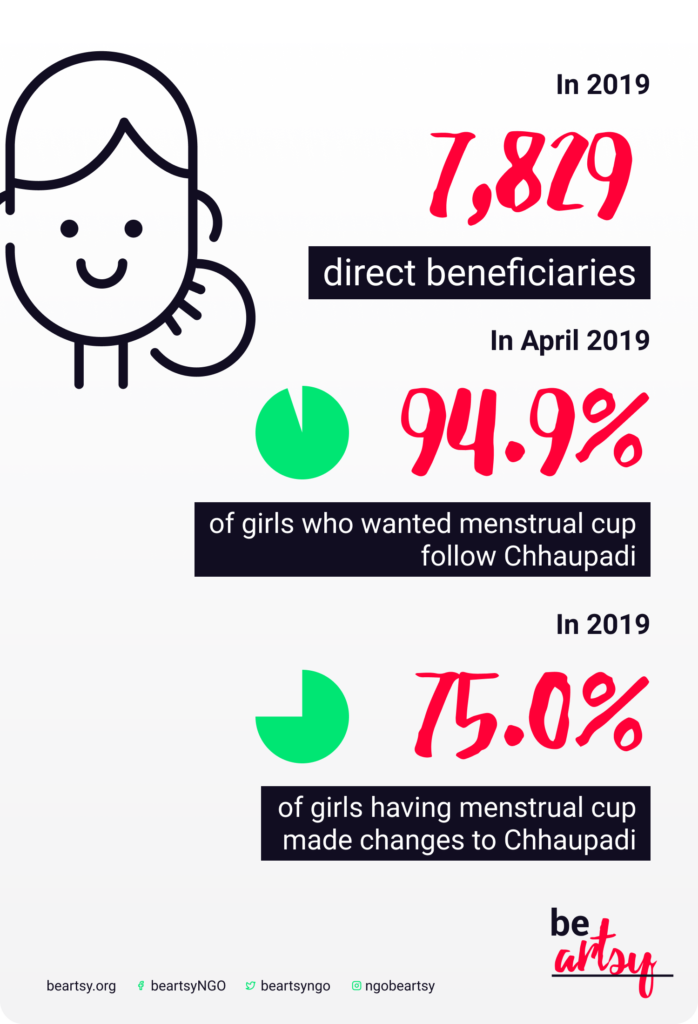
    We teach menstrual health management, reproductive and sexual health education workshops and activities to involve communities. We also teach photography workshops to facilitate the expression of the girls, film screenings, and meetings with the municipal authorities and religious and spiritual leaders of all the villages. In the course of the project, in 2019, we have distributed 1,467 menstrual cups to school girls and young women. They received menstrual cups, a metal bucket to boil the cup, and soap. Work was done on how to use it. 7,829 direct beneficiaries were reached during 2019.

    In the face-to-face follow-up, every two months, with the users of the menstrual cup, the trainers and local mentors and coordinators helped. We also took into account girls who do not use menstrual cups, to assess the difference between girls who use them and those who are not users, and to see if the tradition of chhaupadi can be changed only through education.

    The results

    Talking to the girls, we saw that a very high percentage use the cup, even six months after training. And they would recommend it to other girls. 94% of the girls explained that they followed some type of menstrual restriction before and after the training and implementation of the cups, but when asked if the tradition has changed since then, 75% of the girls reported having made changes in the chhaupadi tradition.

    Some girls reported changes in access to food: now they can eat vegetables, some can eat fruit, and some can drink milk. Some girls reported that, after participating in our workshops, their mothers allowed them to have a thicker blanket in the Chhaupadi hut and since they do not stain, they do not have to be washed every day. Most of the girls said that they no longer have to sleep outside when they have their period, since nobody knows that they are menstruating. Some girls sleep in separate rooms and some still practice chhaupadi, but now they feel clean and safe. Some also reported that since workshops and training they are no longer required to participate in chhaupadi exclusion practices and are now allowed to cook and eat. They mentioned that they are now allowed to touch the animals at home, some girls no longer hesitate to touch water sources or visit the temple without hesitation, or reported that they feel comfortable going to school when they have their period, since the use of the cups nobody can tell if they are menstruating or not. They also believe that it is easier to work when using the cups. The women who agreed to talk about their experience said that they feel much cleaner using the cups, since the blood does not leave their body. These girls and their families also feel safer, and also because they don’t have to wash their clothes due to blood stains.

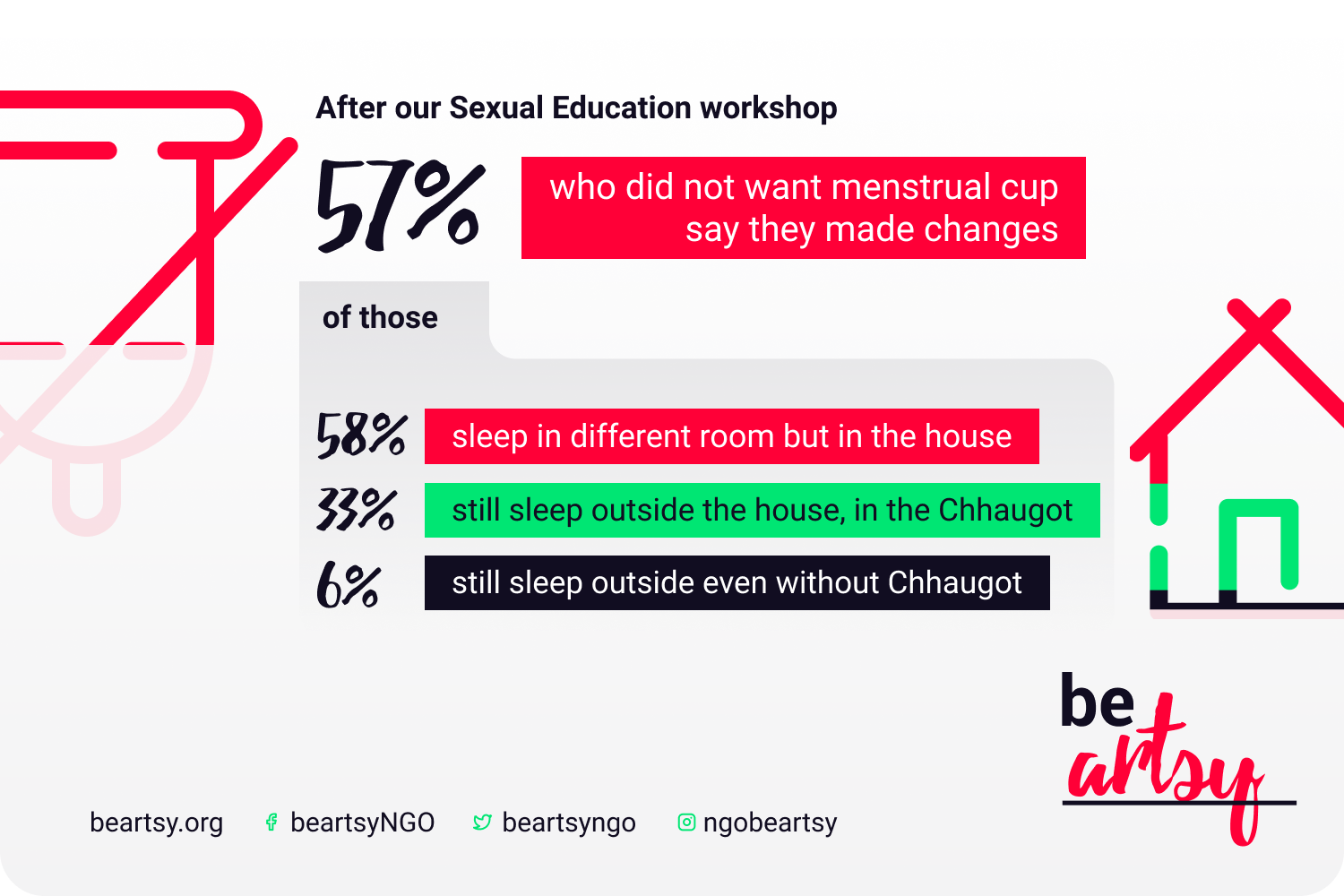
    It is important that girls who do not use the menstrual cup have also undergone changes since we started training in menstrual health management. 57% of these girls have made changes during menstruation. Like the girls who use the cup, they revealed that after the training workshops we did they were able to touch the animals. eat vegetables or drink milk, sleep in their bed indoors, in a separate room, have a thicker blanket if they continue sleeping in a hut, touch water sources. 58% declared to be in a separate room inside the house, while 33% still sleep in a chhaugot and 6% even sleep outside, despite having no chhaugot.

    This year we have managed to maintain the presence of 4 different teams, working on the ground simultaneously. Thanks to the goodwill of the trainers, the monitoring of the project went well, and we were able to obtain many comments from the beneficiaries. Survey findings show that our initial idea that cups can break the taboos surrounding menstruation and chhaupadi works.

    In 2020 the project will not be expanded to many other towns. We will try to reach more women and help them stop chhaupadi, assisting and encouraging them with the help of mentors and training visits.
    Our area staff will be made up exclusively of local girls – from Achham. It is important to highlight that the local counterpart of the year 2020 is made up of women committed to the project, who have created a social company . Specifically, we are talking about three Nepalese women who have worked with our 2019 counterpart throughout the year. They have been trained to work on these types of projects and to know how to raise funds from cooperation organizations around the world and from private entities, and in generating their own capital. Thus, the project can be managed more efficiently, and we can have trainers in each municipality who will take care of their menstrual cups’ users and actively promote awareness of the chhaupadi problem throughout the year. You can read the document with all the details of the evaluation of the 2019 period here.

    Text by Clara Pinilla and Josep Marín

    For just €1.80 a day you can change the future of a girl and prevent her from being forced to marry at 14 years old!

    There are several ways in which you can get involved and sponsor a girl in Achham:

    Teaming Group: 1 euro a month – become part of Rato Baltin Project!

    Teaming Group: 1 euro a month – become part of the team and get your friends to help you sponsor her and avoid early marriage!!

    Regular donation: to https://donorbox.org/againts-chhaupadi

    Become a member: https://beartsy.org/associate/

    🙂 Thanks!
  • Conversation with Clara G.O. about the Rato Baltin Poject.

    Conversation with Clara G.O. about the Rato Baltin Poject.

    Here is the link to listen the interview to Clara G.O at Radio Santvi.

  • United Nations puts the 2020 focus in the sexual and reproductive rights

    United Nations puts the 2020 focus in the sexual and reproductive rights

    Sponsoring girls, to facilitate scholarship and avoid early marriage in some areas in Nepal, is a new project of be artsy.

    The United Nations has called for meetings of governments, women rights activists, and other agents, between May and July this year. Agents who promote a global campaign – Generation Equality, centring in Mexico City and Paris – in the 25th anniversary of the Declaration and platform for the action – Beijing 1995.

    The declaration denounced gender inequality and proposed possible changes in women rights, and the “equality norm”. In an introduction to the campaign, UN Women explains: “Imagine a world where every person has got equal rights and opportunities. Women and girls are not afraid of walking home at night and men and boys are not trapped in oppressive masculinities. And where there is equality in political leadership, corporate boardrooms and factory floors. Women have a word in the decisions that affect their lives, their body, their policies and their environment, from villages to cities”.

    This year 160 countries are expected – 189 states that entered into the declaration will adopt it by unanimity – to inform about the progress achieved, and that the United Nations Secretary-General makes a general evaluation. The new campaign talks  “to facilitate synergies” – explains Katja Iversen, leader of the Women Deliver global group – “to advance effectively in matters such as abortion rights, reproductive health, or to put an end to violence. The potential for this change is huge” – she continues – “but there are already too many empty compromises, we must end up this year with a categorical, responsible and daring action”.

    This declaration also included, amongst 12 key areas, decent work in any sector and equally paid, and to evaluate the impact of the environmental degradation in women, and their role in a sustainable development, specially in rural areas, where women and girls suffer also from a more difficult access to education. This right is challenged in some countries and, if not that, the difficulties to access education cause that, for example, many girls are forced to marry prematurely. The United Nations and other organizations do also point out the violation of basic rights, in the early or forced marriage of the girls.

    Sponsorship project of girls and young women in Accham.

    To this regard, the Edufem project of the association be artsy is based on the assumption that, for every year in school, the marriage age can be delayed in two years, in the remote rural areas of Nepal where the association works. Girls of 13 or 16 are married before having the chance of doing a more advanced grade – they think that their future implies working at their in-law’s house -, or else leave school earlier because they need to work in their parents fields. This project is parallel, and complementary, to the Rato Baltin Project that the NGO is carrying out since 2017, through which it denounces the extreme discrimination suffered by girls and women because of tribal origin traditions – Hindu ones, considering a woman impure when she is having her period -. And which also exposes them to being raped, or to die away from their own house when they are subject to the Chhaupadi. Via workshops and activities, the project promotes the education and the public debate about this sociocultural factor in the country.

    With this new project, Clara García i Ortés, co-founder of be artsy, who has been nominated to the Robert Burns Humanitarian Award in its 2020 edition, personally began in 2018 to assume the sponsorship of two girls, Manisha N. and Tejana, and in the 2019 be artsy has counted with two sponsors helping two more girls, Sangita and Manicha B. To continue with the project, they are working to get sponsors for the schooling of Tulsi y Kamala. The feedback, the reaction, in terms of greater well-being and self-insurance, that these girls are giving, has encouraged the NGO to start this new project. Some volunteers have started to impart English lessons, online, to the girls, to help them communicate better with the people participating in the project, with support to pay the school and have the basic day to day help to facilitate them to continue going to the school.

    Text by Josep Marín & Photos© by Clara García Ortés.  
    Traslation by Tere Salinero.

    For just €1.80 a day you can change the future of a girl and prevent her from being forced to marry at 14 years old!

    There are several ways in which you can get involved and sponsor a girl in Achham:

    Teaming Group: 1 euro a month – become part of the team and get your friends to help you sponsor her!

    Regular donation: to https://donorbox.org/againts-chhaupadi

    Become a member: https://beartsy.org/associate/

    🙂 Thanks!
  • The fight against Chhaupadi in Nepal: We interviewed the photographer and president of the NGO Be Artsy, Clara García Ortés.

    The fight against Chhaupadi in Nepal: We interviewed the photographer and president of the NGO Be Artsy, Clara García Ortés.


    Hace exactamente 3 años, dimos a conocer un proyecto pionero de la ong Be Artsy. Bajo el nombre de Rato Baltin, la iniciativa se centra en la educación de comunidades rurales del Nepal sobre la menstruación y salud.

    Si no escuchaste el programa, repasemos un poco el contexto de esta situación que viven las mujeres nepalíes.

    En Nepal, desterrar a las niñas y mujeres que están menstruando a cobertizos o chozas es una tradición centenaria llamada chhaupadi, a pesar de que, por ley, es una práctica prohibida.

    Durante esos días, las mujeres son consideradas impuras, sucias, contaminadas y con mala suerte. No pueden tocar a su familia, pero tampoco fuentes de agua, árboles frutales o ganado, entre otras muchas cosas. La creencia de que la menstruación es impura es tan profunda que las familias pasan por alto los riesgos extremos involucrados en la práctica.

    Con esta práctica, las niñas y las mujeres quedan expuestas a problemas de salud, como neumonía, diarrea o infecciones, y a violaciones. Cada año, 3 o 4 mujeres mueren durante este destierro, debido a asfixia, hipotermia, mordeduras de serpientes u otros ataques de animales salvajes.

    La práctica es apoyada por ancianos, esposos, suegras, curanderos tradicionales y sacerdotes que tienen una profunda influencia en la comunidad, ya que la creencia de que permitir que las mujeres que menstrúan entren dentro de la casa de la familia enfurecerá a los dioses, con graves consecuencias para las familias y la comunidad, sigue todavía muy vigente.

    Ante esta situación, Be Artsy ha propuesto el Proyecto Rato Baltin, un programa de Gestión de la salud menstrual y educación sexual que tiene como objetivo erradicar esta práctica. Mediante la educación, la fotografía participativa y la copa menstrual, se ofrece una alternativa a la tradición, a la estigmatización de la menstruación, a la exclusión y a la violencia.

    Han pasado tres años desde que conocimos el tema, y ahora queremos saber cuál ha sido el recorrido del proyecto y en qué situación se encuentra, por eso hemos contactado con la fotógrafa y presidenta de la ONG Be Artsy, Clara García Ortés.


    Interview in Reenfoca2 - Versión PDF


  • Don’t miss the exhibitions about Rato Baltin!

    Don’t miss the exhibitions about Rato Baltin!

    Lately we have been talking about the exhibition in networks, we want to introduce you.

    Exposició sobre Rato Baltin


    The idea of mixing the photos that girls have been taking during the Rato Baltin project with photographs of creative women from here was by Magda Gavaldà.

    The exhibition, actually 2 different exhibitions and one installation, are mixed with talks by Clara Garcia Ortés or some other person from the association.

    The first exhibition is in foam, and will hover for different libraries of Barcelona, or nearby, for a long season. It is the one that can now be seen in Poble Sec (Biblioteca Poble Sec-Francesc Boix) until December 10, and from December 11 it can be seen in Cornellà.


    The second one has the form of roll-up and did not arrive in time to Tona (Donaveu Associació de Dones de Tona – Biblioteca Caterina Figueras), which self-made an alternative and fantastic one, but if you want, you can enjoy now in the Biblioteca Volpelleres Miquel Batllori of Sant Cugat.


    Exposició sobre Rato Baltin


    The artistic commissioner of the exhibition is in charge of Alba Metzger and it has not been an easy job to link such different ideas in a single exhibition.

    So far we have had the help of Núria, Paula and Laura for the assembly. In future exhibitions, we will have more volunteers!

    You can see the installation in the windows of the Library Clot – Josep Benet (in the building of the Design Museum), until the end of December, and has been in charge of Viviana Sansone (the videos have been prepared by Marina Gallego).


    If you are in Barcelona, you can come and join us the 17th December at 18:30 h!


    Thanks so much to all the people involved, and please, if you want to get involved or host the exhibitions, installations and talks in your town, or want to help us in the assemblies, get in touch with us! info@beartsy.org

    Thank you all for the fantastic welcome!

    Join our project! We need you more than ever: https://beartsy.org/associate

    West Nepal girls need this kind of program. And we need help to continue the project!

    Paypal recurring donations:

    Select a Donation Option (EUR)

    Enter Donation Amount (EUR)

    Or if you feel like it, you can donate via bank transfer at: Banc Sabadell IBAN: ES23 0081 0900 8200 0430 1934 BIC: BSABESBB (your recurring donation will help us have a better planning of our budget to carry out the projects undertaken).

    Or take a look to others ways to donate at http://beartsy.org/get-involved-with-rato-baltin/   or https://beartsy.org/become-an-associate/
    Thank You! 🙂

  • Talk and projection about the Rato Baltin project

    Talk and projection about the Rato Baltin project

    Xerrada i projecció sobre el projecte Rato Baltin

    Barcelona – Dijous, 28/11/2019

    Coincidint amb els últims dies de l’exposició de fotografies mostrada per l’associació be artsy, la Biblioteca Francesc Boix co-organitza una xerrada i projecció.

    El 28 de novembre, a les 19.00 h a la Biblioteca Francesc Boix del Pobre Sec, a Barcelona, podeu assistir a la xerrada i projecció que Clara Garcia, fundadora del projecte Rato Baltin, farà sobre com es viu la menstruació a l’oest de Nepal.

    Fins aquest dia, es pot veure una exposició fotogràfica que mostra aquesta realitat, juntament amb la mirada de dones occidentals, i sobre com es desenvolupa el projecte d’educació que es realitza al país de forma participativa amb les nenes, dones, i les comunitats.

    Horari de l’exposició (entrada gratuïta): dilluns i divendres de 16.00 h a 21.00 h, dimarts i dijous de 10.00 h a 14.00 h, i de 16.00 h a 21.00 h, dimecres de 10.00 h a 21.00 h, dissabtes de 10.00 h a 14.00 h.
    Data:  Dijous 28 nov  Hora: 19:00
    Organitzador: Biblioteca Francesc Boix i be artsy
    Correu electrònic de l’organitzador: info@beartsy.org
  • Vulvita, an entrepreneur who sews and sells cloth compresses in Cambrils

    Vulvita, an entrepreneur who sews and sells cloth compresses in Cambrils

    Beatriz San Román es la creadora de la marca “Vulvita”, la cual vende productos menstruales reutilizables para poder reducir al máximo los residuos. 

    Beatriz San Román, Vulvita, con sus productos de higiene femenina
    Beatriz San Román, Vulvita, con sus productos de higiene femenina | María Vidal 

    Reducir al máximo los residuos y trabajar en la salud menstrual. Estas son los principales propósitos que tiene Beatriz San Román para seguir adelante con sus proyectos. San Román es una emprendedora madrileña que vivió en Cambrils y que actualmente reside en Mont-Roig. Tiene en marcha tres proyectos: “Vulvita”, “La casita sanadora” y “Residuo Zero Tarragona”, todos relacionados con los objetivos nombrados.


    Actualmente, se encuentra más centrada en “Vulvita”, una marca de compresas de tela y otros productos menstruales que ella misma cose a mano. “La casita sanadora” dice que lo que siempre había querido hacer, “un proyecto donde la gente puede acercarse a mi y de alguna manera sanarse, ya sea a través del yoga, de los masajes, la terapia floral… para buscar la manera de conectar con uno mismo”, de momento es el que tiene más abandonado porque conoció la terapia menstrual y supo que eso era lo que quería hacer. El último que ha creado, junto con una amiga, es “Residuo Zero Tarragona”, donde se venden productos que intentan fabricar ellas mismas o que vengan de cerca, que no produzcan residuos. Porque se han dado cuenta que “en casa es más fácil tener una vida zero waste pero cuando viajas es más complicado”.

    El proyecto va a surgir de una necesidad propia

    La emprendedora explica que el proyecto Vulvita va a surgir de una necesidad propia, ya hacía años que ella cosía sus compresas de tela con roba reciclada que tenía en casa. Hasta que las personas de su círculo y de conocidos también le pidieron de probarlas y así es cómo se va a “profesionalizar” para venderlas, sobretodo a gente cercana. Más tarde llevó a cabo una campaña de crowdfunding  para conseguir financiación y dar a conocer el proyecto. Fue cuando hubo que poner un nombre a lo de coser compresas y como surgió “Vulvita”. Afirma que este nombre se debe al hecho que siempre le gusta “traer a la luz las cosas que están ocultas, y poner este nombre era poner en terreno público una parte del cuerpo que estaba oculta, pero tampoco muy directamente”. En la misma línea, su empresa tiene un componente reivindicativo importante, ya que reclama que la menstruación se ha de desmitificar. “La mitad de la población menstrúa y no podemos hablar de ello?”, protesta. Per este motivo también da talleres a niños, porque le da miedo “que los niños crezcan en una sociedad donde no puedan conocer ni explorar su cuerpo, ni hablar de sus procesos biológicos”.

    Los productos se pueden adquirir en diferentes ferias, en las redes sociales y en algunos establecimientos

    Hoy, los productos de “Vulvita” se pueden adquirir en diferentes ferias de la provincia de Tarragona, como es el caso de “l’Espai Niu” de la Feria Multisectorial de Cambrils, mediante las redes sociales, o en algunos establecimientos de la provincia que tienen productos ecológicos. La emprendedora afirma que hay diversos motivos por los cuales cambiar y empezar a utilizar las compresas de tela, aún que evidentemente, una de las principales razones para usarlas es para favorecer el medio ambiente, ya que permiten tener una menstruación de residuo cero. Un gran cambio respecto a la cantidad de residuos que generan las compresas habituales. Las clientes que las compran forman, forman parte de una gran abanico de edades, ya que va desde jovencitas que quieren tener alternativas al material de un solo uso o mujeres que las usan para la pérdida de orina. Por otra parte en dos ocaciones la creadora de “Vulvita” ha viajado al oeste de Nepal con el proyecto Rato Baltin de la ONG Bearsy, que tiene como objetivo dar información de salud menstrual a niñas y mujeres de la zona. El propósito de este proyecto es que ellas mismas sean consientes de los que les pasa, para poder erradicar la práctica del Chhaupadi y que las jóvenes nepalesas puedan utilizar siempre la compa menstrual.


    Finalmente, ella afirma que, especialmente el proyecto “Vulvita”, lo lleva a cabo porque “a parte de ser mujer, he sufrido lo que es ser mujer en esta sociedad”, también porque tiene mucha conciencia ecológica. Por eso, para ellas lo más importante actualmente sería reducir el residuo al máximo en cualquier ámbito – alimentación, cosmética, menstruación-, ser autosostenible y concienciar a la sociedad sobre esta tema para que comience a ser responsable de los residuos que genera.


    Imagen de las compresas de tela que confecciona Vulvita
    Imagen de las compresas de tela que confecciona Vulvita


    Por: María Vidal | Publicado en: Cambrils.cat 
  • Exploring myself (Nepali Volunteer Testimonial)

    Exploring myself (Nepali Volunteer Testimonial)

    Testimonial write in Nepali by Rupa Pandey, after the Nepali one you can read the English translation.


    Just like every other day, on January the 11th, 2019, I was checking my Facebook and suddenly a post drew my attention: that post was about the Rato Baltin Project, about the menstrual tradition “Chhaupadi”, which is still practised and deeply rooted in the Achham district, Far West part of Nepal, and explained how the project had been helping women and girls in menstruating age for two years by conducting a menstrual health management awareness program and providing health and environment friendly options to the sanitary pad, i.e. the “menstrual cup”, which makes menstruation a little easier for women and girls in Achham.
    The word “Chhaupadi” disturbed me a lot, this word is so cruel in its meaning. When mentioning Chhaupadi we only talk about Achham, but some kind of Chhaupadi is still practised in each and every village and cities of Nepal. The only difference is that menstruating women and girls in Achham are forced to sleep in the chaugoth. Except that, everything is quite similar: don’t touch this, don’t go there, don’t do this, you are impure… We have grown up with all these restrictions and heard these harsh words all our life, which is truly painful.

    After reading this post, I felt a strong impulse to help in the project so I immediately wrote a message to the Rato Baltin project in the “How can we help the project apart from with financial support?” part. The next day, on the 12th January 2019, Rato Baltin replied to my message with a “Hello, My name is Clara, you can come to our office if you want to help”, and including the location map. This was how my relationship with Rato Baltin started.

    I started to work in Rato Baltin as a volunteer from that January, and my main responsibility was to translate all the documents related to the project into Nepali. Clara asked me if I wanted to go to Achham in April for the project. At the beginning I told her that I would only go for 15 days, but later I changed my mind and wanted to go for 2 months, say the full period of the Rato Baltin Project in Achham. This decision changed my life in a very positive manner.


    When we finished all the work for the project in the Kathmandu office, we left for Achham on the 14th April 2019. After 2 days of travelling by bus and jeep, we reached Sanfebagar, municipality of Achham, where we were given a course to become trainers for 10 days. The Rato Baltin project had been working in the Mangalsen municipality for 2 years only, but from this year the project was going to work in one more municipality: Sanfebagar, and 2 rural municipalities – Dhakari and Turmakhat.

    On the 17th of April 2019, the education of the trainers started. 5 foreign volunteers were also with us to help with the project. My job during the training was to translate the training scripts, make our trainers and mentor understand the scripts, and translate their questions and curiosity to Clara. I was there as a translator because all our mentors and trainers were local girls from Achham, who had difficulties in understanding English. During the 10 days of training in Safebagar, I had the opportunity to know our mentors, trainers and foreign volunteers, and to learn to live together helping each other. Every day after the training we used to go for a coffee and a brownie. A brownie in Achham was like water in the desert. Now when I remember those moments, I realize that to be happy you don’t really need big things, as even small things can give us so much happiness.

    When the 10 days training finished, it was the moment for the teams to leave for their work destination. Every team had 1-1 foreign volunteer. Saying goodbye was really hard for me after the bonding we had formed, but I knew I would get the opportunity to meet with all the group members again because Clara and I were in the managing team.

    As the managing team, Clara and I had to visit at least one village of each team and evaluate and supervise their work. I was able to see again all the members of each team and had the opportunity to get closer and to know them more. The girls called me didi (elder sister), and they used to come to me for each and every problem they were having. At the beginning I generally taught them with anger and rudeness, but slowly I realized that I could help them with patience, care and love.

    This project has made me learn to be more patient and kinder in my personal life. The foreign volunteers also needed my help whenever they had to communicate with the girls because neither the foreign volunteers nor our girls could understand each other’s language. I was helping them to connect with each other and understand what they wanted to convey. It was my privilege to be able to help.

    I had a good relationship with all the foreign volunteers. Even though we were from different cultures and backgrounds, we were able to live as a family, helping each other and comforting each other whenever we missed our families. During the stay in the remote village of Achham, sometimes we had to sleep in same room, and at times, due to the superstition of the Chhaupadi, we had to spend the night at the school’s library. Even the simple food we ate in the village was tasty because of the affection that people showed us. We didn’t even have basic things we needed in the village, but I never felt like I was missing something. Two months in Achham has taught me a lot, and I was able to see real the Nepal. I will always thank Clara and the Rato Baltin for this opportunity.
    I consider myself very lucky to be able to help the women and girls of Achham. I felt so proud when I saw our mentors’ and volunteers’ confidence growing slowly with the Project and being empowered. In a society where menstruation is considered a taboo, when our girls describe how clean and pure the menstrual blood is, I really feel proud to be a woman. The work the Rato Baltin Project is doing for the women and girls from Achham is really significant and deserves respect. I cannot describe the happy faces of the women and girls when they were able to talk about their menstruation and when they were receiving the menstrual cups. The Rato Baltin Project is actually changing the menstruation conditions of the Achhami female population. It is priceless.


    Now, I am back to my regular life, but the 2 months in Achham will always be in my heart. Those moments are very precious to me. All those memories from Achham, like bathing in the community tap with our petit-cot, waiting in the queue for using the toilet, the evening walk to the village and through the forest being so beautiful. The simple life and the love of the people of Achham has made this place very special to my heart. I feel like Achham is my second home.

    While working with the Rato Baltin Project in Achham for 2 months I had the opportunity to learn a lot of things. I established some very precious and beautiful relationships which will always remain in my heart. The love and affection from our girls make me feel like they are my own little sisters (bahini), and I wish for their happiness and progress in their future lives.

    My confidence has grown together with that of our girls. I can feel the change in Rupa before Achham and after Achham, and this change is very positive. I had the opportunity to know myself and my capabilities. I have developed the ability to cope with and handle difficult situations, of how to live and work together in a team, and to be able to be helpful to others. The Rato Baltin Project has given me a beautiful family. I want to express my gratitude to the Rato Baltin Project and to Clara for accepting me as a member and giving me the chance to grow positively.

    Thank you so much, Clara and the Rato Baltin Project, for believing in me.

    Written by Rupa Pandey, photos © Anne-Laure Crepin, correction by Ixone Saenz and Tere Salinero.
    

    West Nepal girls need this kind of program. And we need help to continue the project!

    Paypal recurring donations:

    Select a Donation Option (EUR)

    Enter Donation Amount (EUR)

    Or if you feel like it, you can donate via bank transfer at: Banc Sabadell IBAN: ES23 0081 0900 8200 0430 1934 BIC: BSABESBB (your recurring donation will help us have a better planning of our budget to carry out the projects undertaken).

    Or take a look to others ways to donate at http://beartsy.org/get-involved-with-rato-baltin/   or https://beartsy.org/become-an-associate/
    Thank You! 🙂

  • Testimonial for MHDay –Menstrual Hygiene Day– Walk

    Testimonial for MHDay –Menstrual Hygiene Day– Walk

    My name is Shruti, I live in Columbia, Missouri, United States. At my school we did not have free feminine products for school. So I worked with some administrators to provide free products district wide at the high schools in the bathrooms.

    It is a completely student-run initiative. Afterwards, while researching how others are impacted by this problem, a friend of mine (Olivia DeClue) found the Rato Baltin project. It was horrifying to read and learn about how girls our age go through so much more.

    We decided that if we inform more people about the problem, then maybe we can help raise funds. We started a charity walk in order to bring friends together and raise money for Rato Baltin. That’s how MHDay Walk began.

    #Menstrual Hygiene Day 2019

    We registered under the international MHDay organisation and are so proud of how far wave come. We raised over $1000 dollars, which is incredible considering it was a first time event regarding a generally taboo subject led by high scholar. Thank you so much also for Ms. Clara for continuously supporting us!

    Written by Shruti G. and friends, at MHDay Walk Como

    West Nepal girls need this kind of program. And we need help to continue the project!

    Paypal recurring donations:

    Select a Donation Option (EUR)

    Enter Donation Amount (EUR)

    Or if you feel like it, you can donate via bank transfer at: Banc Sabadell IBAN: ES23 0081 0900 8200 0430 1934 BIC: BSABESBB (your recurring donation will help us have a better planning of our budget to carry out the projects undertaken).

    Or take a look to others ways to donate at http://beartsy.org/get-involved-with-rato-baltin/   or https://beartsy.org/become-an-associate/
    Thank You! 🙂