During 2019, one of the local organizations with which we work in Nepal, CODEC, asked us to do a pilot test in Nuwakot, which is the area where this NGO works. This was to undertake a pilot project of our Rato Baltin program in that area.
Our representative in Nepal, Clara García i Ortés, went there in January 2020, and we could see that, in the area, the situation was no different than in Achham. It was about sexual discrimination. Many men explained that they did not force them to follow the Chhaupadi. In fact, effectively the women and the girls did sleep in their home, but the women slept in separated beds, the men would not eat what they prepared, they could not touch the same water sources, things that in all were Chhaupadi practices. So, the only difference that existed between the menstrual discrimination in this area, and others like the ones we worked in Achham, is that women sleep inside the house.
Then, Rupa Pandey, Simran and Raunika conducted this project. We decided to undertake a pilot test, involving only social workers, teachers, and a small representation from each school. This is what we could do, be artsy will not be involved in this program, unless the partner CODEC contributes with the necessary resources, because our efforts focus the Far-West province. The details of the pilot project in the Nuwakot District can be found in this link.
Text by Josep Marín, translation by Tere Salinero.
Photos by Rupa Pandey.
For just €1.80 a day you can change the future of a girl and prevent her from being forced to marry at 14 years old!
There are several ways in which you can get involved and sponsor a girl in Achham:
Teaming Group: 1 euro a month – become part of Rato Baltin Project!
Teaming Group: 1 euro a month – become part of the team and get your friends to help you sponsor her and avoid early marriage!!
Testimonial write by Simran Adhikari, intern and volunteer during 2019, program officer in be artsy’ Nepal headquarter since then, and founder of Be Artsy Nepal:
As a fresh graduate, I was searching for opportunities to showcase my skills and abilities by volunteering and working for social change. I got a chance to know Clara G.O. through an international journalist and joined Rato Baltin project by an NGO called be artsy as a volunteer starting March 7, 2019.
Working on this project made me aware of the harsh menstrual restrictions and also about chhaupadi faced by the girls and women in Achham. Getting to learn about chhaupadi so closely also stroke my mind about the menstrual restrictions which also exist in the urban areas where more educated people live, and girls and women are still restricted to enter their kitchens and also temples. The only difference is that it is much safer in the city.
During my follow-up visit in November for 15 days, I got a chance to go to Achham for evaluation and got introduced to the team. I became more aware of the harsh reality of the community. I travelled to the village of Sanfebagar named Khalsen and Dhakari (Hichma, Dhakari, Dhungachalna) for the follow-up of the schoolgirls and women using the menstrual cups. In Dhungachalna, I also got an opportunity to talk to the mayor of Sanfebagar, who donated funds for the Rato Baltin project. Due to trust to the local partner, the money was all seized by the local partner of that year. At the same time, along with Clara, while managing the team, I interacted with a female teacher continuing Chhaupadi after her delivery. During the interaction, she told me that she has been following this practice because of her fear to God, and fear of society. Even though she is a teacher, she still could not change her beliefs which made me depressed and worried about her 2 months old daughter.
Similarly, at the same time, I got another chance to talk to the mayor of Sanfebagar about the money taken by Samabikas Nepal and misused in the destruction of Chhaugoth at Sanfebagar Municipality. I called him from the office number, but I believe that the number was blocked by him. The second time I called him with another number, he picked up the phone.
The details about our conversation
Me: Hello sir, Good afternoon! I am a volunteer of be artsy’ Rato Baltin project (he recognized the project name). Sir, I am talking on behalf of Clara as a translator, anything I am telling you is Clara asking you don’t mind if it sounds harsh. Mayor: Yes, please tell. Me: Sir, the money you have been giving in the name of Rato Baltin project has been captured by Samabikas Nepal. The purpose of the project is not to destroy the chhaugoths. This money has been misused by the local partner and has not been meeting our objectives. Whereas, SamaBikas Nepal is not in communication with Rato Baltin project. Mayor: Look! I gave the money to Rato Baltin, now it’s not my thing. You should talk to SamaBikas Nepal and move cooperatively. I am a mayor and have a lot of things to do. Don’t call me and ask about small things, now you have to coordinate with the local partner. Me: Sir I get that, but we could see the money is being misused, and we are trying to contact SamaBikas Nepal, they never pick up the call. The money has been used to destroy chhaugoths which is causing more deaths of girls and women. This is not our way for the change! Mayor: Listen, we are planning to destroy chhaugoths, until and unless we don’t do that people are not going to leave this tradition. Me: This is a tradition which has been followed by infinite generations. And at once destroying chhaugoths does people get awaken and stop this practice? Many NGO’s and INGO’s have been working in this sector for many years. They are not able to bring change over time, can this decision of yours bring change instantly? Who will be responsible if the females die after the destruction of chhaugoths? Can you take the responsibility of girls who dies because of the destruction of the menstrual huts? Mayor: I don’t know other things, but I am into destroying chhaugoths. Maybe we give one hour or two days notice to people before destroying them. If we don’t do this, then the practice never ends. During this period if ‘one or two girls die then it is not my problem. They die due to their own reason. We are destroying chhaugoths and allowing them to live inside their house. If because of it they die, it’s their personal matter’. Me: How can you tell this, sir? You being a leader of the area, it is your responsibility to take care of the females and protect them! We can know how many girls die after this step-through media. Mayor: This is our decision, and we are doing this. No one can stop me from this revolution. And if you are giving me the threat of media, then I am not afraid of the media (cuts the phone!).
…I got traumatized because of his words and knowing his mind-set. After that conversation, I could only see the girls in Achham having a dark future because of the cruel mind set of the people here. Yes, revolution brings change, but this kind of selfish revolution will kill many innocent faces.
Similarly, Clara and I were there with the local ward leader disseminating information about the film projection and check if he could manage the hall for film projection. I was talking about social change and how hard it is to change the mindset of people. The local ward leader told us to distribute money, if not much, at least 10 Rupees per person and the hall for the film will be full. I told him- ‘We are here for projecting film for the purpose of changing people’s mind-set and their perception. We don’t want people to come here for the greed of money, but we want them to come here for the real change’.
The overall field trip was a learning experience, while listening to people with patience, analysing the people’s mind set and bring innovative ideas for change. However, this whole experience also made me realize about the harsh reality which was totally unexpected for me.
Text and photos by Simran Adhikari, Program officer in be artsy' Nepal headquarter. And founder of Be Artsy Nepal
Correction / translation by Shweta Manandhar / Tere Salinero.
For just €1.80 a day you can change the future of a girl and prevent her from being forced to marry at 14 years old!
There are several ways in which you can get involved and sponsor a girl in Achham:
Teaming Group: 1 euro a month – become part of Rato Baltin Project!
Teaming Group: 1 euro a month – become part of the team and get your friends to help you sponsor her and avoid early marriage!!
We are really happy to finally show you the impact evaluation from 2019 year. This year we are a little late, because analysing the result from 4 teams has been giving us 4 times the work from last year. But we hope you are going to be as happy as we are with the results.
The remote villages where we have been present have been 18, in 4 municipalities, in Achham. We think that monitoring the project is essential. That is why we went to the villages where we were in 2019 and we evaluated the program and its impact.
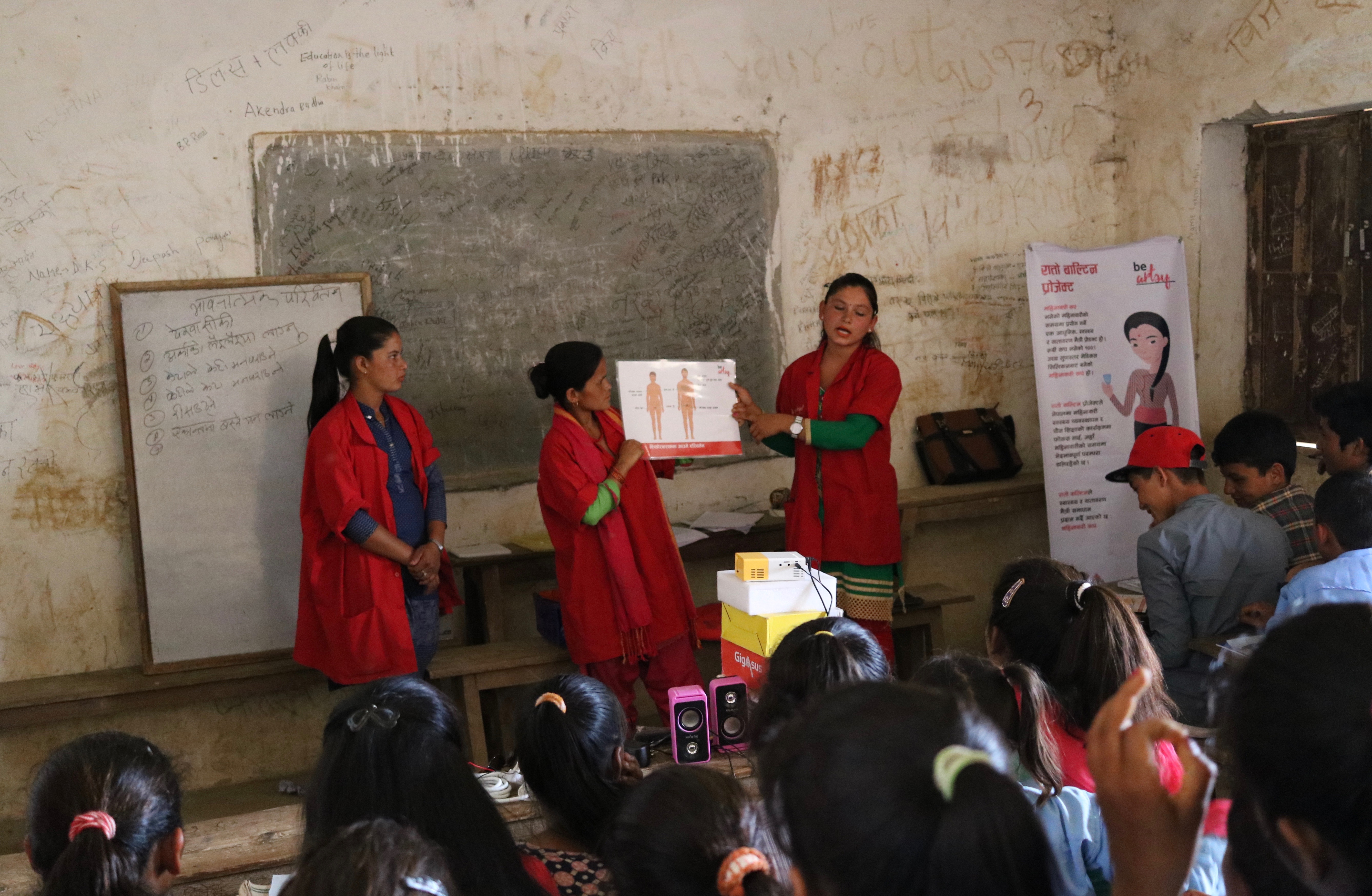
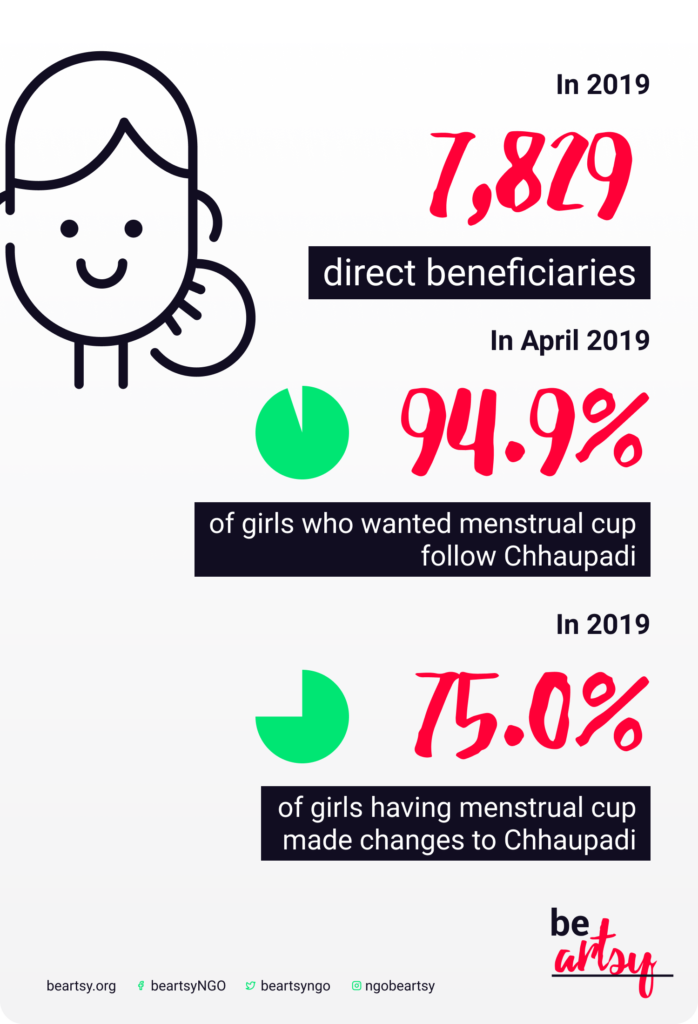
We teach menstrual health management, reproductive and sexual health education workshops and activities to involve communities. We also teach photography workshops to facilitate the expression of the girls, film screenings, and meetings with the municipal authorities and religious and spiritual leaders of all the villages. In the course of the project, in 2019, we have distributed 1,467 menstrual cups to school girls and young women. They received menstrual cups, a metal bucket to boil the cup, and soap. Work was done on how to use it. 7,829 direct beneficiaries were reached during 2019.
In the face-to-face follow-up, every two months, with the users of the menstrual cup, the trainers and local mentors and coordinators helped. We also took into account girls who do not use menstrual cups, to assess the difference between girls who use them and those who are not users, and to see if the tradition of chhaupadi can be changed only through education.
The results
Talking to the girls, we saw that a very high percentage use the cup, even six months after training. And they would recommend it to other girls. 94% of the girls explained that they followed some type of menstrual restriction before and after the training and implementation of the cups, but when asked if the tradition has changed since then, 75% of the girls reported having made changes in the chhaupadi tradition.
Some girls reported changes in access to food: now they can eat vegetables, some can eat fruit, and some can drink milk. Some girls reported that, after participating in our workshops, their mothers allowed them to have a thicker blanket in the Chhaupadi hut and since they do not stain, they do not have to be washed every day. Most of the girls said that they no longer have to sleep outside when they have their period, since nobody knows that they are menstruating. Some girls sleep in separate rooms and some still practice chhaupadi, but now they feel clean and safe. Some also reported that since workshops and training they are no longer required to participate in chhaupadi exclusion practices and are now allowed to cook and eat. They mentioned that they are now allowed to touch the animals at home, some girls no longer hesitate to touch water sources or visit the temple without hesitation, or reported that they feel comfortable going to school when they have their period, since the use of the cups nobody can tell if they are menstruating or not. They also believe that it is easier to work when using the cups. The women who agreed to talk about their experience said that they feel much cleaner using the cups, since the blood does not leave their body. These girls and their families also feel safer, and also because they don’t have to wash their clothes due to blood stains.
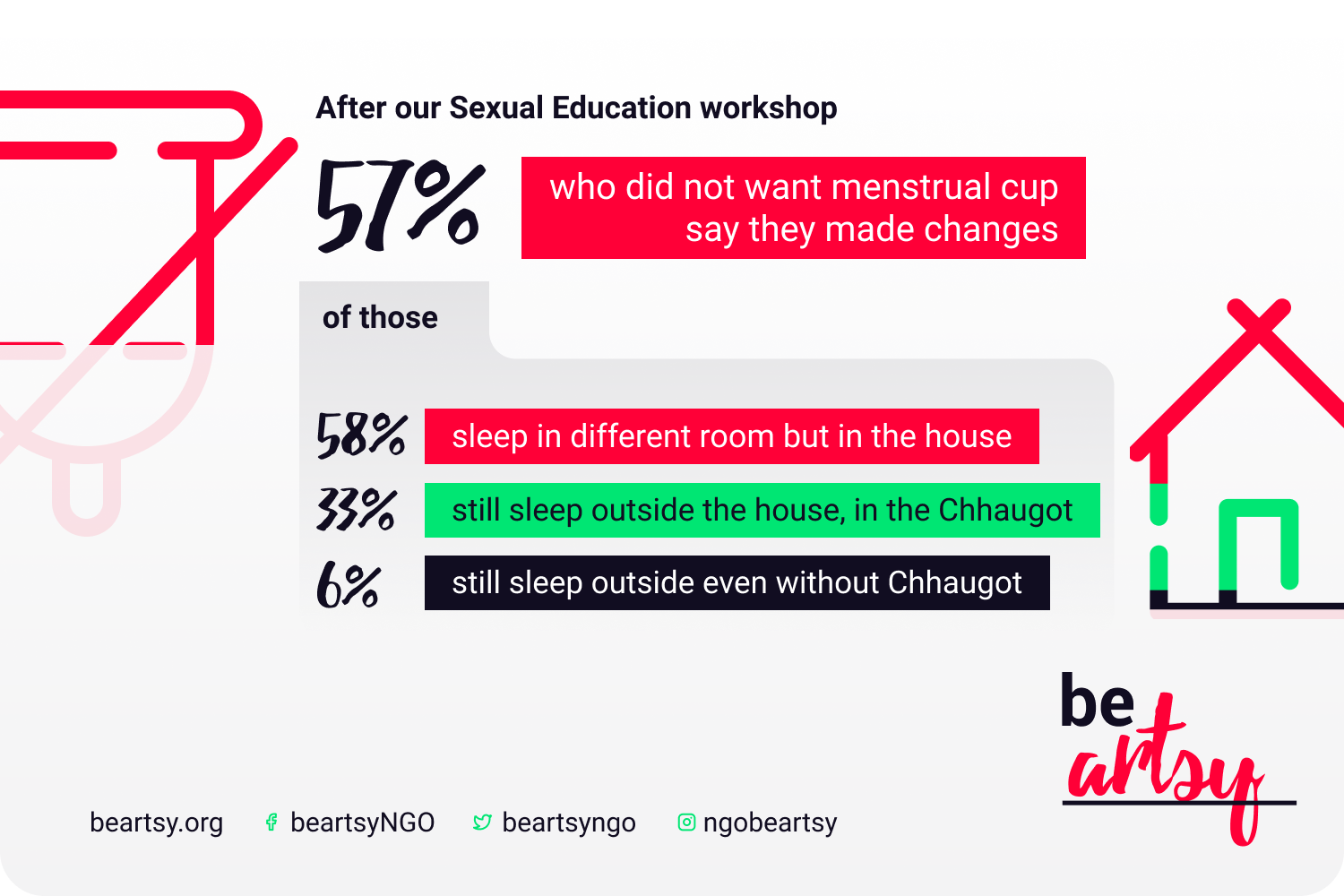
It is important that girls who do not use the menstrual cup have also undergone changes since we started training in menstrual health management. 57% of these girls have made changes during menstruation. Like the girls who use the cup, they revealed that after the training workshops we did they were able to touch the animals. eat vegetables or drink milk, sleep in their bed indoors, in a separate room, have a thicker blanket if they continue sleeping in a hut, touch water sources. 58% declared to be in a separate room inside the house, while 33% still sleep in a chhaugot and 6% even sleep outside, despite having no chhaugot.
This year we have managed to maintain the presence of 4 different teams, working on the ground simultaneously. Thanks to the goodwill of the trainers, the monitoring of the project went well, and we were able to obtain many comments from the beneficiaries. Survey findings show that our initial idea that cups can break the taboos surrounding menstruation and chhaupadi works.
In 2020 the project will not be expanded to many other towns. We will try to reach more women and help them stop chhaupadi, assisting and encouraging them with the help of mentors and training visits.
Our area staff will be made up exclusively of local girls – from Achham. It is important to highlight that the local counterpart of the year 2020 is made up of women committed to the project, who have created a social company . Specifically, we are talking about three Nepalese women who have worked with our 2019 counterpart throughout the year. They have been trained to work on these types of projects and to know how to raise funds from cooperation organizations around the world and from private entities, and in generating their own capital. Thus, the project can be managed more efficiently, and we can have trainers in each municipality who will take care of their menstrual cups’ users and actively promote awareness of the chhaupadi problem throughout the year. You can read the document with all the details of the evaluation of the 2019 period here.
Text by Clara Pinilla and Josep Marín
For just €1.80 a day you can change the future of a girl and prevent her from being forced to marry at 14 years old!
There are several ways in which you can get involved and sponsor a girl in Achham:
Teaming Group: 1 euro a month – become part of Rato Baltin Project!
Teaming Group: 1 euro a month – become part of the team and get your friends to help you sponsor her and avoid early marriage!!
Sponsoring girls, to facilitate scholarship and avoid early marriage in some areas in Nepal, is a new project of be artsy.
The United Nations has called for meetings of governments, women rights activists, and other agents, between May and July this year. Agents who promote a global campaign – Generation Equality, centring in Mexico City and Paris – in the 25th anniversary of the Declaration and platform for the action – Beijing 1995.
The declaration denounced gender inequality and proposed possible changes in women rights, and the “equality norm”. In an introduction to the campaign, UN Women explains: “Imagine a world where every person has got equal rights and opportunities. Women and girls are not afraid of walking home at night and men and boys are not trapped in oppressive masculinities. And where there is equality in political leadership, corporate boardrooms and factory floors. Women have a word in the decisions that affect their lives, their body, their policies and their environment, from villages to cities”.
This year 160 countries are expected – 189 states that entered into the declaration will adopt it by unanimity – to inform about the progress achieved, and that the United Nations Secretary-General makes a general evaluation. The new campaign talks “to facilitate synergies” – explains Katja Iversen, leader of the Women Deliver global group – “to advance effectively in matters such as abortion rights, reproductive health, or to put an end to violence. The potential for this change is huge” – she continues – “but there are already too many empty compromises, we must end up this year with a categorical, responsible and daring action”.
This declaration also included, amongst 12 key areas, decent work in any sector and equally paid, and to evaluate the impact of the environmental degradation in women, and their role in a sustainable development, specially in rural areas, where women and girls suffer also from a more difficult access to education. This right is challenged in some countries and, if not that, the difficulties to access education cause that, for example, many girls are forced to marry prematurely. The United Nations and other organizations do also point out the violation of basic rights, in the early or forced marriage of the girls.
Sponsorship project of girls and young women in Accham.
To this regard, the Edufem project of the association be artsy is based on the assumption that, for every year in school, the marriage age can be delayed in two years, in the remote rural areas of Nepal where the association works. Girls of 13 or 16 are married before having the chance of doing a more advanced grade – they think that their future implies working at their in-law’s house -, or else leave school earlier because they need to work in their parents fields. This project is parallel, and complementary, to the Rato Baltin Project that the NGO is carrying out since 2017, through which it denounces the extreme discrimination suffered by girls and women because of tribal origin traditions – Hindu ones, considering a woman impure when she is having her period -. And which also exposes them to being raped, or to die away from their own house when they are subject to the Chhaupadi. Via workshops and activities, the project promotes the education and the public debate about this sociocultural factor in the country.
With this new project, Clara García i Ortés, co-founder of be artsy, who has been nominated to the Robert Burns Humanitarian Award in its 2020 edition, personally began in 2018 to assume the sponsorship of two girls, Manisha N. and Tejana, and in the 2019 be artsy has counted with two sponsors helping two more girls, Sangita and Manicha B. To continue with the project, they are working to get sponsors for the schooling of Tulsi y Kamala. The feedback, the reaction, in terms of greater well-being and self-insurance, that these girls are giving, has encouraged the NGO to start this new project. Some volunteers have started to impart English lessons, online, to the girls, to help them communicate better with the people participating in the project, with support to pay the school and have the basic day to day help to facilitate them to continue going to the school.
We were in Kathmandu, nearly ready to start our journey to Achham.
This time the team that travelled from Kathmandu was composed by Rupa: Project Manager; Simran: student of International Cooperation in training; Sharmila: community health, although she came as translator; Rita: journalist, who joined the project to take pictures in person of what is happening there and thus round up a story on the work we do; Clara: Managing Director of the Project; and Bea: menstrual therapist.
On arrival to Mangalsen the girls were waiting for us: Tejana and Manisha as Project Coordinators, Hiunkala and Rohina as trainers, and Tulsi, Manisha, Kamala, Rabina and Janaki as mentors.
The first point in the agenda was arriving to Mangalsen and prepare the trainers and the mentors on how would the follow-up take place. It was important that all of them knew what was expected from them.
As always, getting to Mangalsen was a real adventure, a mixture of buses and jeeps, interspersed with stops for tea and snacks to survive the 2 days journey (we have shortened it by one day!!).
In a single day we explained the whole team how to do the follow up, the routines, times and materials, and divided ourselves into groups to cover the 12 villages we had to visit. In each team there were girls for whom this wasn’t the first time they we are doing a follow up, and they knew the annual routine.
We were 3 teams, each of which, as first task, visited a village in the Sanphebagar municipality (Patalkot, Sirkot y Kalsen), and then we would have to visit the three villages in each of the other municipalities: Turmakhand, Dhakari and Mangalsen.
We split up and started with the follow up. We spent 3 nights in each village and during that time we had to find all the women in the village and all the girls from school who were using the menstrual cup, undertake the follow up, and the day before leaving show everybody in the village the film from Mira Rai.
Luckily, we had divided the tasks within the group, so we worked together as efficiently as possible, something that, in Nepal, sometimes seems quite impossible!
We noticed immediately that locating all the women was very difficult, most of them were out in the fields, working, and they had no time to come to the school to do the follow up. So, as the saying goes, “If Muhammad will not come to the mountain, then the mountain must go to Muhammad”: we swept the whole village and surroundings looking for women, knocking on all doors, asking the people we found in the roads…
After this first village, we all met in Sanphebagar, to comment about the visit, discuss the problems we may have had, and any arising queries. We had lunch together and shared our first impressions. Rupa’s health had been quite poor during those first days and seeing that she wasn’t improving, we decided that it was better if she went back to Kathmandu with Rita by plane from Dhangadhi.
In the three villages things had only gone so-so, which made us think that somebody had been disrupting the work, and we had our suspicions on whom this was (and more than just suspicions…).
During the following days, our 3 groups visited the 9 remaining villages: Jupu, Banatoli and Mangalsen, three from the Mangalsen municipality; Dhamali, Toshi and Raniban, from the municipality of Turmakhad; and Hichma, Dhungachalna and Dhakari from the municipality of Dhakari.
We did not find all the users, so it was clear that the job was not finished, and we decided that the trainers would continue at the beginning of December. We needed to know if each user of the cup had been using it, if they were happy with it, if they needed anything, if thanks to the use of the cups and the workshops we did in May their relationship with the menstruation had improved, and if anything had changed in how they live their period days; and the most important thing, are they still subject to the Chhaupadi?
All this information is crucial for the continuation of the project. We finished with the last village on the 15th of November, brought all the remaining material to Mangalsen and got ready to go back to Kathmandu.
The Achham girls will undergo a further training of the menstrual cup in February, and the team will return in May from Kathmandu for the 2020 Project.
Bantaoli Hiunkala making
follow up by phone
Follow up Raniban
Bamnatoli._Kamala
toshi.Kamala_and_Rabina_preparing_snack_in_Toshi
Toshi._Girls_group
Kamala and Sharmila
banatoli Movie room
We continue working, with all our heart and enthusiasm put in the project. Thank you for supporting it!
Si no escuchaste el programa, repasemos un poco el contexto de esta situación que viven las mujeres nepalíes.
En Nepal, desterrar a las niñas y mujeres que están menstruando a cobertizos o chozas es una tradición centenaria llamada chhaupadi, a pesar de que, por ley, es una práctica prohibida.
Durante esos días, las mujeres son consideradas impuras, sucias, contaminadas y con mala suerte. No pueden tocar a su familia, pero tampoco fuentes de agua, árboles frutales o ganado, entre otras muchas cosas. La creencia de que la menstruación es impura es tan profunda que las familias pasan por alto los riesgos extremos involucrados en la práctica.
Con esta práctica, las niñas y las mujeres quedan expuestas a problemas de salud, como neumonía, diarrea o infecciones, y a violaciones. Cada año, 3 o 4 mujeres mueren durante este destierro, debido a asfixia, hipotermia, mordeduras de serpientes u otros ataques de animales salvajes.
La práctica es apoyada por ancianos, esposos, suegras, curanderos tradicionales y sacerdotes que tienen una profunda influencia en la comunidad, ya que la creencia de que permitir que las mujeres que menstrúan entren dentro de la casa de la familia enfurecerá a los dioses, con graves consecuencias para las familias y la comunidad, sigue todavía muy vigente.
Ante esta situación, Be Artsy ha propuesto el Proyecto Rato Baltin, un programa de Gestión de la salud menstrual y educación sexual que tiene como objetivo erradicar esta práctica. Mediante la educación, la fotografía participativa y la copa menstrual, se ofrece una alternativa a la tradición, a la estigmatización de la menstruación, a la exclusión y a la violencia.
Han pasado tres años desde que conocimos el tema, y ahora queremos saber cuál ha sido el recorrido del proyecto y en qué situación se encuentra, por eso hemos contactado con la fotógrafa y presidenta de la ONG Be Artsy, Clara García Ortés.
Lately we have been talking about the exhibition in networks, we want to introduce you.
The idea of mixing the photos that girls have been taking during the Rato Baltin project with photographs of creative women from here was by Magda Gavaldà.
The exhibition, actually 2 different exhibitions and one installation, are mixed with talks by Clara Garcia Ortés or some other person from the association.
The first exhibition is in foam, and will hover for different libraries of Barcelona, or nearby, for a long season. It is the one that can now be seen in Poble Sec (Biblioteca Poble Sec-Francesc Boix) until December 10, and from December 11 it can be seen in Cornellà.
The second one has the form of roll-up and did not arrive in time to Tona (Donaveu Associació de Dones de Tona – Biblioteca Caterina Figueras), which self-made an alternative and fantastic one, but if you want, you can enjoy now in the Biblioteca Volpelleres Miquel Batllori of Sant Cugat.
The artistic commissioner of the exhibition is in charge of Alba Metzger and it has not been an easy job to link such different ideas in a single exhibition.
So far we have had the help of Núria, Paula and Laura for the assembly. In future exhibitions, we will have more volunteers!
You can see the installation in the windows of the Library Clot – Josep Benet (in the building of the Design Museum), until the end of December, and has been in charge of Viviana Sansone (the videos have been prepared by Marina Gallego).
If you are in Barcelona, you can come and join us the 17th December at 18:30 h!
Thanks so much to all the people involved, and please, if you want to get involved or host the exhibitions, installations and talks in your town, or want to help us in the assemblies, get in touch with us! info@beartsy.org
Or if you feel like it, you can donate via bank transfer at: Banc Sabadell IBAN: ES23 0081 0900 8200 0430 1934 BIC: BSABESBB (your recurring donation will help us have a better planning of our budget to carry out the projects undertaken).
Coincidint amb els últims dies de l’exposició de fotografies mostrada per l’associació be artsy, la Biblioteca Francesc Boix co-organitza una xerrada i projecció.
El 28 de novembre, a les 19.00 h a la Biblioteca Francesc Boix del Pobre Sec, a Barcelona, podeu assistir a la xerrada i projecció que Clara Garcia, fundadora del projecte Rato Baltin, farà sobre com es viu la menstruació a l’oest de Nepal.
Fins aquest dia, es pot veure una exposició fotogràfica que mostra aquesta realitat, juntament amb la mirada de dones occidentals, i sobre com es desenvolupa el projecte d’educació que es realitza al país de forma participativa amb les nenes, dones, i les comunitats.
Horari de l’exposició (entrada gratuïta): dilluns i divendres de 16.00 h a 21.00 h, dimarts i dijous de 10.00 h a 14.00 h, i de 16.00 h a 21.00 h, dimecres de 10.00 h a 21.00 h, dissabtes de 10.00 h a 14.00 h.
Data: Dijous 28 nov Hora: 19:00
Organitzador: Biblioteca Francesc Boix i be artsy
Correu electrònic de l’organitzador: info@beartsy.org
It has been many months now since I left Nepal. My life as a volunteer for the Rato Baltin Project seems far away because a lot has happened since I left Achham, but I can still feel how being a part of this project has changed me and my life.
When I first started to write about my experience as a volunteer, I thought I would share my point of view on the contribution of technology in development projects. In fact, most of my tasks as a volunteer were to prepare forms in this new app we used to collect data from the field. This software “Kobotoolbox” kept me busy from February until I left Kathmandu in June. I was an international cooperation student and learned the importance of getting data from the field and Kobo was an amazing technology that allowed us to get all the information we needed without being connected to the internet. With that tool, we could collect and save all our data from remote areas and download them as soon as we got back in the office with internet connection. The data is essential because it gives us information about the project’s impact and with the use of technology it protects information and avoids the loss of papers. It is also a great asset to empower the population because it is a great tool to develop new skills and get access to reliable information more quickly.
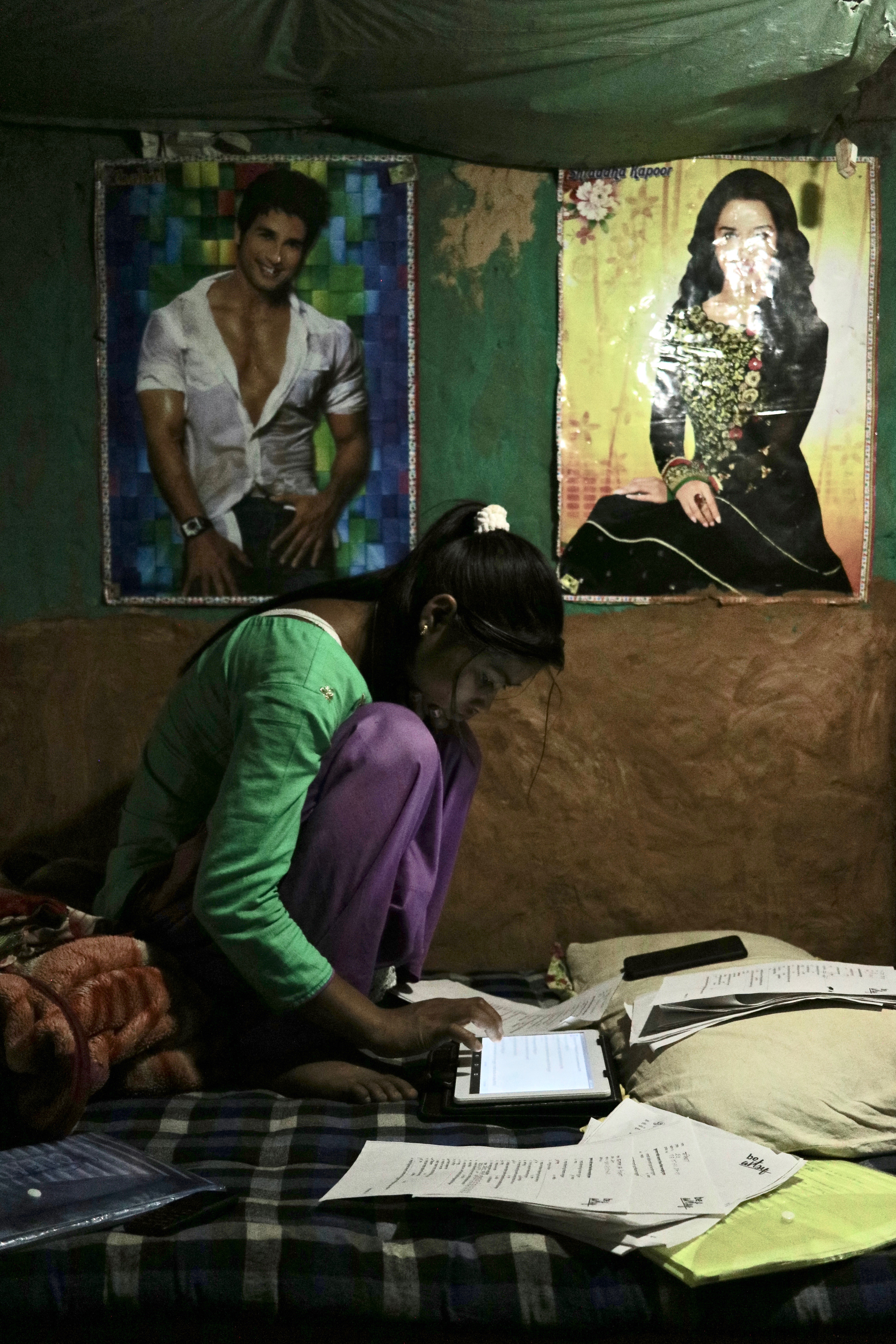
Indeed, it was amazing to see the young mentors and trainers learning how to use the tablets. The responsibilities that came with their tasks helped them grow and gain confidence in what they were able to do in such a short amount of time. For me, the challenge was to explain to them how to use the device without speaking the same language. Patience and imagination became my best friends and I made sure to keep those qualities the whole time I was in the villages.
As I started writing the first draft of this testimonial, I realized I wasn’t talking about what I felt about my experience in the project. I wasn’t able to express my feelings towards it because I couldn’t step back and see what it brought into my life. I was confident the project had a positive impact on the girls and women in Achham, but I couldn’t see the impact it had on my own life.
I had to remember why I decided to go to the far west of Nepal instead of going trekking. Nepal was a destination I had been dreaming of for a long time, but I have to admit, except for the fact that it is the birth place of Buddha and that there are a lot of outdoor activities due to the mountain range, I didn’t know much about the people and the culture. So, when my friend Marisol came back from her trek in the Anapurna and told me that she had met this fantastic woman from Spain who does an incredible job for young women by fighting against the practice of Chaupadi, my only first question was, “What is Chaupadi?” I was studying international cooperation, and had analyzed all kinds of different projects on women empowerment but I had never heard of a practice so degrading and dangerous for women and girls. As I did some research and looked closer at the actions of the Rato Baltin Project, it became clear to me that I had to be part of it! I wanted to be able to use my knowledge from my two years of studies in international cooperation for a project I believed in. In addition to that, it was an opportunity for me to discover this country that I was dreaming to explore.
My semester at university was over and I was flying and driving all the way to Sanfebagar in Achham by the middle of April. When Clara told me it would take two days by bus to reach our meeting point for the training, I have to admit I wasn’t sure where I was going and I was a little bit worried. I had to find my way there by myself since I couldn’t make it on time to leave Kathmandu with the rest of the team. This was my first encounter with the Nepali culture. I had to trust that no matter how long it took, day and night driving on bumpy roads, I would get to my destination. I had to let go of the fear of the unknown and just let myself be in the moment and know that everything would be okay. I can still remember the heat, the dust, and the noise on the road, and how awkward, tired, and lost I felt on my first day of training. But finally, I was there!
Soon enough, I realized that being part of the project wasn’t only about me helping and sharing my knowledge. In Achham, I was mostly receiving and learning. Even though I couldn’t express myself with words, I was interacting with the girls. The young mentors Lalita, Sangita, Manisha, and Tulsi, who I shared a room with, were always concerned about my well-being because they knew that the conditions we were living in were unusual for me. In no time, I was part of their world and somehow they showed me what it was like to be a young woman in Achham.
I was impressed by their investment in their tasks and as I was observing them prepare for class every morning, I couldn’t help but imagine what things would be like for them if they didn’t have the opportunity to be teaching the sexual education class for the Rato Baltin Project. They probably would have been in the field or helping with household tasks, but instead of that, they were proudly making changes in their community.
In each of the three villages we visited, the lifestyle was different, but the lack of access to clean water was always the main issue. I had to get used to taking a shower from the main tap in my undergarments and being curiously observed by anyone who would come to fill up their cans.
In Hichma, the first village, I felt at home right away. We received a warm welcome and a lot of support by the members of the community. At school, students were very open and interested in the class the girls were giving, and when our work was done, my regular evening walks allowed me to take photos of the women and the landscapes. I was taking pictures of moments that I will never forget. I thought I could understand what it feels like to be a woman from Achham by observing them and living with them, but the truth is that I could never relate to the practice of Chhaupadi. I will never be in a position where I am forced to sleep in a shed and am considered impure every month. No matter how much I study the problems associated with the practice, I will never know the fear of being alone, the feeling of injustice and rejection, the feeling of not being able to pray at the temple, or the feeling of being asked to eat separately from the rest of the family. Even if I spend time travelling and even if I stay long enough to immerse myself in the culture and traditions, I will never know what it feels like to grow up and live in an underdeveloped country. Although I never felt like I was privileged back in my own country, in the villages in Nepal I could sense how lucky I was to grow up in environment where I can be free to be the woman I have chosen to be. I am lucky because I was born in a part of the world where I can be free to do anything with my life and love whomever I want. Whether I am rich or poor, I still have the right to decide what to do with my life.
It then became even more obvious that I should use these privileges to help those who need change in their conditions and lives. As a foreigner, it wasn’t my role to force or impose new habits or try to change their traditions. I could only set an example of how free a woman can be when she has the tools to make her period more comfortable and experience it as a natural process. For that, the menstrual cup is the best solution, and any woman can benefit from it. As a privileged individual, it is my responsibility to act and help those in need. What I came to learn is that we are responsible for our own changes. The girls, mentors, and trainers took the opportunity that was given to them. They transformed their life for a while – and probably forever, and I strongly believe that our time with the Rato Baltin Project will also have an impact on young women in Achham and make changes in their lives. As far as I am concerned, I know I will be back in Nepal and my participation in the Rato Baltin Project isn’t over yet. Today I feel grateful for the opportunity to be part of this adventure and every month when it is time to use my menstrual cup, I cannot help but remember what it was like to be woman in Achham.
Written and photos by Anne-Laure Crepin, correction by Shae Marineau.
West Nepal girls need this kind of program. And we need help to continue the project!
Or if you feel like it, you can donate via bank transfer at: Banc Sabadell IBAN: ES23 0081 0900 8200 0430 1934 BIC: BSABESBB (your recurring donation will help us have a better planning of our budget to carry out the projects undertaken).






 Barcelona – Dijous, 28/11/2019