Tag: Women

  • Empowering Women and Girls through MHM: Menstrual Hygiene Awareness Day

    Empowering Women and Girls through MHM: Menstrual Hygiene Awareness Day

    For many of the global population of women and girls, menstruation is time of stress and shame. Some women and girls not only have limited access to and knowledge of clean menstrual management resources and safe, private spaces to dispose of materials, but they consider both themselves and menstruation itself as dirty and shameful.

    To combat these realities and raise awareness of the challenge of menstrual health management (MHM), the 28th of May 2018 marks the fourth international Day of Menstrual Hygiene Awareness. The day was designed as a platform for the voices of individuals, organisations, businesses and the media to unite and break the silence around MHM issues faced by women and girls around the world.

    For many girls, this culture of shame combined with a lack of access to adequate resources and MHM knowledge results in issues of self-confidence and school absenteeism. Ensuring girls stay in school and fully engage in the learning process with confidence is critical to the empowerment focus within the sustainable development goals. When girls go to school and engage in the learning process, they are empowered to reach their full potential.

    In villages across Far-West Nepal where the practice of chhaupadi is still prevalent, MHM practices and the empowerment of women and girls is an important issue of focus. Chhaupadi is a deeply entrenched social practice where women and girls are considering impure during menstruation and are subject to a number of prohibitions which deprive them of their most basic needs.

    These prohibitions include being forbidden from touching food others will consume, crossing water, restricted school attendance, and entering the family home, requiring women and girls to sleep in cattle sheds or makeshift huts. Those subject to the practice risk exposure to rape, snakebites, smoke inhalation, and animal attacks. Furthermore, the restriction of girls from school during menstruation is harmful to their education. Poor MHM tools and knowledge is linked to low education outcomes, as well as broader negative effects to employment, health and overall development.

    Although the Government of Nepal declared chhaupadi illegal, the practice is deeply embedded in social norms and cultural practices. The aim of grassroots social organisations like be artsy is to empower girls in Far-West Nepal through MHM community education, and the provision of menstrual cups and hygiene kits. Ruby Cup is the donor of menstrual cups to be artsy, that also have some individual and other private donors. This approach is designed to reduce school absenteeism, improve girls’ self-confidence, and reduce the prevalence and negative impact of chhaupadi through increased knowledge of menstruation amongst communities.

    It is important that days like today exist to shine a light on the work that organisations do to enable women and girls’ empowerment through MHM education, as well as highlight what there is still left to accomplish. It is with global support and awareness combined with grassroots local engagement that true change will be achieved to the benefit of women and girls across the globe.

    We would like to remind you of the different ways to continue collaborating with us:

    Written by Kristy Davies.
  • 2017- Rato Baltin Pilot Project Impact Evaluation

    2017- Rato Baltin Pilot Project Impact Evaluation

    We hope 2018 has begun with joy and harmony.
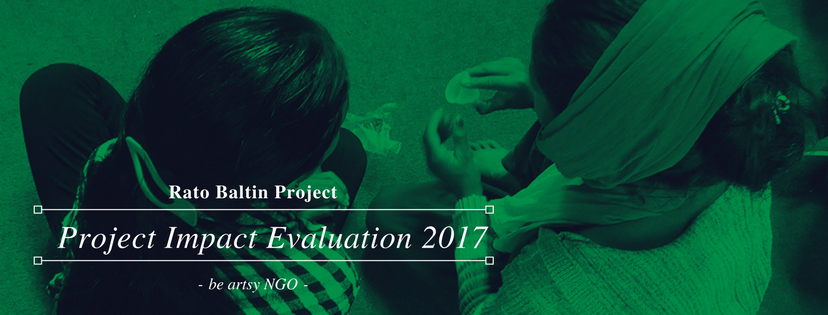
    The whole be artsy team has started the year with great enthusiasm, as we have been working hard over the last few months to analyze the data collected during our last trip to assess the impact of the 2017 Rato Baltin project. We have been encouraged by what we have found, and are more committed now than ever in the fight against chhaupadi using sexual education, participatory photography and menstrual cups.

    2017 was a great success!
    You can read about it here:

    Project Impact Evaluation rato baltin 2017 be artsy ngo nepal


    DESCRIPTION

    In West Nepal, the lack of safe sanitary options often results in health problems and school absenteeism. Menstruation is a topic touched by embarrassment, insecurity, and degrading traditions for women like chhaupadi.

    Chhaupadi is characterised by the banishment of women during menstruation from their usual residence, due to supposed ‘impurity’. It has been criticised for violating the basic human rights of women, and for associated physical and mental health impacts. Despite having been outlawed and criminalised, it continues to exist.

    The Rato Baltin Project run by the NGO be artsy is a Menstrual Health Management (MHM) and sexual education program that aims to eradicate this practice. The Project includes girls, boys, women and their communities in its design.Atb eartsy ,webelievethateducationistheonlywaytochangethesedeeplyheldbeliefs.

    The project has a four-tiered approach:

    1. Workshop which provide sex education to both male and female teenagers in local schools of targeted communities
    2. Hygienic education delivered through workshops to all women in targeted communities
    3. Menstrual cups and training provided to volunteer girls attending school in targeted communities
    4. Participatory photography workshops utilised to showcase how girls and women feel about chhaupadi and their periods, and what they would like to change about the experience

    An important component of the Rato Baltin project is the distribution of a healthy and environmentally friendly solution to MHM in rural areas of Nepal: menstrual cups. Ruby Cup, a UK based company, are the manufacturers and donors of this life changing, medical grade silicone menstrual cup of the same name.

    Twice a year, we visit remote villages to distribute menstrual cups and conduct hygiene and sexual education training. We also revisit villages to check in on those who have already received training and a cup to see what (if anything) has changed, and evaluate the results of the program.

    We have already distributed more than 250 menstrual cups to school girls in remote villages. Each girl received a cup and training in how to use it. They are also given a metal bucket (baltin) to prepare clean water, and have somewhere to boil the cup.

    Intended use of the evaluation

    The intended use of the Rato Baltin project evaluation is to measure any changes in the lives of individual participants and communities targeted in the program, and assist in reaching new project donors for be artsy to achieve its aims in::

    • ●  Educating women, girls, boys and communities on sex, biology and HMH practices
    • ●  Reducing school absenteeism of girls in targeted remote communities of West Nepal
    • ●  Providing girls and women with tools to facilitate menstrual dignity
    • ●  Achieving long term project sustainability of the programFocus of the evaluationThe principal focus of the evaluation is to address the question of:

    – What changes have occurred around the practice of chhaupadi in the lives of girls and communities after the implementation our program?

    To ensure the program is based on best practice methodology and lessons learnt, the evaluation also aims to address the questions of:

    1. How culturally accepted and sustained is the use of menstrual cups in the targeted remote communities of West Nepal?
    2. What (if any) aspects of our program can be improved in design and/or implementation?

    Data sources and methodology

    Throughout the 2017 project implementation period, we have conducted monthly telephone follow-up calls with the volunteer menstrual cup users, as well as participating volunteer local teachers and nurses.

    The be artsy Staff Nurse and volunteers have travelled to the targeted communities twice in 2017 to conduct face-to-face follow-up with the girls, in order to measure how implementation of the cup is progressing. During these trips, girls have completed surveys about changes they have experiences around chhaupadi since our first visit, and initial use of the ruby cup. Informal conversations with community members were also used to discern impressions of the use of menstrual cups and the impact of workshop training and education.

    Girls that participated in the survey are users of the donated menstrual cups. However, our program has delivered workshop training and education to more than 1000 people since its commencement, in 4 villages: Basti, Kunti Bandali, Rachuli and Chilkhaya.

    The results

    CHHAUPADI:

    Only 9 girls reported no change in their experience of the chhaupadi tradition after our program. The rest of the Ruby Cup users experienced some changes.

    Some girls reported changes concerned access to food. Indeed, some girls reported they are now allowed to eat vegetables, some can eat fruits, and some can drink milk. A number of girls reported that after participating in our workshops, their mothers allowed them to have a warm blanket in the chhaugot (Hut), while some reported that they now sleep inside the house but in a separate room or space to other members of their family. A few girls reported that since the workshop trainings they are no longer required to participate in the exclusionary practices of chhaupadi, including being able to cook food.

    Girls communicated that because they no longer bleed outside of the body when using the cup, everything is

    cleaner, and both their families and themselves feel more self-confident. They attend school during their cycle, reducing their absenteeism, and actively try to help other girls in things related with menstruation.

    Girls that did not report changes related to chhaupadi have seen their lives improve in other areas:

    “ For me it is a positive experience. In my life this has brought some changes. My blood is not smelly also it is not bleeding out. And going to school is also easy with the cup.” ~ Bhawana Upadhya (Chilkhaya)

    MENSTRUAL CUPS:

    Of the 111 cups distributed between March and June 2017 to school girls in Achcham and Kalikot, 8 were confirmed as non-users. We were unable to personally contact 14 girls, but on their last follow-up call over the phone they reported they were still using their cups. A minimum of 2 of these girls have been married and now reside in India.

    “I am happy that i got the opportunity to use the ruby cup.” ~ Binda B.K. (Rachuli)

    REASONS FOR USING THE CUP:

    • –  No fear of staining clothes
    • –  No feeling that they are menstruating
    • –  They do not have to worry about drying rags
    • –  They do not feel self-conscious of having a bad smell
    • –  It is easier to attend school as they do not need to carry any pads or replacement materials, nor hide anyrubbish
    • –  Nobody knows they are menstruating, so they can engage in regular activities such as touching tapwater
    • –  They feel cleaner than when using traditional methodsREASONS FOR NOT USING THE CUP:
    • –  They are pregnant, but after the baby’s birth they want to begin using it again
    • –  Some reported slight pain/feelings of discomfort
    • –  Having lost it
    • –  Superstitions at home:

    ▪ The house of one of the girls collapsed; a chaman told the family it was due to a bad spirit, and the family was not allowed to reenter. They were forced to leave the house, and in turn left the village. The cup user could not go inside to take their cup. When her family left she had already been married to someone in the village and now resides there. She asked us to provide her with another cup, which we did. She will continue going to school until she finishes grade 10.

    EMERGENT MYTHS:

    • –  A mother from Kunti Bandali communicated that she believes the cup will prevent girls from being raped during their menstruation, both when they are in the chhaugot and when they have to go into the jungle alone
    • –  In Basti, some people were telling users not to use the cup because it might cause cancer when it is inside themWhat the girls think about our program:All girls feel more comfortable with their bodies after our workshop. They understand the biological processes and reasoning for what is happening, and many feel that they are now able to help other girls understand.

      Most of the girls considered their participation in the program to have been a positive experience, and that their lives have changed for the better in using the cup.

      In response to the question of “What would you change about Rato Baltin?”, most girls communicated that they would not change anything. Girls also rated the workshops on a scale of 0 – 10, with 0 being bad and 10 being excellent. Respondents rated the workshops with an average score of 9.

      BUDGET EVALUATION

    Description

    Pr evist Cost

    Total Cost

    Salaries – Local staff

    Rs 243.000,00

    Rs 269.280

    Supplies and workshop resources

    Rs 121.280,00

    Rs 184.967

    Utilities

    Rs 180.000,00

    Rs 299.092

    Transportation

    Rs 227.436,00

    Rs 288.741

    Total NPR

    Rs 771.716,00

    Rs 1.042.080

    Total Euro

    6.710,57 €

    9061,56 €

    General expenses – 10% of total Euro

    671,06 €

    906,15 €

    Grand Total

    7.381,63 €

    9967,71 €

    Exchange Rate: 1 Euro = 115 NPR (Rs)

    The 2017 budget exceeded the initial proposed expenditure by 2,586 Euros. This was the case for several reasons:1.b eartsy receivedanunexpectednewdonationof160menstrualcupsfromRubyCups

    2. This donation led to the doubling of the expected amount of work and needed complementary resources, particularly in terms of the menstrual kits

    3. Difficulty in finding volunteers to travel to West Nepal without financial compensation

    4.TheneedtoprovideKathmandu-basedvolunteerswithfundsfortravelandfoodrelatedto beartsya ctivities

    5. Difficulty in contracting a staff nurse for only three to four months of the year requiring higher than expected remuneration

    Great care was taken to adjust the budget and account for the increase in work and resources required by the unexpected donation, but a substantial increase was unavoidable to deliver the new cups.

    Discussion and plan for the future

    The results of the evaluation lead us to the conclusion that project is working well. Findings from the survey reveal our initial idea that the cups can break the taboos surrounding menstruation and chhaupadi was correct. However, our evaluation of the program also illustrates a need to implement some changes in the future.

    We have seen the need to design a workshop component aimed at the men in targeted communities, in order to holistically disseminate MHM knowledge and education. We will pursue the design of a men’s group workshop to be delivered in 2018.

    To see the full scope of the impact of the project among non-Ruby Cup users in communities, we will design a survey for all girls in participating schools, as well as the participants of the women’s group. This will be implemented in 2018.

    be artsy is also aware of a large gap in the delivery of the program. The menstrual cups donated by Ruby Cup are to be disseminated among girls that attend school, as a way of addressing absenteeism and MHM. However, not every girl in targeted communities are able to attend school. For instance, some girls are married, must stay at home to assist their families with housework, or tend to family owned fields. be artsy will work to make the program and provision of menstrual cups more inclusive of all girls and their contexts. be artsy is considering implementing a chhaupadi and menstrual cup education program on college and university campuses to raise awareness of this issue, and fundraise for this component of the 2018 project. This will require the hiring of one or two persons for the entirety of 2018 to successful and sustainably implement.

    We experienced problems working with our Nepali partner organisation, the Starts Foundation, throughout every stage of the 2017 Pilot Project. These difficulties in communication and delivery of agreed human and material resources rendered the implementation and evaluation phases difficult. Although the 2017 Pilot Project was successful thanks to the hard work of be artsy volunteers and President Clara Garcia Ortes, present in Nepal for 11 months of the year, it is necessary to consider other options to ensure effectiveness and accountability.

    We have been working to establish a strong volunteer team assembled under the banner of a new Nepali NGO. This new Nepali NGO will be named: be artsy Kalaa Shakti Nepal (be artsy, the power of art).

    In conclusion, in August of 2017, the Government of Nepal passed a law that punishes those forcing women to adhere to chhaupadi-mandated exile while menstruating with a fine of 3,000 Nepalese rupees or three months jail-time. Yet we believe that these advances will not have a significant impact on its prevalence. The practice of chhaupadi is strongly embedded in social norms and cultural practices. However, it is a significant step forward in the right direction on the political level, and represents a developing social change in opinion. Combined with programs such as Rato Baltin that address education on the local grassroots level in remote areas where the practice is still prevalent, we believe that there is significant potential for change into the future.

    🙂
    Thank you very much for being with us, we will soon send you exciting news about the 2018 Rato Baltin project.

    —
    The team of be artsy’s volunteers .
    Clara Go

    Now you can contribute for paying one month salary to the nurse, or for some hygiene kits easily from : https://www.gofundme.com/menstrual-cups-in-nepal-chhaupadi

    Or If you feel like it, you can Donate:

    Banc Sabadell
    IBAN: ES23 0081 0900 8200 0430 1934
    BIC: BSABESBB

    NepalYou can follow us on  Facebook or Twitter.
    Thank you for making this possible!

    Written by kristy Davies and Clara Go.
  • Travel log – Preparation of the follow-up trip: holidays do not exist…

    Travel log – Preparation of the follow-up trip: holidays do not exist…

    By the end of June, after our trip back from Kalikot, I was impatient, for September to arrive and go back to Achham and Kalikot to check on the results.

    Each time we return to the villages, the accumulated tiredness there, and all the things I have seen and experienced do take their toll. Many times I feel depressed because I can’t do more, physically exhausted and thinking in all the work that still remains to be done.

    This time, I decided that I would take 10 or 15 days to lay back. That afterwards I would write and prepare the pictures and that I would have a quiet month of August, a quasi-holidays period. To remain at home, at rest during the rainy season. I rented a room in a guesthouse (a cheap one) in Patan, as I wanted to try if I would like to live in that area, full of expats and maybe with more connections and means for the NGO, and in my first night there I called a friend from the Putali Nepal NGO and fixed with her going to a concert, where we talked about work and our trip all the time! 🙂

    But, from the following day, yes: about ten days doing “practically” nothing. Then we start doing the follow-up of the girls via the telephone, and with the little money we had I started preparing the trip for September. Susmila, our first nurse, recovered from her surgery, was ready to come with me to Achham and Kalikot and that was the plan. To go both of us by ourselves just to do the follow-up. I wrote to Ruby Cup to tell them how things had been. I told them that we had a waiting list of 140 girls and they offered a new donation of 160 units. I jumped for joy! The girls would have their cups this year! I had told them that I could not promise anything, but that we would try to have them for spring and it happens that we would have them way before! Great!

    Ah! But wait… my happiness was short-lasted: 160 cups, that would be 160 buckets, and soaps and towels and more people to carry all… My quiet August had just gone up in smoke! Now to get money to buy all the materials! Furthermore, as if we didn’t have enough to do, we decided to buy cups to Ruby Cup to sell them here. That way we could offer here the promotion “Buy one and we will donate one for free to a girl in need”.

    The idea is to be able to give cups to those girls of 13, 14, 15, 18 years, who can’t go to school because they are too poor to pay the 300 rupee that cost the school every month, or because they were pushed to marry or they have children.

    So the whole of August and the most part of September was even more stressful than the first phase, but with the selling of cups we made contacts, we met wonderful people and we have big hopes.

    Nothing comes for free in this life, it is needed to fight hard to get anything and that’s what we did, and what we are doing. Working hard to be able to improve the quality of life of those girls who suffer the terrible tradition of the Chhaupadi, and little by little to create awareness about in those remote places in West Nepal.

    Thus arrived the 22nd of September and we went out charged with buckets, cups and materials, towards West Nepal, this time with an expedition fully made up of women! 🙂

    We will be back soon with more!

    Written, and photos with Fujifilm XT20, © by Clara Go.


    Now you can contribute for paying one month salary to the nurse, or for some hygiene kit : https://www.gofundme.com/menstrual-cups-in-nepal-chhaupadi

    Written by Clara Go. Translation by Tere Salinero

    West Nepal girls need this kind of program. And we need help to continue the project!

    Or if you feel like it, you can donate via bank transfer at: Banc Sabadell IBAN: ES23 0081 0900 8200 0430 1934 BIC: BSABESBB (your recurring donation will help us have a better planning of our budget to carry out the projects undertaken).

    Or take a look others ways to donate at http://beartsy.org/donate/

    Thank You! 🙂


  • Travel log – Women’s group in Chilkhaya

    Travel log – Women’s group in Chilkhaya

    21-8-17. Because in as Rachuli we couldn’t work  with the  group of women, here, in chilkhaya I didn’t accepted a no as answer, and i propose to do it,  even if it was only for 2 days and  at the the time that they wanted, and they accepted.

    It was not very numerous, because it was a really work time for women, it was the rise planting moment,  but it was very interesting, we were talking about measures of menstrual health and we were astonished to see the hight number of girls of 14, 15, 16 years that came to this group, ie, they were not in school.

    Just as in Rachuli we realized the need to make a group of men the next time we go to teach the full progra, (from April) Here we realized the need to get menstrual cups for these girls not schooled

    It is very hard to see that because parents do not have money to continue studying and/or they got married, they are not entitled to the same sexual hygiene as the others. They sleep in the stables of the cows like the others, they do not have access to the water like the others …. there is no right that we give menstrual cups to the girls who are lucky to study, and to those who do not have this luck, the we punished without a cup. Remember that the donations we got from ruby cup are only for school girls, to keep girls in school.

    And It is for this reason that we have launched a new part of the project. We want to get “extra” money to give these women menstrual cups, too.

    We are selling menstrual cups in Kathmandu for next year to be able to distribute menstrual cups among the youngest girls in the women’s group, and besides, we have already launched a crowdfunding so that whoever wants to collaborate in the continuity of the project can do it already and whenever they want .

    Thank you! 🙂

    Written, and photos with Fujifilm XT20, © by Clara Go. Correction by Phumzile Mpofu

    West Nepal girls need this kind of program. And we need help to continue the project!

    Now you can contribute for paying one month salary to the nurse, or for some hygiene kit : https://www.gofundme.com/menstrual-cups-in-nepal-chhaupadi

    Or if you feel like it, you can donate via bank transfer at: Banc Sabadell IBAN: ES23 0081 0900 8200 0430 1934 BIC: BSABESBB (your recurring donation will help us have a better planning of our budget to carry out the projects undertaken).

    Or take a look others ways to donate at http://beartsy.org/donate/

    Thank You! 🙂

  • Travel log –  Group of girls and Ruby cup training in Chilkhaya (Kalikot)

    Travel log – Group of girls and Ruby cup training in Chilkhaya (Kalikot)

    If at all anywhere, we had a list of girls who wanted menstrual cups, from way back, it has been in Chilkhaya.
    As we explained in the last article, the classes were a minimum of 70 participants, the majority of these being girls. In this case though, each day we had a minimum of 100 participants. We were never able to write down all the participants in the register, as they was never enough time in the one hour.

    In this village, we clearly saw, more than in any other place, the great power of the high castes above those considered to be of the lower castes. Girls from the higher castes were always at the top of the lists, while the lower caste girls, would not approach until the higher caste group was finished.

    The raffle system was absolutely necessary and we chose the class with the most boys to do it. The boys were pulling out numbers not knowing who or what they were choosing. Luck made few girls of that class have a menstrual cup, but at least they saw that the system was totally clear, and they are on the waiting list.

    The training was held at the health post, where we were able to boil the Menstrual Cups easily as they was gas to use. Anuja, the nurse, thanked it, in Rachuli had a really bad time with the smoke!

    Written, and photos, © by Clara Go. Correction by Phumzile Mpofu

    Now you can contribute for paying one month salary to the nurse, or for some hygiene kit : https://www.gofundme.com/menstrual-cups-in-nepal-chhaupadi

    West Nepal girls need this kind of program. And we need help to continue the project!

    Or if you feel like it, you can donate via bank transfer at: Banc Sabadell IBAN: ES23 0081 0900 8200 0430 1934 BIC: BSABESBB (your recurring donation will help us have a better planning of our budget to carry out the projects undertaken).

    Or take a look others ways to donate at http://beartsy.org/donate/

    Thank You! 🙂


  • Travel log – #RatoBaltin at the Chilkhaya school

    Travel log – #RatoBaltin at the Chilkhaya school

    20-7-17

    During the 10 days we have been in Chilkhaya, what has surprised us most is the number of students attending the secondary school  (from class 6 to 10).


    We attended classes with 70 students, “luckily” missing 70 or 80 more. That is, the list of students for these classes was up to 140, 150. Yet the classrooms are not big enough to accommodate all of the students if they happen to all attend class together.

    As are came at the rice planting time, many children do not go to school and instead work in the fields.

    Another thing that has surprised us about the school is that it is probably the best organized we have found so far. It looks clean, and it is easy to see that they have organised every detail. The teachers have helped us a lot, even taking notes of our classes so they can continue them when we are not there. I wish all schools were like this.

    One factor that we have not managed to schedule properly is the “extra” time for girls. Some days they ask us to hold the sessions at the school during school hours, but on others they request us to do it in the health post after school.

    However, everything has went very well and everyone was very happy to have us there.

    On our last day we had a nice homage, and received touching farewell speeches.

    They are already waiting for us to return!

    Now you can contribute for paying one month salary to the nurse, or for some hygiene kit : https://www.gofundme.com/menstrual-cups-in-nepal-chhaupadi

    Written by Clara Go. Correction by Kristy Davies

    West Nepal girls need this kind of program. And we need help to continue the project!

    Or if you feel like it, you can donate via bank transfer at: Banc Sabadell IBAN: ES23 0081 0900 8200 0430 1934 BIC: BSABESBB (your recurring donation will help us have a better planning of our budget to carry out the projects undertaken).

    Or take a look others ways to donate at http://beartsy.org/donate/

    Thank You! 🙂


  • Malnourishment in West Nepal

    Malnourishment in West Nepal

    One significant problem that we have seen in our travels throughout West Nepal is the extent of childhood malnourishment.

    Sometimes this can be associated with very young mothers with little nutritional information support, but in other cases cannot. Though there are some nutritional programs that run throughout West Nepal, it can be difficult for mothers to provide the breadth and quantity of recommended food and vitamins when they only have direct access to the food grown in their fields.

    The districts in West Nepal with the highest rates of malnourishment in children under the age of five are:

    Humla        65.7%
    Bajhang     63.2%
    Achham     59.2%
    Baitadi       59.2%
    Doti            57.6%
    Surkhet     57.9%
    Kalikot       54.1%
    Jumla         54.1%

    To find out the malnourishment rates of children under five in other districts, check out this interactive map:


    Maps and numbers from: www.nepalmap.org


    In Achham, for example, the amount of food grown and accessed by mothers is usually insufficient for the number of children they care for. The father is usually in India or abroad elsewhere working to send money back to their families, and women often don’t have the knowledge and resources to manage the crisis.


    My dear friend Dr Keshav Bhattarai, who passed away last December at 31 years, was the one who introduced me to the world of women in West Nepal. He was really upset because on average, every month six women in Achham committed suicide. These women had large families with many children that they were unable to provide with sufficient food, and often did not want to use contraception, or have access to the choice or relevant education about it. In this situation, women suffer a lot of stress and pressure.

    I don’t think anything has changed in the district since he left last year to work in Humla, before his death.

    Children are the foundation that the future of Nepal rests upon. Only a proper investment in today’s children will bring us to a better tomorrow.

    But a quick glance at the child nourishment data on www.nepalmap.org shows that 40% of children under the age of five in Nepal are malnourished. This means that today, almost half of children in Nepal under five do not receive a well-balanced meal, which not only hampers their development, but in turn the nations.

    In our workshops we teach the importance of proper nutrition, balanced meals, and hydration to the girls. Although this becomes increasingly essential once their menstrual periods start, proper hydration and nutrition is critical every day of the year, from early childhood into adulthood.

    And so we wait, hoping that little by little things are changing.

    Now you can contribute for paying one month salary to the nurse, or for some hygiene kit or for the menstrual cup control in September: https://www.gofundme.com/menstrual-cups-in-nepal-chhaupadi

    Written by Clara Go. Correction by Kristy Davies
    Maps and numbers from: www.nepalmap.org

    West Nepal girls need this kind of program. And we need help to continue the project!

    Or if you feel like it, you can donate via bank transfer at: Banc Sabadell IBAN: ES23 0081 0900 8200 0430 1934 BIC: BSABESBB (your recurring donation will help us have a better planning of our budget to carry out the projects undertaken).

    Or take a look others ways to donate at http://beartsy.org/donate/

    Thank You! 🙂

  • Travel Log – Chilkhaya

    Travel Log – Chilkhaya

    10-6-17. 

    Moving 4 personal rucksacks, 2 suitcases full of materials, 1 bag of cameras and 23 metallic buckets from one village to another in these remote areas can be really complicated! From Rachuli to Cnilkhaya, according to Googlemaps, there are just 9 km. and a slope of 400 m.

    First we had to get somebody to help us bring everything down to the road (30’ downwards, between rice fields and small creeks): 3 alumni from class 10 gave us a hand. Then, we waited for a bus to pass by, with room enough to accommodate us and our junk. We were, once more, lucky, and half an hour later we were on a bus towards Chilkhaya. The bus left us in Galje and there we ate, and contracted two carriers who, to our surprise, could haul all our baggage and resources. Supposedly we needed three people, but they could not find a third one.    

    We started then our way to the village.

    Depending on who you would ask, they said it was an hour walk, or that it would be 3 hours and a half… (this is Nepal… Nobody knows…). We were quite made up to the idea that we would walk for at least 5 hours. The route was really pretty. Kalikot is full of hills from which water sprouts everywhere. And full of fruit trees and paddy fields. We went up and down the hills, stopping to chat with the girls we found along the way, and to eat plums and drink water, taking it really easy, for more than 5 hours.

    On arrival, we popped in to the Health Centre, who were already aware that we were coming, also passed by to say hello to the headmaster of the school, and went to the place which would be our home for the next 10-12 days. The feeling when arriving to that village, located amongst green terraces, was of like being in a dream. The curiosity we arose in the people, the questions, the smiles… The doubts of what would this village hide behind their façades. A while before getting there we had been already hearing music from drums. A child had been born (a male) and they were celebrating. This country will never cease amazing me.

    What we did not know is that he would be the first of 4 children (all male) who would be born during our stay in the village; the second day another was given birth, we saw the kind of rudimentary stretcher they had prepared to carry the midwife to the Health Centre, the woman in pain, in the middle of all the people celebrating the birth of the child.

    And it pained us particularly to know that that woman, together with her newborn, would pass the following 7 days in the stable. If she would have given birth to a baby girl, it would have been 10 days. That’s the Chhaupadi, this matter that impels us to continue with our educational work. So these kind of injustices and violations of the most basic women rights stop happening.


    Written by Clara Go. Photos done with FUJIFILM X-Pro1 © Clara Go.
    Translated to English by Tere Salinero.

    West Nepal girls need this kind of program. And we need help to continue the project!

    Now you can donate for paying one month salary to the nurse, or for some hygiene kit or for the menstrual cup control in September: http://beartsy.org/get-involved-with-rato-baltin

    We also have opened a funding help line at http://www.gofundme.com/menstrual-cups-in-nepal-chhaupadi

    Or If you feel like it, you can donate via bank transfer at: Banc Sabadell IBAN: ES23 0081 0900 8200 0430 1934 BIC: BSABESBB (your recurring donation will help us have a better planning of our budget to carry out the projects undertaken).

    Or take a look to others ways to donate in http://beartsy.org/donate/

    Thank You! 🙂

  • Child marriage and young mothers in West Nepal. #RatoBaltin

    Child marriage and young mothers in West Nepal. #RatoBaltin

    Another of the problems that we are facing during our Rato Baltin workshops is seeing 13 years girls who are married and with children. Everybody (some may not agree) find this practice “normal” in west Nepal (actually in all rural area of Nepal). In Nepal  the legal age for marriage without parental consent is 20 years and with parental consent it’s 18.
    Child marriage is another consequence of the poor sexual education, and is another subject we try to explain and teach in out workshops.

    Child marriage means disempowerment for life

    Doctors say it is biologically possible for a girl to become pregnant as soon as she begins ovulating. By and large, medical experts agree that carrying and delivering a baby at age 15 or younger can come with life-threatening complications, including anaemia, high blood pressure and haemorrhaging.

    Also noted, pelvic bones do not fully develop until girls reach their teens. Before that point vaginal births and full-term pregnancies are dangerous, and even Caesarean sections present significant risks, they say. Such problems, along with complications from unsafe abortions, were the top cause of death among female adolescents in 2015, according to the World Health Organisation.

    http://www.who.int/mediacentre/news/releases/2017/yearly-adolescent-deaths/

    As well, in our workshops, we explain how to use a condom, or how to use the Cervical Mucus Method to control the fertility window every month, although, we emphasize, in such young ages, it is not reliable.

    We believe that, it is really important, that both boys and girls, learn how to use a condom. This is reinforced by statistics in some places such as Achcham, that have a very high rate of HIV infected people. Both boys and girls, have easy access to condoms, in west Nepal, as they are freely given at every health post.

    Cervical Mucus Method
    Cervical Mucus Method © be artsy – Salvador Subarroca
    Write by Clara Go corrected by Phumzile Mpofu 
  • Travel log – Chhaupadi in Rachuli – Kalikot – Karnali Zone – Nepal

    Travel log – Chhaupadi in Rachuli – Kalikot – Karnali Zone – Nepal

    Photographies made by the students of the participatory photography workshop #breakthesilence © of each student.

    7-6-2017

    We have not yet found in Kalikot anybody referring to the tradition using this name, they call it “Chuii” “Chuiigoath” or “Chuiighar”. But as to existing, it does exist the same. Maybe the conditions seem better (in Rachuli, so do they think), because depending of the houses the women are in a separate “room”, on the lower floor. But it is usually an old cowshed without door or any safety measures. Some dispose of a bed, but those are the chosen few. The most usual is that they sleep in the shed on straw, next to buffalos and cows.

    Kalikot is very different to Achcham, Karmali Zone is full of men, it is not like in Achcham where most of the men head of the families work in India. Here they work at home, and the traditions regarding the women are kept by them. Male chauvinism is even more present and noticeable than in Achcham.

    We have held several conversations with fathers who said that they didn’t like what we were doing at the schools. That to explain that the girls, during their period, have to eat better and not to deprive themselves from dairy products, was against what the gods wanted and was absolutely no good.

    At school we tried to teach class without giving out our opinion. When they explain that they don’t like going to the shed, the maximum we do is to have them thinking hard about what would happen if they wouldn’t. The ideal is that they reach the conclusion themselves that this, is a superstition.

    What we actually did talk about in class is women’s rights, equality, of how not to let them enter a temple, for example, is a breach of human rights, as they are not allowed the freedom of worship and religion that men do enjoy.

    The sensation remaining from Rachuli is that we have not been able to go deeper in this matter in this villaje. We haven’t been able to form a group of women, just the one of girls, because of the high amount of work they have at this time of the year, and we have got it clear that there are many things that the girls ignore.

    In our next visit, we know that we have to do better. Now we know how the Karnali Zone works. It is clearer that, apart from the women and girls groups, we have to speak with the men. Would it be folly to prepare a workshop for them? Something to think about. Tomorrow, on our way to Chilkhaya! 🙂

    Written by Clara Go. Photographies made by the students of the participatory photography workshop #breakthesilence © of each student.
    Translated to English by Tere Salinero

    West Nepal girls need this kind of program. And we need help to continue the project!

    Now you can donate for paying one month salary to the nurse, or for some hygiene kit or for the menstrual cup control in September: http://beartsy.org/get-involved-with-rato-baltin

    Or If you feel like it, you can donate via bank transfer at: Banc Sabadell IBAN: ES23 0081 0900 8200 0430 1934 BIC: BSABESBB (your recurring donation will help us have a better planning of our budget to carry out the projects undertaken).

    Or take a look to others ways to donate in http://beartsy.org/donate/

    Thank You! 🙂