Les dones nepaleses expliquen amb imatges com viuen la menstruació, aïllades perquè són impures.
L’exposició “La menstruació al Nepal: un turment cultural” es pot veure a la biblioteca del districte 2 (Bd2) fins al 28 de febrer. És un dels actes de la programació del Mes de la Pau, organitzada per la Regidoria de Solidaritat i Cooperació i la BCT Xarxa per difondre els valors de l’educació per la pau, la solidaritat i el respecte als drets humans.
La mostra resumeix en fotografies com les dones de l’occident nepalès i les dones europees viuen el fet de tenir la regla. Al Nepal estan sotmeses a la tradició Chhaupadi, una pràctica centenària que desterra nenes i dones a cabanes o coberts durant la seva menstruació. Se les allunya perquè se les considera impures.
L’objectiu d’aquesta entitat és mitigar les conseqüències d’aquesta tradició a través de l’educació, l’ús de copes menstruals i l’art. Be artsy és una petita ONG amb seu a Barcelona que va néixer per desenvolupar aquest projecte (Rato Baltin Projecte). A banda de la mostra, la Bd2 acollirà una xerrada sobre aquest tema el 24 de febrer a les 6 de la tarda.
Si no escuchaste el programa, repasemos un poco el contexto de esta situación que viven las mujeres nepalíes.
En Nepal, desterrar a las niñas y mujeres que están menstruando a cobertizos o chozas es una tradición centenaria llamada chhaupadi, a pesar de que, por ley, es una práctica prohibida.
Durante esos días, las mujeres son consideradas impuras, sucias, contaminadas y con mala suerte. No pueden tocar a su familia, pero tampoco fuentes de agua, árboles frutales o ganado, entre otras muchas cosas. La creencia de que la menstruación es impura es tan profunda que las familias pasan por alto los riesgos extremos involucrados en la práctica.
Con esta práctica, las niñas y las mujeres quedan expuestas a problemas de salud, como neumonía, diarrea o infecciones, y a violaciones. Cada año, 3 o 4 mujeres mueren durante este destierro, debido a asfixia, hipotermia, mordeduras de serpientes u otros ataques de animales salvajes.
La práctica es apoyada por ancianos, esposos, suegras, curanderos tradicionales y sacerdotes que tienen una profunda influencia en la comunidad, ya que la creencia de que permitir que las mujeres que menstrúan entren dentro de la casa de la familia enfurecerá a los dioses, con graves consecuencias para las familias y la comunidad, sigue todavía muy vigente.
Ante esta situación, Be Artsy ha propuesto el Proyecto Rato Baltin, un programa de Gestión de la salud menstrual y educación sexual que tiene como objetivo erradicar esta práctica. Mediante la educación, la fotografía participativa y la copa menstrual, se ofrece una alternativa a la tradición, a la estigmatización de la menstruación, a la exclusión y a la violencia.
Han pasado tres años desde que conocimos el tema, y ahora queremos saber cuál ha sido el recorrido del proyecto y en qué situación se encuentra, por eso hemos contactado con la fotógrafa y presidenta de la ONG Be Artsy, Clara García Ortés.
Coincidint amb els últims dies de l’exposició de fotografies mostrada per l’associació be artsy, la Biblioteca Francesc Boix co-organitza una xerrada i projecció.
El 28 de novembre, a les 19.00 h a la Biblioteca Francesc Boix del Pobre Sec, a Barcelona, podeu assistir a la xerrada i projecció que Clara Garcia, fundadora del projecte Rato Baltin, farà sobre com es viu la menstruació a l’oest de Nepal.
Fins aquest dia, es pot veure una exposició fotogràfica que mostra aquesta realitat, juntament amb la mirada de dones occidentals, i sobre com es desenvolupa el projecte d’educació que es realitza al país de forma participativa amb les nenes, dones, i les comunitats.
Horari de l’exposició (entrada gratuïta): dilluns i divendres de 16.00 h a 21.00 h, dimarts i dijous de 10.00 h a 14.00 h, i de 16.00 h a 21.00 h, dimecres de 10.00 h a 21.00 h, dissabtes de 10.00 h a 14.00 h.
Data: Dijous 28 nov Hora: 19:00
Organitzador: Biblioteca Francesc Boix i be artsy
Correu electrònic de l’organitzador: info@beartsy.org
Beatriz San Román es la creadora de la marca “Vulvita”, la cual vende productos menstruales reutilizables para poder reducir al máximo los residuos.
Beatriz San Román, Vulvita, con sus productos de higiene femenina | María Vidal
Reducir al máximo los residuos y trabajar en la salud menstrual. Estas son los principales propósitos que tiene Beatriz San Román para seguir adelante con sus proyectos. San Román es una emprendedora madrileña que vivió en Cambrils y que actualmente reside en Mont-Roig. Tiene en marcha tres proyectos: “Vulvita”, “La casita sanadora” y “Residuo Zero Tarragona”, todos relacionados con los objetivos nombrados.
Actualmente, se encuentra más centrada en “Vulvita”, una marca de compresas de tela y otros productos menstruales que ella misma cose a mano. “La casita sanadora” dice que lo que siempre había querido hacer, “un proyecto donde la gente puede acercarse a mi y de alguna manera sanarse, ya sea a través del yoga, de los masajes, la terapia floral… para buscar la manera de conectar con uno mismo”, de momento es el que tiene más abandonado porque conoció la terapia menstrual y supo que eso era lo que quería hacer. El último que ha creado, junto con una amiga, es “Residuo Zero Tarragona”, donde se venden productos que intentan fabricar ellas mismas o que vengan de cerca, que no produzcan residuos. Porque se han dado cuenta que “en casa es más fácil tener una vida zero waste pero cuando viajas es más complicado”.
El proyecto va a surgir de una necesidad propia
La emprendedora explica que el proyecto Vulvita va a surgir de una necesidad propia, ya hacía años que ella cosía sus compresas de tela con roba reciclada que tenía en casa. Hasta que las personas de su círculo y de conocidos también le pidieron de probarlas y así es cómo se va a “profesionalizar” para venderlas, sobretodo a gente cercana. Más tarde llevó a cabo una campaña de crowdfunding para conseguir financiación y dar a conocer el proyecto. Fue cuando hubo que poner un nombre a lo de coser compresas y como surgió “Vulvita”. Afirma que este nombre se debe al hecho que siempre le gusta “traer a la luz las cosas que están ocultas, y poner este nombre era poner en terreno público una parte del cuerpo que estaba oculta, pero tampoco muy directamente”. En la misma línea, su empresa tiene un componente reivindicativo importante, ya que reclama que la menstruación se ha de desmitificar. “La mitad de la población menstrúa y no podemos hablar de ello?”, protesta. Per este motivo también da talleres a niños, porque le da miedo “que los niños crezcan en una sociedad donde no puedan conocer ni explorar su cuerpo, ni hablar de sus procesos biológicos”.
Los productos se pueden adquirir en diferentes ferias, en las redes sociales y en algunos establecimientos
Hoy, los productos de “Vulvita” se pueden adquirir en diferentes ferias de la provincia de Tarragona, como es el caso de “l’Espai Niu” de la Feria Multisectorial de Cambrils, mediante las redes sociales, o en algunos establecimientos de la provincia que tienen productos ecológicos. La emprendedora afirma que hay diversos motivos por los cuales cambiar y empezar a utilizar las compresas de tela, aún que evidentemente, una de las principales razones para usarlas es para favorecer el medio ambiente, ya que permiten tener una menstruación de residuo cero. Un gran cambio respecto a la cantidad de residuos que generan las compresas habituales. Las clientes que las compran forman, forman parte de una gran abanico de edades, ya que va desde jovencitas que quieren tener alternativas al material de un solo uso o mujeres que las usan para la pérdida de orina. Por otra parte en dos ocaciones la creadora de “Vulvita” ha viajado al oeste de Nepal con el proyecto Rato Baltin de la ONG Bearsy, que tiene como objetivo dar información de salud menstrual a niñas y mujeres de la zona. El propósito de este proyecto es que ellas mismas sean consientes de los que les pasa, para poder erradicar la práctica del Chhaupadi y que las jóvenes nepalesas puedan utilizar siempre la compa menstrual.
Finalmente, ella afirma que, especialmente el proyecto “Vulvita”, lo lleva a cabo porque “a parte de ser mujer, he sufrido lo que es ser mujer en esta sociedad”, también porque tiene mucha conciencia ecológica. Por eso, para ellas lo más importante actualmente sería reducir el residuo al máximo en cualquier ámbito – alimentación, cosmética, menstruación-, ser autosostenible y concienciar a la sociedad sobre esta tema para que comience a ser responsable de los residuos que genera.
Imagen de las compresas de tela que confecciona Vulvita
6 days left to go to Nepal, and the project is ever more outlined and clear. However, difficulties are also fast approaching.
The original idea was to go West by the end of February to be there during March until mid-April. We had to change the plan (as usual in Nepal) and adapt to current events. And we will most likely have to change plans again!
The government of Nepal, after signing the constitution last year, reformed the educational curriculum and, as of today, neither teachers nor students in the area we are going to know which day the holidays start. They don’t know exam dates either or the date the school year will start.
Therefore, we have decided that on our first trip at the end of February and March, we will offer our workshops in just two villages in the Achcham Disctrict (the area with the most Chhaupadi-related deaths this winter). In April local staff take their annual end-of-year holidays, so we will wait until the new school year starts, by the end of April or beginning of May, when we will go to Kalikot to work in two more villages.
This made us rethink most of the project and face new expenses and challenges. The temperature is not the same in April as in May. In May the heat is suffocating and the monsoon rains may start anytime. We will have double the expenses to take all the staff to the area.Moreover, some volunteers who could have made it in April will not be able to in May, so we will have to find others.
But that’s how Nepal is. Unpredictable. Their typical saying is: “Nobody knows”… and “What are we to do”? (K garne). And this is something we must not forget.
We have copied and translated the following article – originally published at BBC News – because we consider it important that our Catalan and Spanish-speaking readers understand the text properly.
— be artsy team
An ancient Hindu tradition in which menstruating women are banished to an outhouse is under the spotlight in Nepal after the death of a 15-year-old girl. The practice was banned in 2005 but still continues in western areas. BBC Nepali reporter Krishnamaya Upadhayaya, 24, describes how she has fought against the tradition, known as chhaupadi.
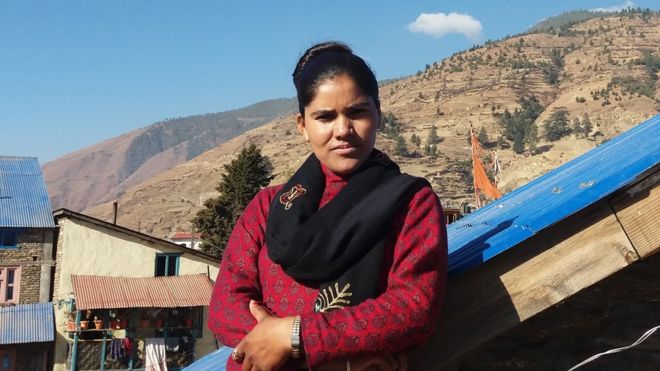
Krishnamaya in her village, where she has challenged traditional attitudes to menstruating women
I started menstruating when I was 12. My mother, sisters and sisters-in-law used to stay outdoors in a mud hut when they were menstruating so I started staying there too. I was always afraid of what would happen. I was scared of insects and wild animals.
I was told it was a sin to touch books during menstruation so I did not go to school during the three days of my period. I used to wonder why I was not allowed to touch books. I missed school and I wasn’t the only one. Many girls in my village faced the same problem.
Even today, menstruating women are not allowed to enter their courtyard for seven days and are not allowed to consume dairy products like milk, butter, yoghurt etc. I was very hurt when I was not allowed to enter my own courtyard. During your period, people don’t hand you food, they fling it at you. The belief that you must not touch your elders during menstruation still persists.
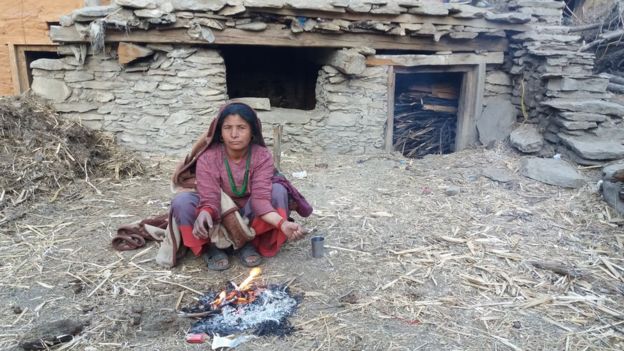
A menstruating woman crouches outside a mud hut in Krishnamaya’s home village
And I still had to deal with it when I moved from Kutari village to Khalanga, the capital of Jumla district, to go to college when I was 17.
When I went looking for a room to rent, the landlord asked me if I had begun menstruating. When I truthfully replied that I had, I was turned away. I wanted to cry, I did not know what to do. If I went back home, I would miss my studies but it looked like I would not find a room to rent.
Period taboos
In many world religions, women are seen as impure during their period
They are restricted from entering places of worship and following religious rites
The chhaupadi tradition followed by Hindus in western Nepal is the most extreme version where women are banished outside during their monthly cycle
In India, women are not allowed enter some Hindu temples and Muslim mosques while menstruating but there have been court cases to overturn this
In southern India, a girl reaching puberty is celebrated with a party and presents
In the Dogon tribe in Mali, women of the village also live in a hut during their period
Finally, I found a room where the landlord said he would allow me to live on the ground floor, but not on the first floor of the house. I agreed to live on the ground floor (as far away from the others and as close to the door as possible).
But there were problems. I was not allowed to touch the water tap during my period so someone would have to give me water. I had read that you should maintain hygiene during your period so I used the inside toilet, even though the landlord asked me not to and wanted me to go outside.
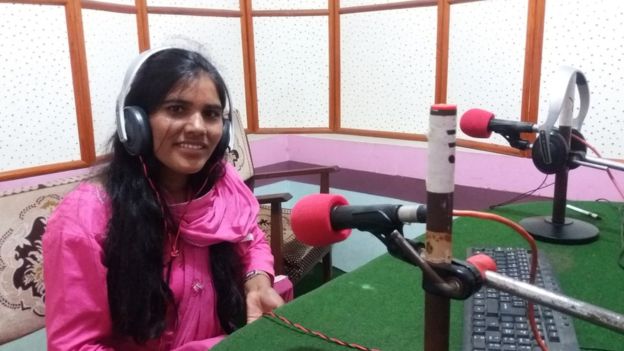
Krishnamaya has educated herself about chhaupadi through her work as a radio journalist
After spending a month in Khalanga, I started working in radio. I learned more and more about menstruation. When my landlord complained that my menstruation was creating problems for him, I moved. Usually women are not allowed to rent the upper floor in Jumla because they menstruate. This belief persists even among educated people.
It has been six years since I started working in radio. I stay in my room during my period. But I do not tell anyone, including my landlord, that I am menstruating, because I am afraid that I will be sent to a shed. One person cannot end a social ill that has been passed down for generations. Change cannot happen unless society accepts it.
When I go home to my village, I stay in the house during my period. I stay in my own room. I do not enter the kitchen and prayer room. After protesting many times to my family, I have been able to stay inside the house rather than outside in a mud hut. I hope that one day the chhaupadi tradition, like the Sati tradition (of a widow immolating herself on her husband’s pyre), will end.
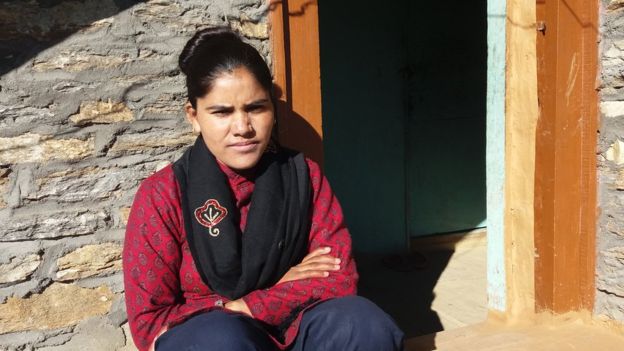
Krishnamaya in front of her rented room where she is not allowed live on the first floor
I am very sad to hear of women losing their lives due to the chhaupadi tradition in the mid and far western regions of Nepal. Even in my district, a lot of women live in sheds, so the same thing could happen here too. The government needs to do more to educate people. Chhaupadi is banned but mindsets have not changed.
As you might already know, we are beginning the implementation of Rato Baltin Project in Nepal very soon. Rato Baltin (meaning Red Bucket in Nepalese) is a long-term project which intends to generate a space for reflection within Western Nepalese communities – where the practice of Chhaupadi is rife – in order to help improve girls’ and women’s life conditions and wellbeing. Besides participatory photography workshops and sex ed in schools, we are also going to distribute menstrual cups to four groupsof girls who are going to be instructed on how to use them by local nurses.
Please meet Ruby Cup:
These menstrual cups were donated by our strategic partner Ruby Cup. Ruby Cup not only sells and distributes menstrual cups, but its social mission is devoted to helping women and girls affected by poverty, who face problems during their periods because they simply cannot afford menstrual hygiene products. As stated by themselves, “Without proper sanitary products, girls and women are forced to use degrading substitutes (like mud or old newspapers), which do not absorb well and often carry serious health implications for infections and diseases.” Moreover, the lack of menstrual products is a huge factor in school absenteeism. Through their Buy One, Give One programme – every, time someone buys a Ruby Cup, another one is donated to a girl who would otherwise not be able to access it – Ruby Cup distributes the Ruby Cups in collaboration with local partner organisations.
The girls in West Nepal do face all the challenges stated above, with the addition that the practice of Chhaupadi deprives them from their most basic needs and forces them out of their homes, creating a host of problems – including death.
We have copied and translated the following article – originally published at The Guardian – because we consider it important that our Catalan and Spanish-speaking readers understand the text properly.
— be artsy team
I was 13 years old with a red ribbon cascading on my oiled hair when I got my first period. I thought I had dysentery. When I asked my mother about it, she slammed a bunch of rags in my hand and said “nani ta nachune bhais” – my daughter, you become untouchable [you are menstruating]. She pulled me inside my brother’s room. I remember it was dark and creepy.
Then came a list of restrictions: “Do not touch the kitchen and worshiping area”, and “Stay away from your father and other relatives”. I had to stay alone in brother’s room for a week. What hurt the most was not able to see my father or any male members of my family during those days.
I asked my mother several times: “Why can’t I go outside the room?” But she stayed silent. The crippling sensation running deep in my entire body, the red blood was a sin. The same red blood that represents me as a woman. In a fit of rage, I would enter the kitchen and touch everything that my mother restricted. I would eat pickles from refrigerator, singing and touching everything.
The second time I menstruated I kept it a secret. It was just a normal day for me. I woke up, went to the kitchen and did whatever I liked. Then when everybody knew I was on my period and touching everything it turned into a heated debate. I was lucky enough that my father was progressive and supported my move.
‘Women around the country are not as lucky as me. The situation of women living at the rural areas of Nepal is terrible,’ says Pragya Lamsal (pictured).
But women around the country are not as lucky as me. The situation of women living at the rural areas of Nepal is terrible. The practice of isolating women during their period exists across the country in differing forms. In some places, women cannot be in their own homes. While in others, women can be in the house but not in the kitchen and worship room. They are also forbidden from touching other people (especially male members of the family), cattle and growing fruit and vegetables.
In Nepal, menstruation is associated with stigmatising traditions and restrictions for women. I’m calling for an end to the – sometimes deadly – suffering.
The most extreme form of seclusion is practised in the western part of the country. Chhaupadi banishes menstruating women to live in sheds outside the houses. Recently, two young women died in menstrual huts in Achham, a hilly district in far-west Nepal, in less than a month. On 18 November, Dambara Upadhyay, 21 from Timilsen village was discovered dead in the shed while a fifteen-year-old girl Roshani Tiruwa of Gajra died on 17 December. They are not the first and sadly we can’t say for sure that they will be the last. The exact numbers are not available but it is believed that dozens of women die every year in the name of tradition, as if menstruating women do not deserve basic human rights.
Chhaupadi was outlawed by the supreme court of Nepal in 2005. But the police often see menstruation as a private family issue. The government’s indifference is taking toll on women’s lives. How many more women must die before taboos and stigmas surrounding menstruation come to an end?
Further, little attention has been paid to the other severe health impacts associated with menstrual taboos and stigmas. Women suffer from pneumonia, diarrhoea, suffocation and respiratory tract infections while they are in seclusion. During my visits to remote areas of the country, women tell me they are not looked after properly by family during menstruation.
Speaking up against menstrual taboos is not easy. There are many initiatives across the country but the tradition is deeply rooted. For example, the villages where young women recently died had been declared a menstrual-hut free area. Families had pledged to discontinue the practice after shed-demolishing campaigns. But they resorted back to the practice and the newly-built sheds were found to be even worse than the previous ones.
Another challenge is that women themselves believe the traditions. A schoolgirl in Udaypur, eastern Nepal, once told me that God will curse her if she doesn’t follow the rules of seclusion during her period. Girls continue the practice because they fear God will be angry with them and they will bring misfortune on the family.
The government needs to take a new approach to this issue. Legal initiative and awareness campaigns must go hand-in-hand. I have long been advocating that it is not cultural issue. It is a human rights issue. It is not a part of religion but part of superstition. It is against women’s rights. It is also a legal issue.



 Barcelona – Dijous, 28/11/2019