Tag: Dones

  • From the classroom to the field: two Basque psychology students share their experience in Nepal

    From the classroom to the field: two Basque psychology students share their experience in Nepal

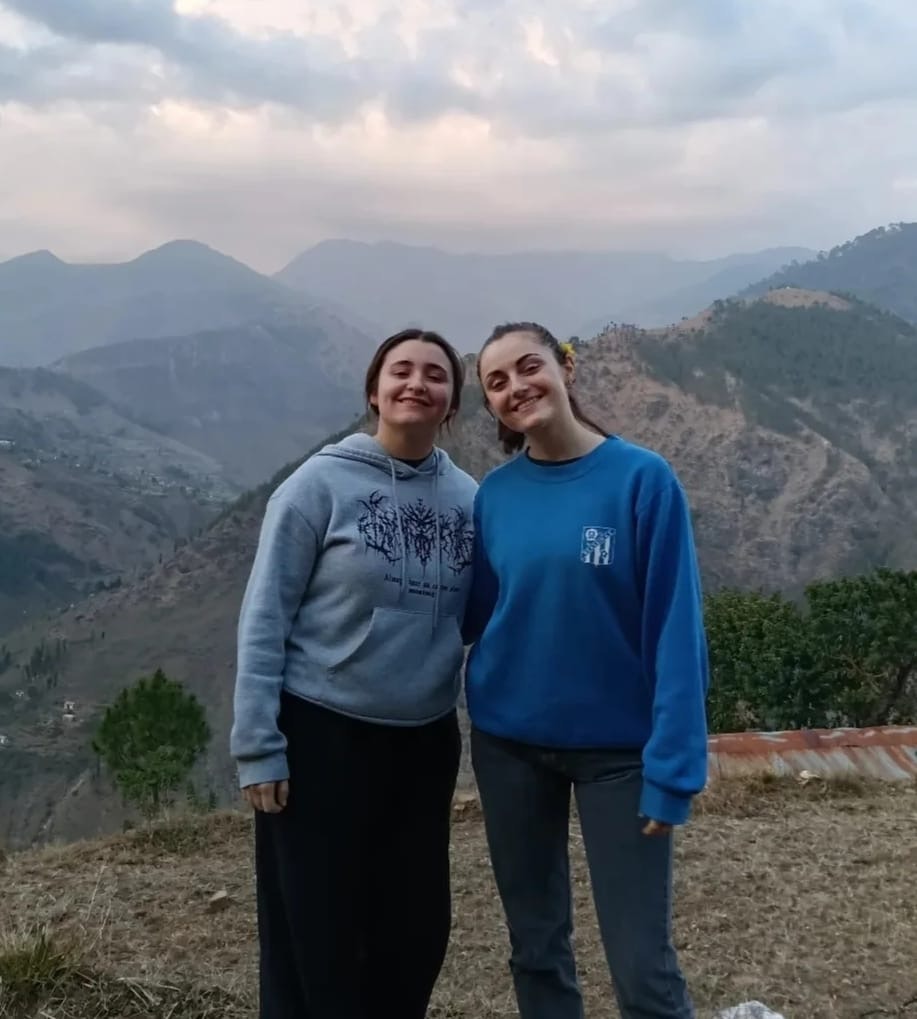
    For three months, Nahia and Loraine, final-year Psychology students from the Basque Country, took part in the Rato Baltin project of be artsy in the Achham district of Nepal.
    Before leaving, they wrote a note full of expectations, curiosity, and a little nervousness about the adventure ahead. Now, after returning home, they share how this experience has changed their way of seeing the world.

    “One of our expectations for this trip was to take off a little of the Eurocentric mask that we unconsciously wear… We wanted to get to know this culture up close and personally, and free ourselves from some prejudices.”

    With that open attitude, they arrived to Nepal, where they lived and worked alongside the local team, taking part in educational workshops and learning from the community. After three months, they both recognise that the cultural and emotional impact was profound, but also deeply enriching.

    “Living with the people of Achham, listening to their stories and sharing their daily lives made us rethink many things and look at the world through different eyes.”

    They also emphasise that their time as volunteers was an important professional learning experience, allowing them to grow both as psychologists and as individuals:

    “Working with a different team, with distinct values and a different work ethic, made us grow… Achham has taught us about empathy, respect, and the power of small actions.”

    Their reflections reveal how an internship abroad can transform the way we understand cooperation and global justice — when approached with humility, empathy, and a genuine desire to learn.

    At be artsy, we deeply value the involvement of young people like Nahia and Loraine, who approach Nepal’s reality with openness and respect. Experiences like theirs strengthen the bridge between universities, students, and transformative projects, helping to build connections of knowledge and empathy across cultures.

    Read their full stories:

    Acknowledgements

    Many thanks to the Faculty of Psychology of the University of the Basque Country (Donostia) and to Professor and be artsy member Luixa Reizabal for their support in making this collaboration possible.

  • Artistes molt reconeguts ‘visiten’ la vila de Ripoll (Girona), a benefici de be artsy, en un exposició. També online

    Artistes molt reconeguts ‘visiten’ la vila de Ripoll (Girona), a benefici de be artsy, en un exposició. També online

    Una exposició d’art a Ripoll – també es pot fer la tramitació d’una adquisició online, i enviament per UPS) – dóna suport als projectes de be artsy. Algunes dels lectors d’aquest article ja coneixeu l’entitat. Veieu al final de l’article: dades bàsiques de l’exposició. Un cop acabada l’exposició, es podran adquirir online amb enviament segur per UPS (a través del correu electrònic admin@sylvaner.cat). Anirem afegint algunes fotos d’obres d’art disponibles per la seva adquisició.

    Un col·laborador voluntari d’aquesta associació, molt petit col·leccionista d’obra gràfica original – litografies, gravats – i de pòsters d’art acreditats i d’edició limitada, ha decidit exposar part d’aquesta petita col·lecció a Ripoll, i donar una part de la recaptació a l’associació.

    Les obres surten sense preu. Però tampoc es tracta d’una subhasta. La primera oferta raonable que es faci per una peça serà acceptada, totes les ofertes seran considerades i s’oferirà informació, documentació, de manera personalitzada (admin@sylvaner.cat)

    L’exposició mostra obra gràfica original -litografies i altres – d’artistes com Miquel Barceló, Joan Hernández Pijoan, Perico Pastor, Joan Miró, Maria Girona, Antoni Tàpies, Eduardo Arranz-Bravo, i pòsters d’edició limitada y acreditats d’Albert Ràfols Casamada, Lola Anglada, Montserrat Gudiol, Tàpies, Josep Guinovart, J-J. Tharrats, Josep Subirachs, Keith Haring, Marc Rothko, Paul Klee, Eduardo Chillida… entre altres artistes. La majoria tenen o bé certificat de compra en subhasta o acreditació de compra en subhasta.

    Tot i ser una petita associació, està registrada com a organització no lucrativa pel Desenvolupament, i també d’Utilitat Pública, així que les donacions desgraven de l’IRPF. Pràcticament són només els donants particulars els que sostenen els projectes, tot i comptar en ocasions d’ajudes d’entitats privades.

    Dades bàsiques:

    Art – Exposició d’obra gràfica original, i pòsters d’edició limitada
    Procedents d’una petita col·lecció. Del 10 de gener al 5 de febrer de 2024. A La Qperativa, Plaça Gran, 23, Ripoll (Girona). De dilluns a divendres, de 9h a 21h. Dissabtes, de 9h a 22h. Diumenge tancat.

    Per veure detalls de l’exposició i el seu funcionament: sylvaner.cat. Ni a l’exposició, ni a la web sylvaner,cat, ni en aquesta galeria, estan totes les obres disponibles. Demana informació a admin@sylvaner.cat! També es pot parlar de fer la tramitació d’una adquisició online. Algunes de les obres disponibles:


    Joan Miró (1893 – 1983): litografies originals. Primer, ‘Omnium Cultural’ (póster litogràfic editat per la prestigiosa editorial d’art Polígrafa) 73 x 54 cm. 2: Litografia originale VI. Al revers: Joan Miró: Litografia originale VI / Graphis Art, Livorno / Toninelli Modern Art, Milà. Tot i que pertany a la sèrie Miró Lithographe-III (1964 – 1969), en aquesta ocasió, en una edició limitada de 1972, a Itàlia, aquesta litografia evoca la sèrie de l’artista ‘Animals surrealistes’. Referenciada al Catàleg Raonat: Litografia Miró-III, 1964-1969, p. 30 (i en altres Catàlegs). 33 x 53 cm. Sobre paper blanc d’alta qualitat (250 g). La primera litografia té certificat de compra; la segona, acreditació de compra (en subhastes).


    Joan Hernandez Pijoan. Premi Nacional d’Arts Plàstiques el 1981, l’artista (1931-2005) va crear un Quadern d’Artista amb disset gouaches originals. D’aquest Quadern es va fer una carpeta d’artsta, limitada, de reprografies sobre paper ‘old mill’ blanc. La seva tècnica pictòrica, molt meditada i continguda, mostra en aquest conjunt d’obres una gran austeritat que dota els treballs d’una qualitat poètica extrema. Es venen individualment o bé la totalitat de la carpeta. Els fulls estan doblats, i cada obra és una part del full desplegat, o el full desplegat complet, i estan impreses per les dues cares. Un dells té certificat de compra en subhasta, en qualsevol cas totes poden ser acreditades. Full doblat: 40 x 30,5 cm.

    Pablo Picasso (1881 – 1973) va il·lustrar amb litografies el llibre ‘Lisístrata’, d’Aristòfanes, comèdia representada l’any 411 aC. En el marc de la ‘vella comèdia’, va tenir un èxit extraordinari. Les litografies es poden adquirir individualment, tot i que el conjunt mostra les dos cares de la situació causada pel personatge ‘Lisístrata’, amb la seva idea (convèncer la resta de gregues d’iniciar una vaga de sexe per tal de forçar els homes a negociar la pau, una estratègia que encendria la batalla entre sexes), per acabar amb la Guerra del Peloponès (Atenes i aliats, contra Esparta i aliats). Una mostra a la protagonista, parlant a les dones i soldats, i l’altra mostra l’altra cara, la d’ambaixadors i pensador, imaginant com acabar amb el conflicte creat per Lisístrata. S’acompanyen amb els corresponents Certificats de compra en subhasta.

    Miquel Barceló (1957). Reprografies a pàgina completa procedents d’una petita carpeta vinculada al llibre (3 volums) ‘La Divina Comèdia’, carpeta en edició limitada, per presentar el llibre. Sobre paper Acadèmia de Frabriano de 200 gr. A partir de les aquarel·les originals de l’artista usades per l’edició del llibre. 29 x 21 cm. Al revers tenen una altra il·lustració, o bé un poema extret del llibre. Un d’ells té certificat de compra en subhasta, en qualsevol cas totes poden ser acreditades. Es venen individualment o el conjunt de les il·lustracions de la carpeta.

  • We evaluate the impact of the Rato Baltin 2019 project

    We evaluate the impact of the Rato Baltin 2019 project

    We are really happy to finally show you the impact evaluation from 2019 year. This year we are a little late, because analysing the result from 4 teams has been giving us 4 times the work from last year. But we hope you are going to be as happy as we are with the results.

    The remote villages where we have been present have been 18, in 4 municipalities, in Achham. We think that monitoring the project is essential. That is why we went to the villages where we were in 2019 and we evaluated the program and its impact.
    Resultats Rato Baltin 2019

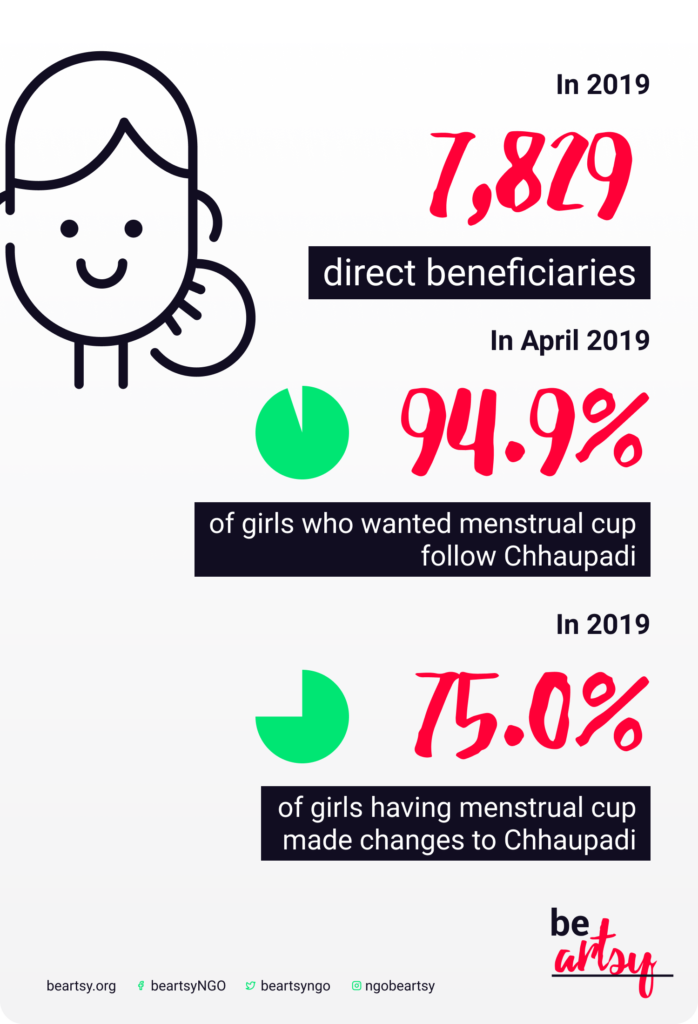
    We teach menstrual health management, reproductive and sexual health education workshops and activities to involve communities. We also teach photography workshops to facilitate the expression of the girls, film screenings, and meetings with the municipal authorities and religious and spiritual leaders of all the villages. In the course of the project, in 2019, we have distributed 1,467 menstrual cups to school girls and young women. They received menstrual cups, a metal bucket to boil the cup, and soap. Work was done on how to use it. 7,829 direct beneficiaries were reached during 2019.

    In the face-to-face follow-up, every two months, with the users of the menstrual cup, the trainers and local mentors and coordinators helped. We also took into account girls who do not use menstrual cups, to assess the difference between girls who use them and those who are not users, and to see if the tradition of chhaupadi can be changed only through education.

    The results

    Talking to the girls, we saw that a very high percentage use the cup, even six months after training. And they would recommend it to other girls. 94% of the girls explained that they followed some type of menstrual restriction before and after the training and implementation of the cups, but when asked if the tradition has changed since then, 75% of the girls reported having made changes in the chhaupadi tradition.
    Some girls reported changes in access to food: now they can eat vegetables, some can eat fruit, and some can drink milk. Some girls reported that, after participating in our workshops, their mothers allowed them to have a thicker blanket in the Chhaupadi hut and since they do not stain, they do not have to be washed every day. Most of the girls said that they no longer have to sleep outside when they have their period, since nobody knows that they are menstruating. Some girls sleep in separate rooms and some still practice chhaupadi, but now they feel clean and safe. Some also reported that since workshops and training they are no longer required to participate in chhaupadi exclusion practices and are now allowed to cook and eat. They mentioned that they are now allowed to touch the animals at home, some girls no longer hesitate to touch water sources or visit the temple without hesitation, or reported that they feel comfortable going to school when they have their period, since the use of the cups nobody can tell if they are menstruating or not. They also believe that it is easier to work when using the cups. The women who agreed to talk about their experience said that they feel much cleaner using the cups, since the blood does not leave their body. These girls and their families also feel safer, and also because they don’t have to wash their clothes due to blood stains.

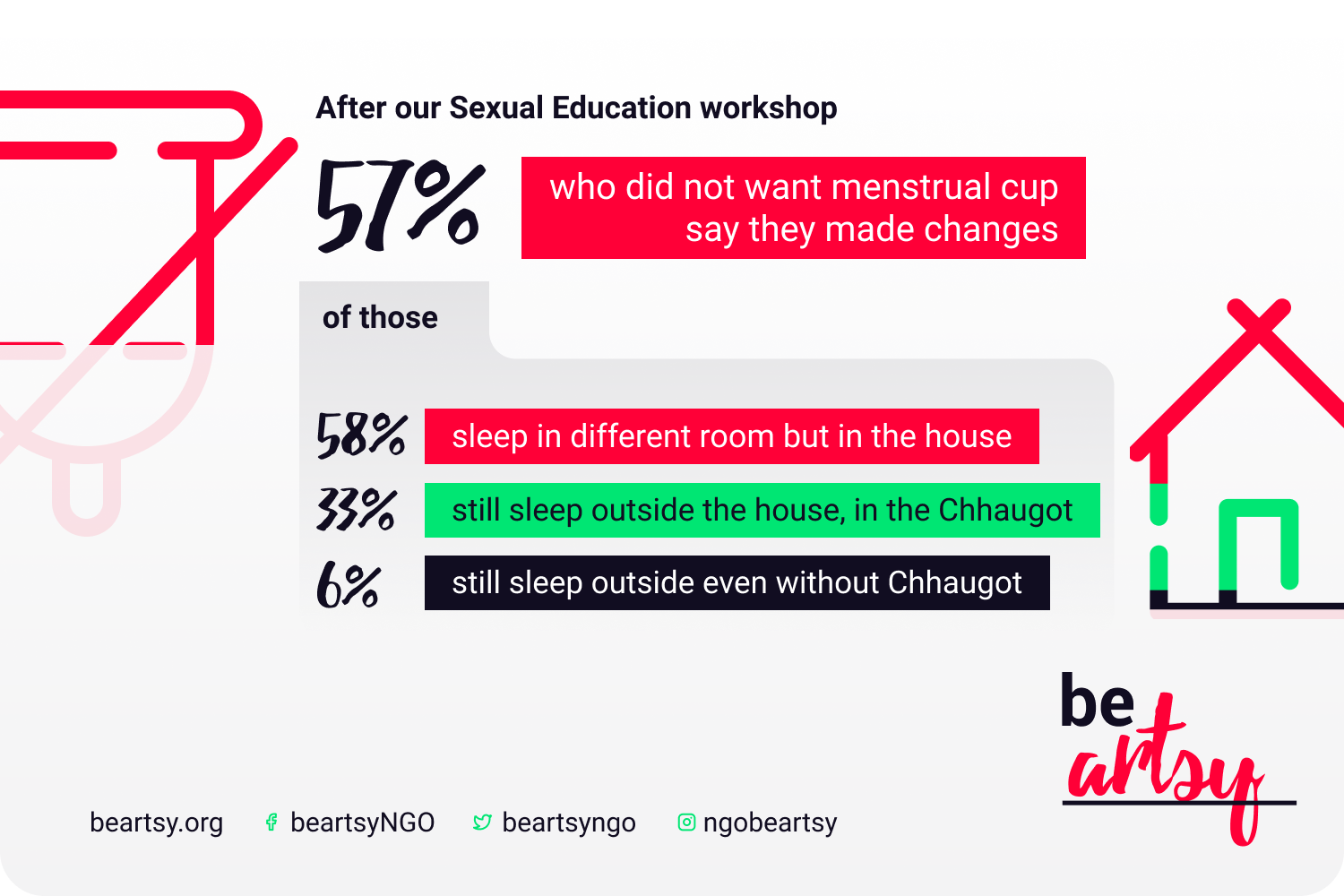
    It is important that girls who do not use the menstrual cup have also undergone changes since we started training in menstrual health management. 57% of these girls have made changes during menstruation. Like the girls who use the cup, they revealed that after the training workshops we did they were able to touch the animals. eat vegetables or drink milk, sleep in their bed indoors, in a separate room, have a thicker blanket if they continue sleeping in a hut, touch water sources. 58% declared to be in a separate room inside the house, while 33% still sleep in a chhaugot and 6% even sleep outside, despite having no chhaugot.

    This year we have managed to maintain the presence of 4 different teams, working on the ground simultaneously. Thanks to the goodwill of the trainers, the monitoring of the project went well, and we were able to obtain many comments from the beneficiaries. Survey findings show that our initial idea that cups can break the taboos surrounding menstruation and chhaupadi works.

    In 2020 the project will not be expanded to many other towns. We will try to reach more women and help them stop chhaupadi, assisting and encouraging them with the help of mentors and training visits.
    Our area staff will be made up exclusively of local girls – from Achham. It is important to highlight that the local counterpart of the year 2020 is made up of women committed to the project, who have created a social company . Specifically, we are talking about three Nepalese women who have worked with our 2019 counterpart throughout the year. They have been trained to work on these types of projects and to know how to raise funds from cooperation organizations around the world and from private entities, and in generating their own capital. Thus, the project can be managed more efficiently, and we can have trainers in each municipality who will take care of their menstrual cups’ users and actively promote awareness of the chhaupadi problem throughout the year. You can read the document with all the details of the evaluation of the 2019 period here.

    Text by Clara Pinilla and Josep Marín

    For just €1.80 a day you can change the future of a girl and prevent her from being forced to marry at 14 years old!

    There are several ways in which you can get involved and sponsor a girl in Achham:

    Teaming Group: 1 euro a month – become part of Rato Baltin Project!

    Teaming Group: 1 euro a month – become part of the team and get your friends to help you sponsor her and avoid early marriage!!

    Regular donation: to https://donorbox.org/againts-chhaupadi

    Become a member: https://beartsy.org/associate/

    🙂 Thanks!
  • Travel Log – Ruby cup training at Rachuli. Once again, total success!

    Travel Log – Ruby cup training at Rachuli. Once again, total success!

    4-6-2017 

    The menstruation cup training that we have set at Rachuli, exceeded all expectations. We have spent, so far, 10 days in town, talking with the ladies and girls, teachers of both sexes, and trying to reach out to the men. to talk with the men…

    The girls were asked to talk with their parents about the concept of using a menstruation cup and ask them for their permission. Mothers are talking to us too.

    Every day we dedicate a while to stroll around the villages so they can be able to ask us questions about whatever they want.

    At first, opposite to what we experienced in Achcham, there was some resistance to agreeing with our concept; however as the training day approaches the list is growing and once again we have a waiting list for girls to receive the menstruation cup.

    For the very first time local teachers and nurses attended the training together with the girls. We have found this to be effective as teachers and nurses will be able to control better its use in front of their students.

    Instructions were also given to the Primary Care Centre, following a discussion with the management, including a list of the cup users. This way the girls using the cup can be better monitored and in case there are issues with the cup or its use, they are quickly detected.

    I never get tired repeating this to them: “Clean your hands with soap, clean the cup with clean water directly to its bucket and if possible, boiled water. And boil the cup once menstruation has gone, a minimum of 5 minutes.”

    The team, jokingly, said that I should get that tattooed on my face, 😉 I am considering to prepare a banner which I could hang up during the workshops; so the girls will thinking about the cup, with the constant message of using very clean water, soap, and boil routine!

    Written by Clara Go. Photos done with FUJIFILM X-Pro1 © Clara Go
    Translated to English by Dominic Ramirez and Corrections by Hannah Cremona.

    West Nepal girls need this kind of program. And we need help to continue the project!

    Now you can donate for paying one month salary to the nurse, or for some hygiene kit or for the menstrual cup control in September: http://beartsy.org/get-involved-with-rato-baltin

    Or If you feel like it, you can donate via bank transfer at: Banc Sabadell IBAN: ES23 0081 0900 8200 0430 1934 BIC: BSABESBB (your recurring donation will help us have a better planning of our budget to carry out the projects undertaken).

    Or take a look others ways to donate in http://beartsy.org/donate/

    Thank You! 🙂

  • Travel Log – The day the children of Rachuli learned how to speak Buffalese!

    Travel Log – The day the children of Rachuli learned how to speak Buffalese!

    28-5-2017.
    7 days after leaving Kathmandu we were able to start teaching at the school. Our first school day at Rachuli’s school had cracking-up moments.

    We started with 10th grade, which means some of the students were 17 years old, only 3 years younger than the two nurses we hired. Being so close in age created a previously unseen complicity with the class. Both boys and girls made enquiries and intervened a lot in class; including some fun moments such as when they were trying to guess how many holes female organs have. Answers varied between 2 and 4! 🙂Very few students said 3.

    Other fun moments were related to the fact that our nurses were nervous and did not remember certain words in Nepalese, so they had to ask students! Or when talking about the clitoris and I took the chance to make comments a Nepalese woman would never dare say… these are advantages of being a foreigner: I play “dumb” and say or ask things they would never do.

    After class I went for a walk with my camera and a parade of women and girls came with me. When we were back at my home’s front door, we met the nurses and, suddenly, as we were bidding farewell to my “following”, we heard a buffalo “shouting”. I started imitating it, and the buffalo “replied”, so I went on and ask the nurse to translate to children the following: “Don’t you at Rachuli speak Buffalese? I do!”; and I went on imitating the buffalo’s cries. It really did sound as if he were replying to me. The children and women cracked up, even though they were not completely sure whether I did understand what the animal was telling me! 🙂 Cool.

    Later on, when our “Didi” (Sister) was coming to call us for dinner, it so happened that I opened the door at the same time as she got there. When I ran into her, small and in the dark, telling me “Didi khana Khane” (Sister, come to eat rice!), I screamed in fear, she got startled as well as the nurses in the room, followed by great laughter afterwards. 😀

    There are days so special in this country, that they make you forget how hard sleeping on the floor is, or the rough roads and 5-day journeys, and boring dhal bat (rice with lentil or bean soup. Here, with beans , beans,lentils are not local) twice a day.

    Written by Clara Go. Photos done with FUJIFILM X-Pro1 © Clara Go
    Translated to English by Alba Miquel

    West Nepal girls need this kind of program. And we need help to continue the project!

    Now you can donate for paying one month salary to the nurse, or for some hygiene kit or for the menstrual cup control in September: http://beartsy.org/get-involved-with-rato-baltin

    Or If you feel like it, you can donate via bank transfer at: Banc Sabadell IBAN: ES23 0081 0900 8200 0430 1934 BIC: BSABESBB (your recurring donation will help us have a better planning of our budget to carry out the projects undertaken).

    Or take a look others ways to donate in http://beartsy.org/donate/

    Thank You! 🙂

  • Travel log – The way to Rachuli (Kalikot)

    Travel log – The way to Rachuli (Kalikot)

    May 25, 2017.

    Getting to Rachuli (pronounced RAH-chuli) took us 5 days. At the moment of writing this, I can’t imagine having to leave this place. The ways to get up here are mountain roads with very few paved parts. There are lots of rocks all around, landslides everywhere, heavy rocks in the middle of the way and fine sand in some areas. The rainy season is starting, we will see how it goes.

    To begin with, since it is spring in Kathmandu and therefore very rainy, all my luggage containing the workshop materials has been water-proofed. In local buses luggage is stacked on top, so I wrapped it in plastic, just in case it rained.

    On the fourth day of our journey, when we arrived to Manma (Kalikot), the bus stopped at a hostel by the bus station, and we were told to get out: we would stay there cause the night bus was not working. We checked the rooms and noticed they were horrible, but it was what was available. Staying there meant not having to unload all the stuff from the bus. We only took some personal items, the camera and the laptop.

    At 5 am, when we woke up, there were 15 cm of water in the room. My backpack containing my camera and laptop was soaked. The nurses’ clothing too. My mind had warned me about water… but never did I think water would come from the ground and not from the ceiling. I could not kill the man form the hostel, he said the water was clean, it came from the deposit which had overflown… In this sort of situations I would like to take the way of doing things in Nepal and break it in a million pieces.

    But I did not. I paid for my room and we went on to Rachuli: all soaked and amazed by the landscape. The name of Karnali Highway started to take a different dimension. These were incredible hills, framed with frightening sharp edges and heights which kept zig-zagging its way up and down.

    When we finally got there and stepped out of the bus, there was nobody to be seen. We enquired about the house we were staying in and it was just there. An old man helped us carry our stuff and Didi cooked us lunch…

    Written by Clara Go. Photos done with the phone © Clara Go
    Translated to English by Regla Maria López / Alba Miquel

    West Nepal girls need this kind of program. And we need help to continue the project!

    Now you can donate for paying one month salary to the nurse, or for some hygiene kit or for the menstrual cup control in September: http://beartsy.org/get-involved-with-rato-baltin

    Or If you feel like it, you can donate via bank transfer at: Banc Sabadell IBAN: ES23 0081 0900 8200 0430 1934 BIC: BSABESBB (your recurring donation will help us have a better planning of our budget to carry out the projects undertaken).

    Or take a look to others ways to donate in http://beartsy.org/donate/

    Thank You! 🙂