Manisha Kumari Nath is from Kuntibandali, a small town in the Achham region of western Nepal.
She lives with her father, mother and two little sisters in the house. As like most rural areas of Nepal, her family is very humble, her mother sells vegetables and thus can pay for the education of her daughters.
After she finished her final exam, she was asked to participate in the Rato Baltin Project, so right now Manisha is teaching other girls to use the menstrual cup, to have more knowledge about their own body, to know what the menstrual cycle implies, and to be able to differentiate between the Chhaupadi tradition and menstruation.
Before participating in the project, Manisha had never been in a different environment than her town and never had the opportunity to understand how different it can be to live elsewhere. Working on this project is helping her gain experience and learn new skills. Also thanks to the project she can continue with her higher education.
When we asked Manisha what her life was like since she was part of the project, she told us: ‘I was never concerned about learning new things and was also not aware that I could do something good to change the society. Since I joined the project, my life has been very good since. I have learned to be helpful and responsible. Yes, my vision towards my future has changed. I can see myself growing in this project’.
Clara, CEO and co-founder of be artsy witnessed Manisha’s evolution, and she said ‘When we first met her, she was a young, carefree girl, but now she is a responsible young woman who is in charge of her life and cares about the lives of others. And now in Nepal people are facing a health and a food emergency, and people can help us’.
2019. Tejana, Raunika, Manisha N. and Bea, our menstrual therapist
Manisha, boiling cups in 2018
Manisha is helping to KTM nurses, in 2018
March2017, in Kuntibandali. Manisha (second-right) is now our coordinator, then she was student
Manisha (first-left), with trainers, mentors, coordinators and volunteers the day we did a practical training in a school
Manisha giving class in Kathmandu
Text by Carmen Alcañiz, photos by Clara Garcia i Ortés.
There are several ways in which you can get involved with our projects and help girls in Achham:
Teaming Group: 1 euro a month – become part of Rato Baltin Project!
Teaming Group: 1 euro a month – become part of the team and get your friends to help you sponsor her and avoid early marriage!!
We are in Nepal, on the ground, weaving a network of women who sew and distribute masks 😷 so that when the biggest part of the pandemic arrives, probably in late autumn, the area will be more prepared with this contribution.
At the moment there are few cases, but the country does not have hospitals or how to deal with it, so precaution will be the best solution. We also will work in passing on comprehensible messages about the precautions, physical distancing, hands hygiene, and clear information about the real dangers.
And we can, with your donation, help to provide food for hundreds of returnees from India, now in quarantine centres (schools). There is a food emergency (read Food for returnees Project) where the municipalities have not enough resources. You can read here our Mask 4 Health Project.
With only 3 euros you can help us to respond to the problem of covid19🦠 in west Nepal.
The Rato Baltin Project is on site since the beginning of 2017, working to eradicate the Nepalese cultural practice establishing that during the menstruation, girls and women are considered impure, and are deprived of their basic needs. This practice is penalized since 2018, but they will never denounce, because that would be denouncing their mother, their father, their mother-in-law… Nobody in be artsy uses the term ‘Chhaupadi’ without the participants mentioning it before: menstruation, different from the tradition. Be artsy – Nepal shall take a leadership role in the evaluation of the project, in order to ensure a non-biased perspective on the results, and determine the efficacy of the project.
The project has been a success in Achham, and apart from the activities, it must ‘make noise’, to discuss menstruation and Chhaupadi in a context of change. In this link you can see the results from the year 2019, and we will continue in this line to set the project, to strengthen the impact in the areas we have already worked in, involving the community, also with boys groups. In new schools as well, located near the villages where we may have already worked.
Photography allows girls to showcase their own thoughts and experiences
be artsy trainers talking with girls about the menstrual cup.
Manisha and Clara in photography class.
A goup in a workshop.
We want to stimulate a critical dialogue on their worries, and it enables them to display and reflect their experiences in their communities. Be artsy and the Rato Baltin Project, being relatively new endeavours, has limited capacity for its implementation at a bigger scale.
The 2020 project is adapted to the lessons learned with the 2017, 2018 and 2019 projects, and taking into account the important new factors that have taken place this year worldwide.
We shall emphasize on the implication of the local communities of Achham, and working with local entities: eradicating the practice should not be by a foreigner cultural judgement. This would inhibit the efforts in matters such as hygiene, health and menstrual sexual education, and would finally have a negative impact. The local be artsy partner is formed by women so committed to the project that they themselves have created a social company. They are three Nepalese women who worked with be artsy last year, with studies in cooperation, business administration, and gender studies. Also, local girls do conform the trainers group, and they can be future managers. ROKPA International and Ruby Cup continue being our strategic partners.
Some members of be artsy are interested in a parallel project, and during some follow-up months, they will prepare with our local mentors a social theatre piece against the Chhaupadi.
They will have the opportunity of having a better future and avoid an early marriage. They remember that they were our students and now are working with us. For those ready to continue studying but whose families were not able to pay their way through high school, we pay for that, and for the housing, uniform, food, etc. to avoid them being married too soon.
The total sum needed for the project is €74,230, without including the Edufem Project. It is higher this year because we want that two girls, in each village, do work throughout the year as social facilitators to attack directly the issue of the Chhaupadi, apart from the trainers. A single person cannot, with the existing social pressure, keep her mind strong against the tradition. If we do not have all the money we need, we shall do this every two months, but it would not be that effective. The expense for each of the 4 teams we have is €18,557.
We shall work on the social distancing and hand hygiene messages
We part from the idea that in Nepal, the peak of the Covid-19 shall arrive at the start of this next winter; we wanted to have a network of women sewing face masks, but that is complicated; it should be the Town Halls themselves facilitating the resources. Our contribution will mostly be to pass on comprehensible messages about the precautions, social distancing, hand hygiene, and clear information about the real dangers.
Conferences with film screenings and exhibitions in several Catalan towns
We have started working to create awareness, with conferences and exhibitions in several Catalan towns, on the problems relating to the Chhaupadi, avoiding ethnocentric and patronizing arguments, to inform about our need for collaborations. We do still need support, from more people!
Les dones nepaleses expliquen amb imatges com viuen la menstruació, aïllades perquè són impures.
L’exposició “La menstruació al Nepal: un turment cultural” es pot veure a la biblioteca del districte 2 (Bd2) fins al 28 de febrer. És un dels actes de la programació del Mes de la Pau, organitzada per la Regidoria de Solidaritat i Cooperació i la BCT Xarxa per difondre els valors de l’educació per la pau, la solidaritat i el respecte als drets humans.
La mostra resumeix en fotografies com les dones de l’occident nepalès i les dones europees viuen el fet de tenir la regla. Al Nepal estan sotmeses a la tradició Chhaupadi, una pràctica centenària que desterra nenes i dones a cabanes o coberts durant la seva menstruació. Se les allunya perquè se les considera impures.
L’objectiu d’aquesta entitat és mitigar les conseqüències d’aquesta tradició a través de l’educació, l’ús de copes menstruals i l’art. Be artsy és una petita ONG amb seu a Barcelona que va néixer per desenvolupar aquest projecte (Rato Baltin Projecte). A banda de la mostra, la Bd2 acollirà una xerrada sobre aquest tema el 24 de febrer a les 6 de la tarda.
We have sent the proceedings from the Teaming Group, where the people that help us contribute with €1 per month to the Rato Baltin Project of be artsy.
With this contributions, we add resources to the project and help it grow and consolidate. Rohini Bhandary and Hiukala Chalaune, our trainers from Turmakhand and Mangalsen, have followed with the project this winter, and also training new users of the Ruby Cup menstrual cup. Our project is showing itself effective in eradicating the tradition of Chhaupadi, which penetrates across a large part of Nepalese society, and because of it, girls and women are strongly discriminated when they have the menstruation. With our project, the girls and the communities themselves do determine the need for changes.
The money we have sent has been used to cover the expenses and salaries of the winter training in Mangalsen (we have distributed 136 menstrual cups), and in Turmakhand (17 menstrual cups). Our trainer Hiukala and our collaborator Rupa Pandei do explain all of it. The contribution of €1 monthly from each of our Teamers is very important, because without it this would not have been possible. Help the Rato Baltin project. In 3 years we reached 13.700 direct beneficiaries, and more than 2.075 users of the menstrual cup.
We have created a separate group to pay for the school of the girls to whom we pay for school, home, food and English classes to give them a chance and prevent them from getting married at 17. Thank you!
A goup in a workshop.
Text and photos by Clara Garcia i Ortés, translation by Tere Salinero.
For just €1.80 a day you can change the future of a girl and prevent her from being forced to marry at 14 years old!
There are several ways in which you can get involved and sponsor a girl in Achham:
Teaming Group: 1 euro a month – become part of Rato Baltin Project!
Teaming Group: 1 euro a month – become part of the team and get your friends to help you sponsor her and avoid early marriage!!
During 2019, one of the local organizations with which we work in Nepal, CODEC, asked us to do a pilot test in Nuwakot, which is the area where this NGO works. This was to undertake a pilot project of our Rato Baltin program in that area.
Our representative in Nepal, Clara García i Ortés, went there in January 2020, and we could see that, in the area, the situation was no different than in Achham. It was about sexual discrimination. Many men explained that they did not force them to follow the Chhaupadi. In fact, effectively the women and the girls did sleep in their home, but the women slept in separated beds, the men would not eat what they prepared, they could not touch the same water sources, things that in all were Chhaupadi practices. So, the only difference that existed between the menstrual discrimination in this area, and others like the ones we worked in Achham, is that women sleep inside the house.
Then, Rupa Pandey, Simran and Raunika conducted this project. We decided to undertake a pilot test, involving only social workers, teachers, and a small representation from each school. This is what we could do, be artsy will not be involved in this program, unless the partner CODEC contributes with the necessary resources, because our efforts focus the Far-West province. The details of the pilot project in the Nuwakot District can be found in this link.
Text by Josep Marín, translation by Tere Salinero.
Photos by Rupa Pandey.
For just €1.80 a day you can change the future of a girl and prevent her from being forced to marry at 14 years old!
There are several ways in which you can get involved and sponsor a girl in Achham:
Teaming Group: 1 euro a month – become part of Rato Baltin Project!
Teaming Group: 1 euro a month – become part of the team and get your friends to help you sponsor her and avoid early marriage!!
In Tejana´s village there is no electricity nor transport means. Despite all that, she manages to get the menstrual cups and educational workshops reaching there through Basti’s muddy roads. A small village in Achham to which you take more than two days to arrive from the province main city.
She is happy for that. She coordinates the trainers’ team of be artsy and is one of the first girls that participated in the project in 2017. From the beginning, she showed a lot of interest in the matter, and a high level of involvement. “Coverage in the area is very bad and Tejana helped us to contact some participants that were impossible to get in touch with” says Clara, CEO and co-founder of be artsy. When she started attending the be artsy workshops, she quickly realized that the Chhaupadi, the Nepalese thousand-year-old tradition that isolates women during their period, is not right. Before that, Tejana, like all the women in her community, isolated herself in a hut during her period days. She believed it to be a bad thing and used old rags when bleeding. She wasn’t even able to speak to her parents about the menstruation taboos.
Now she is studying in Achham’s main city, Mangalsen, to become a nurse. In the meantime, she works with be artsy coordinating other trainers who will be teaching in the local schools what she learned a few years ago and changed her life.
Tejana, thanks to the menstrual cups and the education workshops, feels clean, comfortable, and above all, sure of herself. She is not afraid of speaking her mind about the menstrual taboos, even before the elder people, as, like she herself says, she has got her ideas very clear. In fact, she has spoken with her parents about the menstruation and has succeeded in changing their minds about it.
She is convinced that it is oneself who has to start first eradicating the taboos.
Please donate now so more girls like Tejana live their menstruation naturally and change their lifes.
Women group in Oligaun
Teaching in Oligaun 2018
be artsy trainers talking with girls about the menstrual cup.
Manisha and Clara in photography class.
February 2017- Tejana could not come the day that we did the MCT and we did one only for her. The nurse in the picture is Susmila Khanal
2019 – Tejana in front (Manisha back) in the ToT (Training of Trainers) coordinators teaching the closing ceremony
Tejana and Manisha conducting a class as trainers in Mangalsen 2019
Tejana and Manisha were the responsable for that school 2019
Text by Arrate Sarrionandia and Rupa Pandey, translation by Tere Salinero.
Photos by Clara Garcia i Ortés.
For just €1.80 a day you can change the future of a girl and prevent her from being forced to marry at 14 years old!
There are several ways in which you can get involved and sponsor a girl in Achham:
Teaming Group: 1 euro a month – become part of Rato Baltin Project!
Teaming Group: 1 euro a month – become part of the team and get your friends to help you sponsor her and avoid early marriage!!
Testimonial write by Simran Adhikari, intern and volunteer during 2019, program officer in be artsy’ Nepal headquarter since then, and founder of Be Artsy Nepal:
As a fresh graduate, I was searching for opportunities to showcase my skills and abilities by volunteering and working for social change. I got a chance to know Clara G.O. through an international journalist and joined Rato Baltin project by an NGO called be artsy as a volunteer starting March 7, 2019.
Working on this project made me aware of the harsh menstrual restrictions and also about chhaupadi faced by the girls and women in Achham. Getting to learn about chhaupadi so closely also stroke my mind about the menstrual restrictions which also exist in the urban areas where more educated people live, and girls and women are still restricted to enter their kitchens and also temples. The only difference is that it is much safer in the city.
During my follow-up visit in November for 15 days, I got a chance to go to Achham for evaluation and got introduced to the team. I became more aware of the harsh reality of the community. I travelled to the village of Sanfebagar named Khalsen and Dhakari (Hichma, Dhakari, Dhungachalna) for the follow-up of the schoolgirls and women using the menstrual cups. In Dhungachalna, I also got an opportunity to talk to the mayor of Sanfebagar, who donated funds for the Rato Baltin project. Due to trust to the local partner, the money was all seized by the local partner of that year. At the same time, along with Clara, while managing the team, I interacted with a female teacher continuing Chhaupadi after her delivery. During the interaction, she told me that she has been following this practice because of her fear to God, and fear of society. Even though she is a teacher, she still could not change her beliefs which made me depressed and worried about her 2 months old daughter.
Similarly, at the same time, I got another chance to talk to the mayor of Sanfebagar about the money taken by Samabikas Nepal and misused in the destruction of Chhaugoth at Sanfebagar Municipality. I called him from the office number, but I believe that the number was blocked by him. The second time I called him with another number, he picked up the phone.
The details about our conversation
Me: Hello sir, Good afternoon! I am a volunteer of be artsy’ Rato Baltin project (he recognized the project name). Sir, I am talking on behalf of Clara as a translator, anything I am telling you is Clara asking you don’t mind if it sounds harsh. Mayor: Yes, please tell. Me: Sir, the money you have been giving in the name of Rato Baltin project has been captured by Samabikas Nepal. The purpose of the project is not to destroy the chhaugoths. This money has been misused by the local partner and has not been meeting our objectives. Whereas, SamaBikas Nepal is not in communication with Rato Baltin project. Mayor: Look! I gave the money to Rato Baltin, now it’s not my thing. You should talk to SamaBikas Nepal and move cooperatively. I am a mayor and have a lot of things to do. Don’t call me and ask about small things, now you have to coordinate with the local partner. Me: Sir I get that, but we could see the money is being misused, and we are trying to contact SamaBikas Nepal, they never pick up the call. The money has been used to destroy chhaugoths which is causing more deaths of girls and women. This is not our way for the change! Mayor: Listen, we are planning to destroy chhaugoths, until and unless we don’t do that people are not going to leave this tradition. Me: This is a tradition which has been followed by infinite generations. And at once destroying chhaugoths does people get awaken and stop this practice? Many NGO’s and INGO’s have been working in this sector for many years. They are not able to bring change over time, can this decision of yours bring change instantly? Who will be responsible if the females die after the destruction of chhaugoths? Can you take the responsibility of girls who dies because of the destruction of the menstrual huts? Mayor: I don’t know other things, but I am into destroying chhaugoths. Maybe we give one hour or two days notice to people before destroying them. If we don’t do this, then the practice never ends. During this period if ‘one or two girls die then it is not my problem. They die due to their own reason. We are destroying chhaugoths and allowing them to live inside their house. If because of it they die, it’s their personal matter’. Me: How can you tell this, sir? You being a leader of the area, it is your responsibility to take care of the females and protect them! We can know how many girls die after this step-through media. Mayor: This is our decision, and we are doing this. No one can stop me from this revolution. And if you are giving me the threat of media, then I am not afraid of the media (cuts the phone!).
…I got traumatized because of his words and knowing his mind-set. After that conversation, I could only see the girls in Achham having a dark future because of the cruel mind set of the people here. Yes, revolution brings change, but this kind of selfish revolution will kill many innocent faces.
Similarly, Clara and I were there with the local ward leader disseminating information about the film projection and check if he could manage the hall for film projection. I was talking about social change and how hard it is to change the mindset of people. The local ward leader told us to distribute money, if not much, at least 10 Rupees per person and the hall for the film will be full. I told him- ‘We are here for projecting film for the purpose of changing people’s mind-set and their perception. We don’t want people to come here for the greed of money, but we want them to come here for the real change’.
The overall field trip was a learning experience, while listening to people with patience, analysing the people’s mind set and bring innovative ideas for change. However, this whole experience also made me realize about the harsh reality which was totally unexpected for me.
Text and photos by Simran Adhikari, Program officer in be artsy' Nepal headquarter. And founder of Be Artsy Nepal
Correction / translation by Shweta Manandhar / Tere Salinero.
For just €1.80 a day you can change the future of a girl and prevent her from being forced to marry at 14 years old!
There are several ways in which you can get involved and sponsor a girl in Achham:
Teaming Group: 1 euro a month – become part of Rato Baltin Project!
Teaming Group: 1 euro a month – become part of the team and get your friends to help you sponsor her and avoid early marriage!!
We are really happy to finally show you the impact evaluation from 2019 year. This year we are a little late, because analysing the result from 4 teams has been giving us 4 times the work from last year. But we hope you are going to be as happy as we are with the results.
The remote villages where we have been present have been 18, in 4 municipalities, in Achham. We think that monitoring the project is essential. That is why we went to the villages where we were in 2019 and we evaluated the program and its impact.
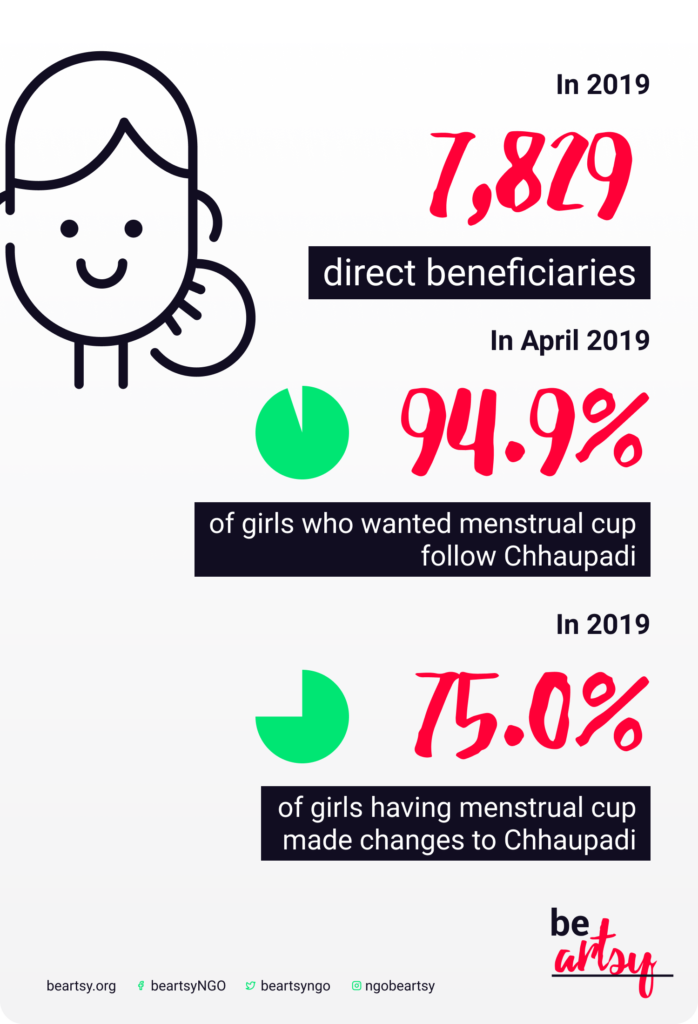
We teach menstrual health management, reproductive and sexual health education workshops and activities to involve communities. We also teach photography workshops to facilitate the expression of the girls, film screenings, and meetings with the municipal authorities and religious and spiritual leaders of all the villages. In the course of the project, in 2019, we have distributed 1,467 menstrual cups to school girls and young women. They received menstrual cups, a metal bucket to boil the cup, and soap. Work was done on how to use it. 7,829 direct beneficiaries were reached during 2019.
In the face-to-face follow-up, every two months, with the users of the menstrual cup, the trainers and local mentors and coordinators helped. We also took into account girls who do not use menstrual cups, to assess the difference between girls who use them and those who are not users, and to see if the tradition of chhaupadi can be changed only through education.
The results
Talking to the girls, we saw that a very high percentage use the cup, even six months after training. And they would recommend it to other girls. 94% of the girls explained that they followed some type of menstrual restriction before and after the training and implementation of the cups, but when asked if the tradition has changed since then, 75% of the girls reported having made changes in the chhaupadi tradition.
Some girls reported changes in access to food: now they can eat vegetables, some can eat fruit, and some can drink milk. Some girls reported that, after participating in our workshops, their mothers allowed them to have a thicker blanket in the Chhaupadi hut and since they do not stain, they do not have to be washed every day. Most of the girls said that they no longer have to sleep outside when they have their period, since nobody knows that they are menstruating. Some girls sleep in separate rooms and some still practice chhaupadi, but now they feel clean and safe. Some also reported that since workshops and training they are no longer required to participate in chhaupadi exclusion practices and are now allowed to cook and eat. They mentioned that they are now allowed to touch the animals at home, some girls no longer hesitate to touch water sources or visit the temple without hesitation, or reported that they feel comfortable going to school when they have their period, since the use of the cups nobody can tell if they are menstruating or not. They also believe that it is easier to work when using the cups. The women who agreed to talk about their experience said that they feel much cleaner using the cups, since the blood does not leave their body. These girls and their families also feel safer, and also because they don’t have to wash their clothes due to blood stains.
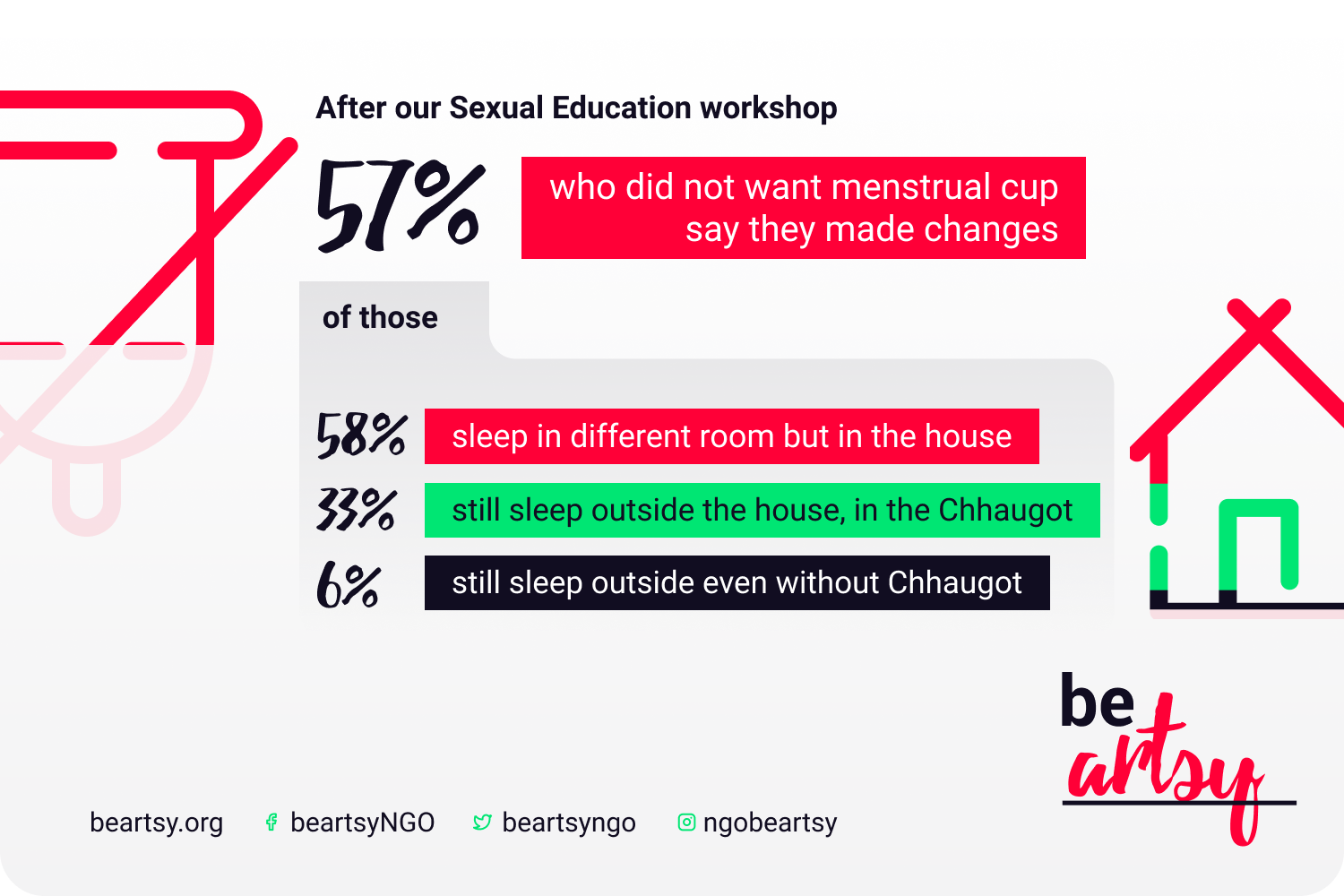
It is important that girls who do not use the menstrual cup have also undergone changes since we started training in menstrual health management. 57% of these girls have made changes during menstruation. Like the girls who use the cup, they revealed that after the training workshops we did they were able to touch the animals. eat vegetables or drink milk, sleep in their bed indoors, in a separate room, have a thicker blanket if they continue sleeping in a hut, touch water sources. 58% declared to be in a separate room inside the house, while 33% still sleep in a chhaugot and 6% even sleep outside, despite having no chhaugot.
This year we have managed to maintain the presence of 4 different teams, working on the ground simultaneously. Thanks to the goodwill of the trainers, the monitoring of the project went well, and we were able to obtain many comments from the beneficiaries. Survey findings show that our initial idea that cups can break the taboos surrounding menstruation and chhaupadi works.
In 2020 the project will not be expanded to many other towns. We will try to reach more women and help them stop chhaupadi, assisting and encouraging them with the help of mentors and training visits.
Our area staff will be made up exclusively of local girls – from Achham. It is important to highlight that the local counterpart of the year 2020 is made up of women committed to the project, who have created a social company . Specifically, we are talking about three Nepalese women who have worked with our 2019 counterpart throughout the year. They have been trained to work on these types of projects and to know how to raise funds from cooperation organizations around the world and from private entities, and in generating their own capital. Thus, the project can be managed more efficiently, and we can have trainers in each municipality who will take care of their menstrual cups’ users and actively promote awareness of the chhaupadi problem throughout the year. You can read the document with all the details of the evaluation of the 2019 period here.
Text by Clara Pinilla and Josep Marín
For just €1.80 a day you can change the future of a girl and prevent her from being forced to marry at 14 years old!
There are several ways in which you can get involved and sponsor a girl in Achham:
Teaming Group: 1 euro a month – become part of Rato Baltin Project!
Teaming Group: 1 euro a month – become part of the team and get your friends to help you sponsor her and avoid early marriage!!