Tag: educacio menstrual

  • We evaluate the impact of the Rato Baltin 2019 project

    We evaluate the impact of the Rato Baltin 2019 project

    We are really happy to finally show you the impact evaluation from 2019 year. This year we are a little late, because analysing the result from 4 teams has been giving us 4 times the work from last year. But we hope you are going to be as happy as we are with the results.

    The remote villages where we have been present have been 18, in 4 municipalities, in Achham. We think that monitoring the project is essential. That is why we went to the villages where we were in 2019 and we evaluated the program and its impact.
    Resultats Rato Baltin 2019

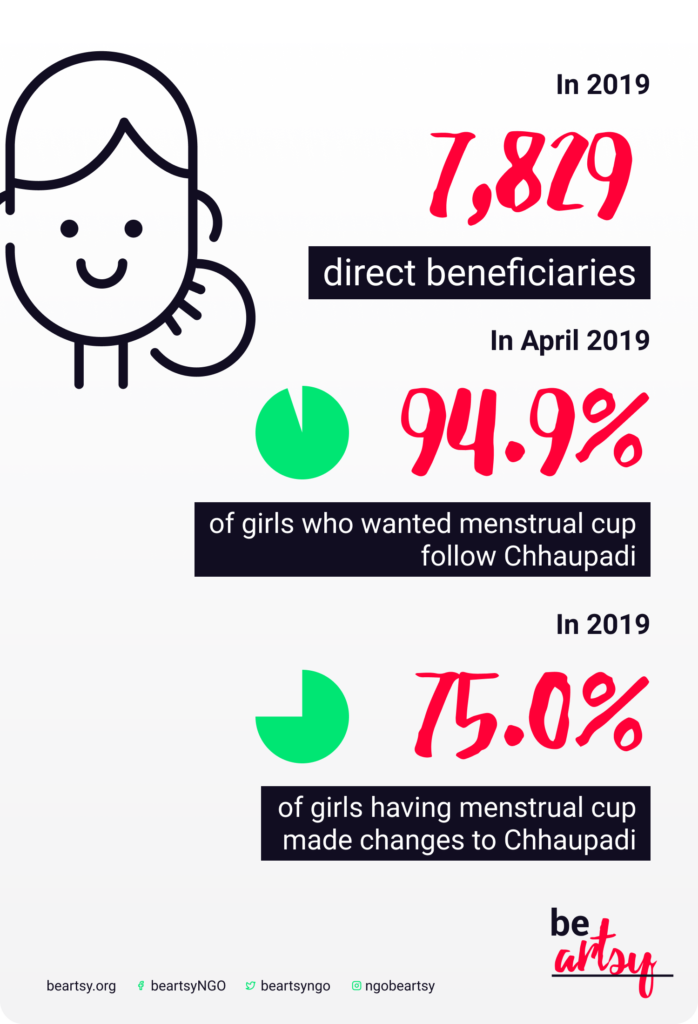
    We teach menstrual health management, reproductive and sexual health education workshops and activities to involve communities. We also teach photography workshops to facilitate the expression of the girls, film screenings, and meetings with the municipal authorities and religious and spiritual leaders of all the villages. In the course of the project, in 2019, we have distributed 1,467 menstrual cups to school girls and young women. They received menstrual cups, a metal bucket to boil the cup, and soap. Work was done on how to use it. 7,829 direct beneficiaries were reached during 2019.

    In the face-to-face follow-up, every two months, with the users of the menstrual cup, the trainers and local mentors and coordinators helped. We also took into account girls who do not use menstrual cups, to assess the difference between girls who use them and those who are not users, and to see if the tradition of chhaupadi can be changed only through education.

    The results

    Talking to the girls, we saw that a very high percentage use the cup, even six months after training. And they would recommend it to other girls. 94% of the girls explained that they followed some type of menstrual restriction before and after the training and implementation of the cups, but when asked if the tradition has changed since then, 75% of the girls reported having made changes in the chhaupadi tradition.
    Some girls reported changes in access to food: now they can eat vegetables, some can eat fruit, and some can drink milk. Some girls reported that, after participating in our workshops, their mothers allowed them to have a thicker blanket in the Chhaupadi hut and since they do not stain, they do not have to be washed every day. Most of the girls said that they no longer have to sleep outside when they have their period, since nobody knows that they are menstruating. Some girls sleep in separate rooms and some still practice chhaupadi, but now they feel clean and safe. Some also reported that since workshops and training they are no longer required to participate in chhaupadi exclusion practices and are now allowed to cook and eat. They mentioned that they are now allowed to touch the animals at home, some girls no longer hesitate to touch water sources or visit the temple without hesitation, or reported that they feel comfortable going to school when they have their period, since the use of the cups nobody can tell if they are menstruating or not. They also believe that it is easier to work when using the cups. The women who agreed to talk about their experience said that they feel much cleaner using the cups, since the blood does not leave their body. These girls and their families also feel safer, and also because they don’t have to wash their clothes due to blood stains.

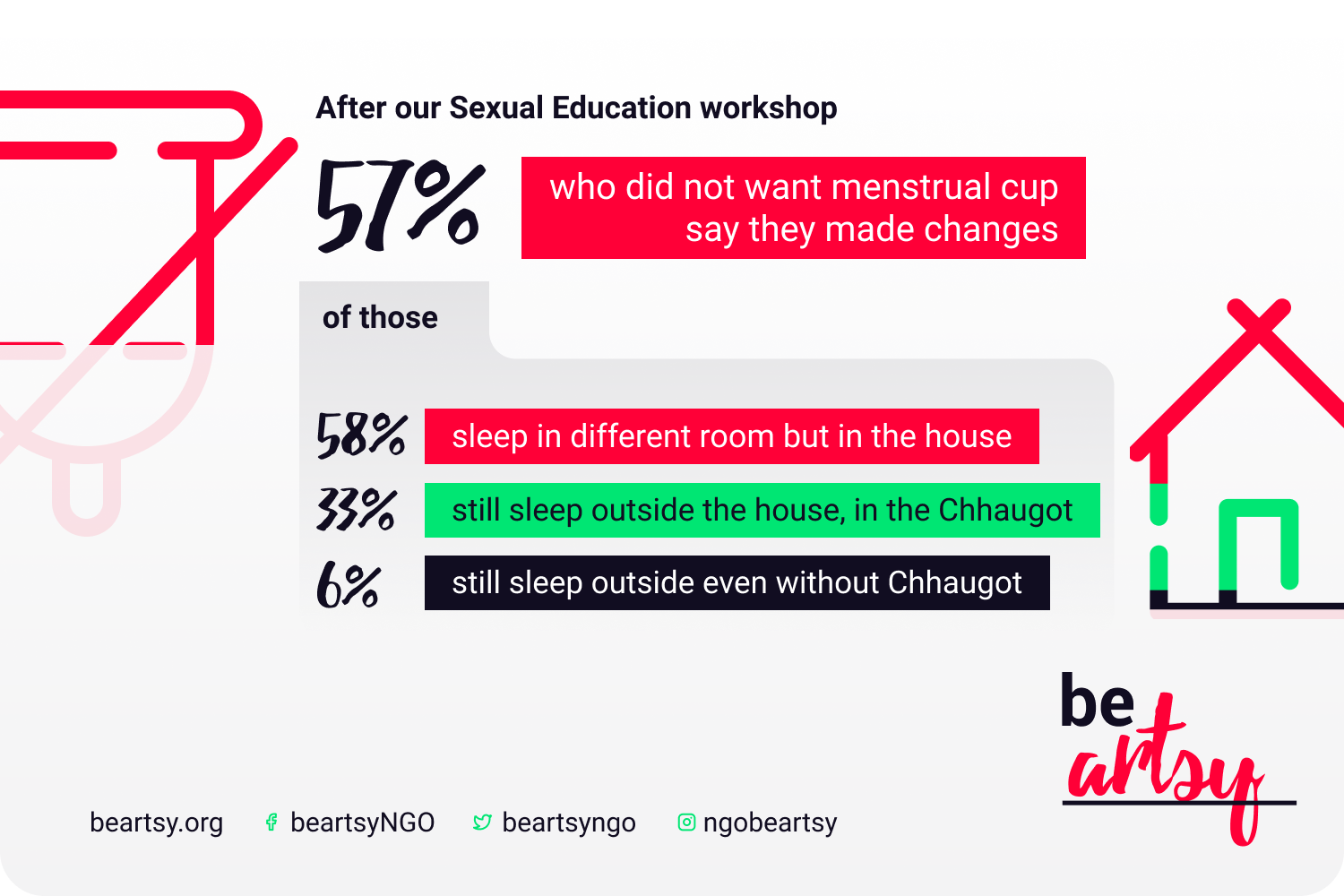
    It is important that girls who do not use the menstrual cup have also undergone changes since we started training in menstrual health management. 57% of these girls have made changes during menstruation. Like the girls who use the cup, they revealed that after the training workshops we did they were able to touch the animals. eat vegetables or drink milk, sleep in their bed indoors, in a separate room, have a thicker blanket if they continue sleeping in a hut, touch water sources. 58% declared to be in a separate room inside the house, while 33% still sleep in a chhaugot and 6% even sleep outside, despite having no chhaugot.

    This year we have managed to maintain the presence of 4 different teams, working on the ground simultaneously. Thanks to the goodwill of the trainers, the monitoring of the project went well, and we were able to obtain many comments from the beneficiaries. Survey findings show that our initial idea that cups can break the taboos surrounding menstruation and chhaupadi works.

    In 2020 the project will not be expanded to many other towns. We will try to reach more women and help them stop chhaupadi, assisting and encouraging them with the help of mentors and training visits.
    Our area staff will be made up exclusively of local girls – from Achham. It is important to highlight that the local counterpart of the year 2020 is made up of women committed to the project, who have created a social company . Specifically, we are talking about three Nepalese women who have worked with our 2019 counterpart throughout the year. They have been trained to work on these types of projects and to know how to raise funds from cooperation organizations around the world and from private entities, and in generating their own capital. Thus, the project can be managed more efficiently, and we can have trainers in each municipality who will take care of their menstrual cups’ users and actively promote awareness of the chhaupadi problem throughout the year. You can read the document with all the details of the evaluation of the 2019 period here.

    Text by Clara Pinilla and Josep Marín

    For just €1.80 a day you can change the future of a girl and prevent her from being forced to marry at 14 years old!

    There are several ways in which you can get involved and sponsor a girl in Achham:

    Teaming Group: 1 euro a month – become part of Rato Baltin Project!

    Teaming Group: 1 euro a month – become part of the team and get your friends to help you sponsor her and avoid early marriage!!

    Regular donation: to https://donorbox.org/againts-chhaupadi

    Become a member: https://beartsy.org/associate/

    🙂 Thanks!

  • Don’t miss the exhibitions about Rato Baltin!

    Don’t miss the exhibitions about Rato Baltin!

    Lately we have been talking about the exhibition in networks, we want to introduce you.

    Exposició sobre Rato Baltin


    The idea of mixing the photos that girls have been taking during the Rato Baltin project with photographs of creative women from here was by Magda Gavaldà.

    The exhibition, actually 2 different exhibitions and one installation, are mixed with talks by Clara Garcia Ortés or some other person from the association.

    The first exhibition is in foam, and will hover for different libraries of Barcelona, or nearby, for a long season. It is the one that can now be seen in Poble Sec (Biblioteca Poble Sec-Francesc Boix) until December 10, and from December 11 it can be seen in Cornellà.


    The second one has the form of roll-up and did not arrive in time to Tona (Donaveu Associació de Dones de Tona – Biblioteca Caterina Figueras), which self-made an alternative and fantastic one, but if you want, you can enjoy now in the Biblioteca Volpelleres Miquel Batllori of Sant Cugat.


    Exposició sobre Rato Baltin


    The artistic commissioner of the exhibition is in charge of Alba Metzger and it has not been an easy job to link such different ideas in a single exhibition.

    So far we have had the help of Núria, Paula and Laura for the assembly. In future exhibitions, we will have more volunteers!

    You can see the installation in the windows of the Library Clot – Josep Benet (in the building of the Design Museum), until the end of December, and has been in charge of Viviana Sansone (the videos have been prepared by Marina Gallego).


    If you are in Barcelona, you can come and join us the 17th December at 18:30 h!


    Thanks so much to all the people involved, and please, if you want to get involved or host the exhibitions, installations and talks in your town, or want to help us in the assemblies, get in touch with us! info@beartsy.org

    Thank you all for the fantastic welcome!

    Join our project! We need you more than ever: https://beartsy.org/associate

    West Nepal girls need this kind of program. And we need help to continue the project!

    Paypal recurring donations:

    Select a Donation Option (EUR)

    Enter Donation Amount (EUR)

    Or if you feel like it, you can donate via bank transfer at: Banc Sabadell IBAN: ES23 0081 0900 8200 0430 1934 BIC: BSABESBB (your recurring donation will help us have a better planning of our budget to carry out the projects undertaken).

    Or take a look to others ways to donate at http://beartsy.org/get-involved-with-rato-baltin/   or https://beartsy.org/become-an-associate/
    Thank You! 🙂

  • Travel Log – Ruby cup training at Rachuli. Once again, total success!

    Travel Log – Ruby cup training at Rachuli. Once again, total success!

    4-6-2017 

    The menstruation cup training that we have set at Rachuli, exceeded all expectations. We have spent, so far, 10 days in town, talking with the ladies and girls, teachers of both sexes, and trying to reach out to the men. to talk with the men…

    The girls were asked to talk with their parents about the concept of using a menstruation cup and ask them for their permission. Mothers are talking to us too.

    Every day we dedicate a while to stroll around the villages so they can be able to ask us questions about whatever they want.

    At first, opposite to what we experienced in Achcham, there was some resistance to agreeing with our concept; however as the training day approaches the list is growing and once again we have a waiting list for girls to receive the menstruation cup.

    For the very first time local teachers and nurses attended the training together with the girls. We have found this to be effective as teachers and nurses will be able to control better its use in front of their students.

    Instructions were also given to the Primary Care Centre, following a discussion with the management, including a list of the cup users. This way the girls using the cup can be better monitored and in case there are issues with the cup or its use, they are quickly detected.

    I never get tired repeating this to them: “Clean your hands with soap, clean the cup with clean water directly to its bucket and if possible, boiled water. And boil the cup once menstruation has gone, a minimum of 5 minutes.”

    The team, jokingly, said that I should get that tattooed on my face, 😉 I am considering to prepare a banner which I could hang up during the workshops; so the girls will thinking about the cup, with the constant message of using very clean water, soap, and boil routine!

    Written by Clara Go. Photos done with FUJIFILM X-Pro1 © Clara Go
    Translated to English by Dominic Ramirez and Corrections by Hannah Cremona.

    West Nepal girls need this kind of program. And we need help to continue the project!

    Now you can donate for paying one month salary to the nurse, or for some hygiene kit or for the menstrual cup control in September: http://beartsy.org/get-involved-with-rato-baltin

    Or If you feel like it, you can donate via bank transfer at: Banc Sabadell IBAN: ES23 0081 0900 8200 0430 1934 BIC: BSABESBB (your recurring donation will help us have a better planning of our budget to carry out the projects undertaken).

    Or take a look others ways to donate in http://beartsy.org/donate/

    Thank You! 🙂

  • Travel log – First conversation with a group of women in Rachuli (Kalikot)

    Travel log – First conversation with a group of women in Rachuli (Kalikot)

    26-5-2017.
    Our contact people in the area (all male) told us that here there was no Chhaupadi unlike in Achcham: that there are no special huts for women on their period, that they have a room inside their homes. However, during our journey we saw a few of them. There are some characteristics that make them easily recognisable: the plate to eat outdoors, the clothes in the sun, the door without any kind of lock.

    Our first conversation with a group of women was really interesting. At the beginning, we talked about superfluous things, they laughed with us and made questions to me and the nurses; until the moment they asked what were we doing here. With the nurses we have an agreement to never utter the word Chhaupadi or talk about the tradition, so our answer was: we are coming to the school to develop a programme about menstrual hygiene and sex education. We did not mention menstrual cups either.

    Right away they asked if we had brought something to give them. Our answer was: No. We have come to teach about menstruation. They started talking about menstruation, about what they do: depending on which house, there is a local divinity: if you have this god at home, you cannot be there while you are on your period, and you have to sleep with the animals. But only if you have this god (I need to find out how they decide whether there is such god in the houses or not). They can eat fruit, but not touch the fruit trees. They cannot drink cow milk, but they can drink buffalo milk. They cannot touch any male relative, not even their parents or eldest sons (they can touch the younger ones). No one else can touch the plates they used for eating, someone else has to give them the food and water they need. They cannot get close to the temples…
    The women without a local god at home can stay inside, but just in a special room for them. They cannot go out. The food and drink are brought inside by other members of the family.

    Next, and for the first time since we started project Rato Baltin, they kindly invited us to follow the rules in town, and asked us not to go into the school or temple if we were on our period. If that were the case, we would have to go back. Oops!

    In no occasion did they use the word impure, chhau, chhaupadi or anything similar. I do not know if it was because the nurses used the technical term, following the style of the girls, or because here they do not even name it, the Chhaupadi. We will have to see the pictures resulting from the participative photography workshop: let’s hope they will get more open towards us.


    Written by Clara Go. Photos done with FUJIFILM X-Pro1 © Clara Go 
    Translated to English by Regla Maria López / Alba Miquel

    West Nepal girls need this kind of program. And we need help to continue the project!

    Now you can donate for paying one month salary to the nurse, or for some hygiene kit or for the menstrual cup control in September: http://beartsy.org/get-involved-with-rato-baltin

    Or If you feel like it, you can donate via bank transfer at: Banc Sabadell IBAN: ES23 0081 0900 8200 0430 1934 BIC: BSABESBB (your recurring donation will help us have a better planning of our budget to carry out the projects undertaken).

    Or take a look others ways to donate in http://beartsy.org/donate/

    Thank You! 🙂