Author: Josep Marín

  • Travel log – Chhaupadi in Rachuli – Kalikot – Karnali Zone – Nepal

    Travel log – Chhaupadi in Rachuli – Kalikot – Karnali Zone – Nepal

    Photographies made by the students of the participatory photography workshop #breakthesilence © of each student.

    7-6-2017

    We have not yet found in Kalikot anybody referring to the tradition using this name, they call it “Chuii” “Chuiigoath” or “Chuiighar”. But as to existing, it does exist the same. Maybe the conditions seem better (in Rachuli, so do they think), because depending of the houses the women are in a separate “room”, on the lower floor. But it is usually an old cowshed without door or any safety measures. Some dispose of a bed, but those are the chosen few. The most usual is that they sleep in the shed on straw, next to buffalos and cows.

    Kalikot is very different to Achcham, Karmali Zone is full of men, it is not like in Achcham where most of the men head of the families work in India. Here they work at home, and the traditions regarding the women are kept by them. Male chauvinism is even more present and noticeable than in Achcham.

    We have held several conversations with fathers who said that they didn’t like what we were doing at the schools. That to explain that the girls, during their period, have to eat better and not to deprive themselves from dairy products, was against what the gods wanted and was absolutely no good.

    At school we tried to teach class without giving out our opinion. When they explain that they don’t like going to the shed, the maximum we do is to have them thinking hard about what would happen if they wouldn’t. The ideal is that they reach the conclusion themselves that this, is a superstition.

    What we actually did talk about in class is women’s rights, equality, of how not to let them enter a temple, for example, is a breach of human rights, as they are not allowed the freedom of worship and religion that men do enjoy.

    The sensation remaining from Rachuli is that we have not been able to go deeper in this matter in this villaje. We haven’t been able to form a group of women, just the one of girls, because of the high amount of work they have at this time of the year, and we have got it clear that there are many things that the girls ignore.

    In our next visit, we know that we have to do better. Now we know how the Karnali Zone works. It is clearer that, apart from the women and girls groups, we have to speak with the men. Would it be folly to prepare a workshop for them? Something to think about. Tomorrow, on our way to Chilkhaya! 🙂

    Written by Clara Go. Photographies made by the students of the participatory photography workshop #breakthesilence © of each student.
    Translated to English by Tere Salinero

    West Nepal girls need this kind of program. And we need help to continue the project!

    Now you can donate for paying one month salary to the nurse, or for some hygiene kit or for the menstrual cup control in September: http://beartsy.org/get-involved-with-rato-baltin

    Or If you feel like it, you can donate via bank transfer at: Banc Sabadell IBAN: ES23 0081 0900 8200 0430 1934 BIC: BSABESBB (your recurring donation will help us have a better planning of our budget to carry out the projects undertaken).

    Or take a look to others ways to donate in http://beartsy.org/donate/

    Thank You! 🙂


  • Travel log – We just started #BreakTheSilence – Participatory Photography

    Travel log – We just started #BreakTheSilence – Participatory Photography

    31-5-2017.

    We already have the first results form our participatory photography workshops. Seeing how girls start freeing themselves and start explaining things through photography is exciting. The first thing that surprised us was that most of them are convinced to follow the tradition. There are few Chhaupadi huts here, most girls sleep in the cowshed or in “rooms” on the ground floor of their homes. Most don’t have a door or any safety measure, as well as all the inconvenience of Chhaupadi in Achcham. The weather is probably colder than in Achcham, it is windy, and there is water everywhere.

    Nobody has told us yet that they do it because of social pressure, which is what we were told in Achcham. Here, it really looks like they do it because of their faith. During the workshops, they spoke about “impure” blood, but they do not mention the word Chhaupadi or Chhau. They do use the word Got, but not Chhaugot, they only call it Got.

    We think it will be even more difficult to deal with the issue here. Luckily, this time we will spend longer in each town, and so far we are establishing a very beautiful relationship with girls and women. They are all very interested. Yesterday, some women who were around joined the lessons, and today we had more than 60 girls at the workshop for over 11-year-olds we do after school – this, even though it was the day they were sorting the grain from the hay! It is a day when boys work in the morning and girls help out in the afternoon (even though it is the women the ones who sow and harvest the grain).
    Let’s bear in mind that it is one of the areas in Nepal where malnutrition is highest – and, therefore, has one of the highest rates of infant mortality. They mainly live off agriculture. Now is the season for harvesting wheat, and we are witnessing how everything is done manually. This makes me think of my grandma telling me what granaries and plots were for in country houses. Here I am seeing how everyone works in the plots.

    We are hoping to find out more in the next few days, and manage to sow the seed of doubt regarding superstitions. Today we also introduced the menstrual cups and have told them we have a few for a pilot project. They are all very interested in it. I think tomorrow morning we will have a long queue to sign up on the list. The ones who do not get one will be registered in the waiting list for next time. K Garne? 😉

    Written by Clara Go. Photos done with FUJIFILM X-Pro1 © Clara Go
    Translated to English by Alba Miquel

    West Nepal girls need this kind of program. And we need help to continue the project!

    Now you can donate for paying one month salary to the nurse, or for some hygiene kit or for the menstrual cup control in September: http://beartsy.org/get-involved-with-rato-baltin

    Or If you feel like it, you can donate via bank transfer at: Banc Sabadell IBAN: ES23 0081 0900 8200 0430 1934 BIC: BSABESBB (your recurring donation will help us have a better planning of our budget to carry out the projects undertaken).

    Or take a look others ways to donate in http://beartsy.org/donate/

    Thank You! 🙂

  • Travel Log – The day the children of Rachuli learned how to speak Buffalese!

    Travel Log – The day the children of Rachuli learned how to speak Buffalese!

    28-5-2017.
    7 days after leaving Kathmandu we were able to start teaching at the school. Our first school day at Rachuli’s school had cracking-up moments.

    We started with 10th grade, which means some of the students were 17 years old, only 3 years younger than the two nurses we hired. Being so close in age created a previously unseen complicity with the class. Both boys and girls made enquiries and intervened a lot in class; including some fun moments such as when they were trying to guess how many holes female organs have. Answers varied between 2 and 4! 🙂Very few students said 3.

    Other fun moments were related to the fact that our nurses were nervous and did not remember certain words in Nepalese, so they had to ask students! Or when talking about the clitoris and I took the chance to make comments a Nepalese woman would never dare say… these are advantages of being a foreigner: I play “dumb” and say or ask things they would never do.

    After class I went for a walk with my camera and a parade of women and girls came with me. When we were back at my home’s front door, we met the nurses and, suddenly, as we were bidding farewell to my “following”, we heard a buffalo “shouting”. I started imitating it, and the buffalo “replied”, so I went on and ask the nurse to translate to children the following: “Don’t you at Rachuli speak Buffalese? I do!”; and I went on imitating the buffalo’s cries. It really did sound as if he were replying to me. The children and women cracked up, even though they were not completely sure whether I did understand what the animal was telling me! 🙂 Cool.

    Later on, when our “Didi” (Sister) was coming to call us for dinner, it so happened that I opened the door at the same time as she got there. When I ran into her, small and in the dark, telling me “Didi khana Khane” (Sister, come to eat rice!), I screamed in fear, she got startled as well as the nurses in the room, followed by great laughter afterwards. 😀

    There are days so special in this country, that they make you forget how hard sleeping on the floor is, or the rough roads and 5-day journeys, and boring dhal bat (rice with lentil or bean soup. Here, with beans , beans,lentils are not local) twice a day.

    Written by Clara Go. Photos done with FUJIFILM X-Pro1 © Clara Go
    Translated to English by Alba Miquel

    West Nepal girls need this kind of program. And we need help to continue the project!

    Now you can donate for paying one month salary to the nurse, or for some hygiene kit or for the menstrual cup control in September: http://beartsy.org/get-involved-with-rato-baltin

    Or If you feel like it, you can donate via bank transfer at: Banc Sabadell IBAN: ES23 0081 0900 8200 0430 1934 BIC: BSABESBB (your recurring donation will help us have a better planning of our budget to carry out the projects undertaken).

    Or take a look others ways to donate in http://beartsy.org/donate/

    Thank You! 🙂

  • Travel log – First conversation with a group of women in Rachuli (Kalikot)

    Travel log – First conversation with a group of women in Rachuli (Kalikot)

    26-5-2017.
    Our contact people in the area (all male) told us that here there was no Chhaupadi unlike in Achcham: that there are no special huts for women on their period, that they have a room inside their homes. However, during our journey we saw a few of them. There are some characteristics that make them easily recognisable: the plate to eat outdoors, the clothes in the sun, the door without any kind of lock.

    Our first conversation with a group of women was really interesting. At the beginning, we talked about superfluous things, they laughed with us and made questions to me and the nurses; until the moment they asked what were we doing here. With the nurses we have an agreement to never utter the word Chhaupadi or talk about the tradition, so our answer was: we are coming to the school to develop a programme about menstrual hygiene and sex education. We did not mention menstrual cups either.

    Right away they asked if we had brought something to give them. Our answer was: No. We have come to teach about menstruation. They started talking about menstruation, about what they do: depending on which house, there is a local divinity: if you have this god at home, you cannot be there while you are on your period, and you have to sleep with the animals. But only if you have this god (I need to find out how they decide whether there is such god in the houses or not). They can eat fruit, but not touch the fruit trees. They cannot drink cow milk, but they can drink buffalo milk. They cannot touch any male relative, not even their parents or eldest sons (they can touch the younger ones). No one else can touch the plates they used for eating, someone else has to give them the food and water they need. They cannot get close to the temples…
    The women without a local god at home can stay inside, but just in a special room for them. They cannot go out. The food and drink are brought inside by other members of the family.

    Next, and for the first time since we started project Rato Baltin, they kindly invited us to follow the rules in town, and asked us not to go into the school or temple if we were on our period. If that were the case, we would have to go back. Oops!

    In no occasion did they use the word impure, chhau, chhaupadi or anything similar. I do not know if it was because the nurses used the technical term, following the style of the girls, or because here they do not even name it, the Chhaupadi. We will have to see the pictures resulting from the participative photography workshop: let’s hope they will get more open towards us.


    Written by Clara Go. Photos done with FUJIFILM X-Pro1 © Clara Go 
    Translated to English by Regla Maria López / Alba Miquel

    West Nepal girls need this kind of program. And we need help to continue the project!

    Now you can donate for paying one month salary to the nurse, or for some hygiene kit or for the menstrual cup control in September: http://beartsy.org/get-involved-with-rato-baltin

    Or If you feel like it, you can donate via bank transfer at: Banc Sabadell IBAN: ES23 0081 0900 8200 0430 1934 BIC: BSABESBB (your recurring donation will help us have a better planning of our budget to carry out the projects undertaken).

    Or take a look others ways to donate in http://beartsy.org/donate/

    Thank You! 🙂

  • Travel log – The way to Rachuli (Kalikot)

    Travel log – The way to Rachuli (Kalikot)

    May 25, 2017.

    Getting to Rachuli (pronounced RAH-chuli) took us 5 days. At the moment of writing this, I can’t imagine having to leave this place. The ways to get up here are mountain roads with very few paved parts. There are lots of rocks all around, landslides everywhere, heavy rocks in the middle of the way and fine sand in some areas. The rainy season is starting, we will see how it goes.

    To begin with, since it is spring in Kathmandu and therefore very rainy, all my luggage containing the workshop materials has been water-proofed. In local buses luggage is stacked on top, so I wrapped it in plastic, just in case it rained.

    On the fourth day of our journey, when we arrived to Manma (Kalikot), the bus stopped at a hostel by the bus station, and we were told to get out: we would stay there cause the night bus was not working. We checked the rooms and noticed they were horrible, but it was what was available. Staying there meant not having to unload all the stuff from the bus. We only took some personal items, the camera and the laptop.

    At 5 am, when we woke up, there were 15 cm of water in the room. My backpack containing my camera and laptop was soaked. The nurses’ clothing too. My mind had warned me about water… but never did I think water would come from the ground and not from the ceiling. I could not kill the man form the hostel, he said the water was clean, it came from the deposit which had overflown… In this sort of situations I would like to take the way of doing things in Nepal and break it in a million pieces.

    But I did not. I paid for my room and we went on to Rachuli: all soaked and amazed by the landscape. The name of Karnali Highway started to take a different dimension. These were incredible hills, framed with frightening sharp edges and heights which kept zig-zagging its way up and down.

    When we finally got there and stepped out of the bus, there was nobody to be seen. We enquired about the house we were staying in and it was just there. An old man helped us carry our stuff and Didi cooked us lunch…

    Written by Clara Go. Photos done with the phone © Clara Go
    Translated to English by Regla Maria López / Alba Miquel

    West Nepal girls need this kind of program. And we need help to continue the project!

    Now you can donate for paying one month salary to the nurse, or for some hygiene kit or for the menstrual cup control in September: http://beartsy.org/get-involved-with-rato-baltin

    Or If you feel like it, you can donate via bank transfer at: Banc Sabadell IBAN: ES23 0081 0900 8200 0430 1934 BIC: BSABESBB (your recurring donation will help us have a better planning of our budget to carry out the projects undertaken).

    Or take a look to others ways to donate in http://beartsy.org/donate/

    Thank You! 🙂


  • Online Supportive group for Nepal #sintabumenstrual

    Online Supportive group for Nepal #sintabumenstrual

    Written by Clara Go.
    Translate to english by Tere Salinero


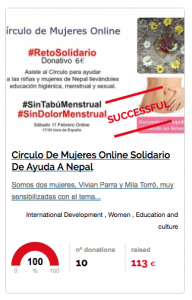
    A few days before returning to Nepal, I participated in a women’s group organized by Mila Torró (From Círculo Afrodita) together with Vivian Parra, to help us gather funds for the Rato Baltin Project.

    For me it was a very special day, the last one I was going to be with my family: I remind you that I had just arrived from Chile and I spent only four days with them.

    The event was organized online, using a program with which a lot of women could connect to the meeting. The donations for the project were arranged through migranodearena and that way the money arrived straight to us.

    It was a very touching and special moment.

    I want to thank to all the people who contributed with donations and to the women who participated in the event, and I hope to see all of you soon in some other activity of this kind. Do count with me for anything!

    Thanks a lot!

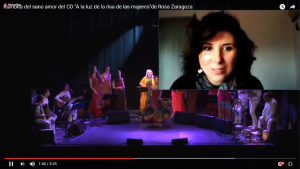
    I leave here the video that so kindly they posted in their youtube channel, if you want to enjoy the experience!


    And I remind you that if you want you can organize your own event in you area to help with the Rato Baltin Project, which, as you know, is a long term project and we expect to work on it for some years. In https://www.migranodearena.org/en/create-your-challenge

    We still need your help to raise funds to continue with our project. You can donate at: https://www.migranodearena.org/en/challenge/13821/rato-baltin-nepal—facing-chhaupadi-with-menstrual-education/

    You may make a one-off donation or become a regular contributor by making regular transfers (monthly, quarterly or annual) for the amount you wish.

    Bank transfer to the following bank account:

    Account Holder: Associació be artsy

    Bank: Banc Sabadell

    IBAN: ES23 0081 0900 8200 0430 1934

    BIC: BSABESBB

    Re: One-off donation / Regular donation (whichever applies).
    (Your Recurring donation will help us have a better planning of our budget to carry out the projects undertaken.)


    Thanks a lot!

  • Kunti Bandali. Trodden path.

    Kunti Bandali. Trodden path.

    Written by Alba Maria Campos, Spanish volunteer nurse, specialised in family and community health
    Translate to english by Tere Salinero corrections by Alba Miquel
    Photo done for Kamal Bhattarai with X-pro1 © Clara Go

    “I have learnt to think like I was taught to and I even got to believe that it is me who thinks. I find it difficult to understand that all I do is just start a thinking mechanism with patterns and embedded circuits. That is why it is hard for us to accept what goes against what we have previously learnt. All I have absorbed only makes me inflexible and places me, tyrannically, at the service of the cultural group that has trained me”.

    We left Basti in the direction of Kunti Bandali on Saturday the 11th of March. We passed by the house of the kid whose head had been injured the prior day. He was still bleeding a bit. The woman had gone to the hospital with her husband and we could not see her. Alba and I went ahead, silent for a good while, digesting all we had seen in Basti during the past few days. At the start, the uphill incline seemed impossibly hard… In the end, it was not that bad. We stopped to eat some hard boiled eggs, a tuna can coming from Lumbini, and a bag of raw noodles. After a three-hour walk, we stopped for a chia… We only had bagged noodles for food… I am absolutely not keen on packaged meals… I would have rather had a DalBat and Tarkari (although I had had enough of it already for a lifetime). Damned progress… Reaching even farther than the roads!!!!

    As we were finishing eating, a tractor appeared, full of drums and… Alba and I saw the light: this would be our transportation to Kunti Bandali!!! We asked Kamal to enquire if it would be possible for us to climb in the wagon to get to the place. Alba, Samita and myself shared the wagon with some of the girls from the school. To be honest, it was good fun!!! Thankfully, we didn’t have go by foot. It would have meant a few more hours walking.

    We reached the village. The houses and shops were made of tin, which didn’t make for a nice sight. We barely saw any women on the street. There was a very nice boy with a naughty face, very dirty and thin, who was forever working on something: cleaning, minding the goats… or helping the drunks get home… Below the house there was always a group of men wobbling around a big garbage bin full of bottles of Roxi. The place was horrible. Drunken men ambling around the whole day, the kid attending his chores and working for them, always looking happy, and the women carrying tons of stuff over their heads, whilst the girls walked past holding rocks in their hands “just in case”… They knew very well what they were doing by that.

    This small boy, like many others, did not attend school. So we were not reaching all the population, just the “civilised” part (this word is not to be always taken as a positive one). But there was another part of the population who would never have the “privilege” of education. We saw it in Basti more than in here, many young girls who were barely 7 or 9 would cart their young siblings around in their arms and lingered in the school playground whilst other children their age were in class.

    The teachers seemed to be more involved here than in Basti, they interacted more with us. We also encountered a couple of classrooms who were not very receptive. On the first day, we discovered that, that same year, UNICEF had been around with a project against Chhaupadi that, we gathered, had caused quite a lot of damage… The women, organised here as “health volunteers”, were distinguishable by their blue saris. They asked Clara if they would be given money for posing for the pictures and attending the lectures, like UNICEF had done. When one of them told us, we were flabbergasted. Money, really??? We also met one in a classroom, the one for the youngest girls, who was the only one who did not give any importance to how they lived the menstruation, and did not say anything either about what they may like less about their usual practices during their period… So we continued talking, sharing information on periods, sexuality and menstrual cycle, just touching very lightly on Chhaupadi… if they did not want to change things, not much to do then!!! In any case, we had the impression that they came very well trained from home.

    The women, throughout the pictures, showed different traditions when practising the Chhaupadi. Here, they could not touch any fountain or take a shower. A woman took a photograph of the moment when a baby who had slept with his mother – who was on her period – in the chaughot, was purified in the morning with a bath, and once purified, another woman took him and cared for him during the day. Another photograph showed that the cutlery they used for their meals during those days could only be used by them, not by other members of the family, and they were left outside the chaughot, never inside.

    When we left KB, I discussed with Alba Clara’s reply when we sent her the program: she said that it was too “daring”. Whereas she and Pepa laughed at the “pussies” in the signs were were going to put up in the classes, Alba and I were convinced that everything would go fine and were very happy about how we had prepared things. And thus it was, neither in Basti nor in KB we changed a single iota of the contents and on the spot we added some dynamic depending on the participation of the classroom… I must also say that Nepalese boys and girls are real stars when it comes to behaving  themselves. We have so enjoyed working with them!!! It would have been great to establish a deeper bond and share more things, which are so far from their school programs as from ours… 

    Sharing other perspectives about menstruation, sexuality or masturbation with other nurses and knowing the superstitions that they themselves also practice was also very gratifying. In the end, they will surely be generators of changes wherever they may educate. I was surprised when Susmila told me that, contrary to my belief, it was more convenient that it was us who came do the workshops than they themselves doing them, because they do have similar superstitions and traditions as well. From the youngsters point of view, apparently, us being “white”, must obviously mean we are right in what we say, and we are more convincing. At that moment I saw myself as the “symbol of the progress” that I so much rejected, and I didn’t like it a bit. We continued talking about the future, marriage and motherhood, and she extended my replies to all the women in the peninsula. I asked her not to create in her mind an image of the West just by looking at us, as it would be an erroneous one, given that we are not at all a representative part of it.

    I am very proud to have been a part of all this process. Not because of the paradox that representing the “selfishness in helping others to feel better and so my entourage acknowledges my inner goodness” thing… but because it is one of the deepest learnings life can offer you: from how to communicate with somebody who does not speak your language (not even near likely), to how you can be happy without delving into the extreme consumerism of the Western world; that happiness has nothing to do with the consumerism-driven happiness we are being sold; learn simple things like having a shower in the school fountain, do the laundry by hand, wipe your butt with your hand or throw your snot into the air as toilet paper has not yet reached these boundaries; learn to respect the values and traditions of a culture that is very much different from our own and that, really, we are nobody to impose any changes, unless they really want to do it. And I decided to soak it in as much as possible without judging it from a Western perspective.

    Learning to work in a multicultural team with the Nepalese-English-Spanish language barrier has also been a real challenge. To learn that, when you are part of a team, assuming “power roles” because it is the easiest way to manage does not lead to anything good. Because in a team, all voices must be heard, also those who remain silent because of fear, lack of confidence, shyness or the “cultural baggage” to say yes to everything and not complain. Also learning to detect barriers and try to break them down instead of making them bigger, to create new opportunities. To learn to sleep properly, to go to bed at a time I would have never imagined and then rise up early with no trouble, something that in Spain was unthinkable of; to learn to disconnect from the world, to live perfectly well without internet, to dispense with so many external stimulations and influences that are thousands of kilometres away, and see that you are much better that way than with the over-connection we are used to.

    Learning to be at peace, to take the plunge and do things that I had always wanted to do, like percussion instruments, macramé, writing and developing my introspective skills, to evolve and know myself better, or simply enjoy an Indian biri whilst I admire the views… Something for which I did not have time in Barcelona. Or to learn to trust in myself and, above all, learn to adapt to any, and I insist, any, event.

    I think that we are developing a really huge adaptive capacity… from plan changes concerning Nepal that forced us to reshape everything at the last minute, to difficult temperatures, food and odd smells.

    “To withstand uncertainty”… I will never forget this sentence…

    Thus, this capacity of adaptation and acceptance of given circumstances is something we should accept from this culture. There are times when this “conformist” or “passive” attitude is seen as something “negative”… So what, is the nonconformity and self-demanding level of us Westerners better? To want more and more from everything every passing day? To compete constantly to fulfil the needs they create in us? There is still a lot of room for reflection…  And we haven’t got any right to judge. 

    Kunti Bandali. Trodden path.

    Please remember we still need your help to raise funds to continue with our project. You can donate at: https://www.migranodearena.org/en/challenge/13821/rato-baltin-nepal—facing-chhaupadi-with-menstrual-education/

    You may make a one-off donation or become a regular contributor by making regular transfers (monthly, quarterly or annual) for the amount you wish.

    Bank transfer to the following bank account:

    Account Holder: Associació be artsy

    Bank: Banc Sabadell

    IBAN: ES23 0081 0900 8200 0430 1934

    BIC: BSABESBB

    Re: One-off donation / Regular donation (whichever applies).
    (Your Recurring donation will help us have a better planning of our budget to carry out the projects undertaken.)

  • International Women’s Day in Basti: recap after of our first week of workshops

    International Women’s Day in Basti: recap after of our first week of workshops

    After one week in Basti, 50 hours of workshops, 25 menstrual cups handed to women in town and lots of emotional conversations with women of all ages, on March 8th we were invited to be part of the celebrations on occasion of International Women’s Day.

    For the second year in Basti there is a big celebration with women from all Ward (villages) of the VDC (municipality). The event is organised by the women’s awareness group with the support of the Nepalese government. There are song competitions, speeches by health volunteers, by the 3 women’s groups, all the principals of the 4 local schools and local politicians from the 5 main political parties.

    The first thing we saw where the celebration was taking place, was an old sign from the government welcoming visitors to “Chhaupadi-free Basti” VDC. During our stay here, we have seen lots of chhaugots (Chhaupadi huts) and the women have been speaking and taking lots of pictures related to Chhaupadi, even though we did not specifically ask for it.

    When the women arrived they were chanting mottos such as: “let’s finish violence again women”, or “let’s make women’s day successful”. After that, the “Deuda” competition began: Deuda is a cultural song, and every ward has their group. In the songs they spoke about:

    – Chhaupadi being a bad tradition.
    – Problems related to Chhaupadi.
    – Violence against women in the village.
    – The importance of being able to eat dairy products during menstruation.
    – Destroying Chhaugoats is not the only solution: there is a need to
    change people’s beliefs and mentality.
    – If people respect pregnant women, they need to respect and
    take care of menstruating women, too.

    The conclusions of the speeches by various guests:

    – Women have to be aware of their rights.
    – Women are the ones that build chhaugoats, they are responsible for them, and they can also change whatever they want.
    – Low caste women have more problems with everything.
    – Society is slowly changing, but if they want quick changes related to women issues, women have to take responsibility and stop following certain traditions.
    – Women have to stop violence amongst themselves in instances such as:
    -Low Caste vs High Caste
    -Mother in law vs Daughter in law
    – Women need support from men to build self-confidence
    – Social rules are made by men, so only blaming women is not fair
    – Therefore, men’s contributions are essential too to change society.

    We must keep working, but up to now we are really happy with the results obtained and the dialogue generated with our workshops.

    Please remember we still need your help to raise funds to continue with our project. You can donate at: https://www.migranodearena.org/en/challenge/13821/higiene-menstrual-en-nepal—chhaupadi—rato-baltin/ Rato Baltin Project.

    Written by Clara Go and Kamal Bhattarai (Starts Foundation), translated and corrected from English by Alba Miquel.
    © Photography Clara GO