Author: Josep Marín

  • The girl that could not be touched by a menstruating girl

    The girl that could not be touched by a menstruating girl

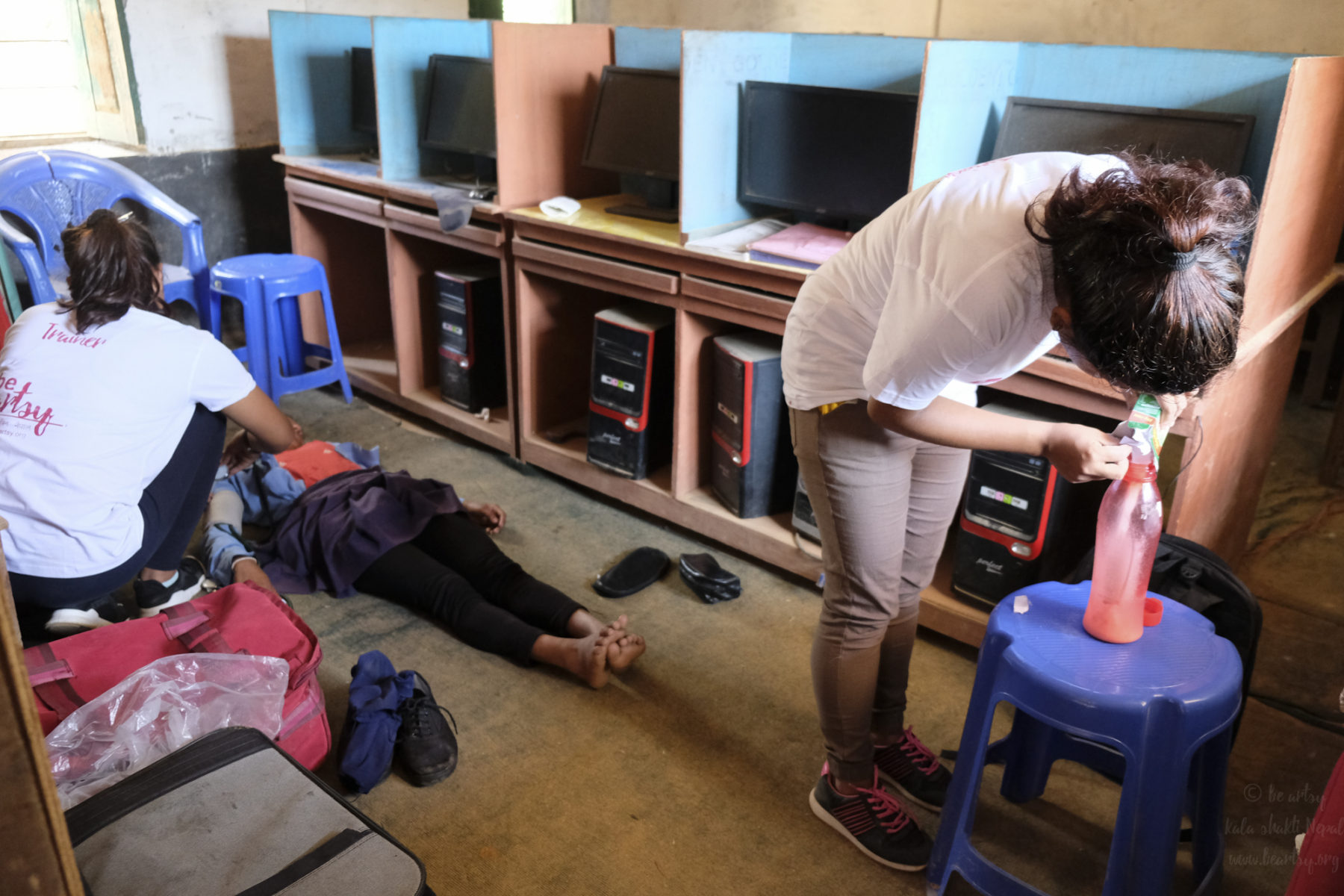
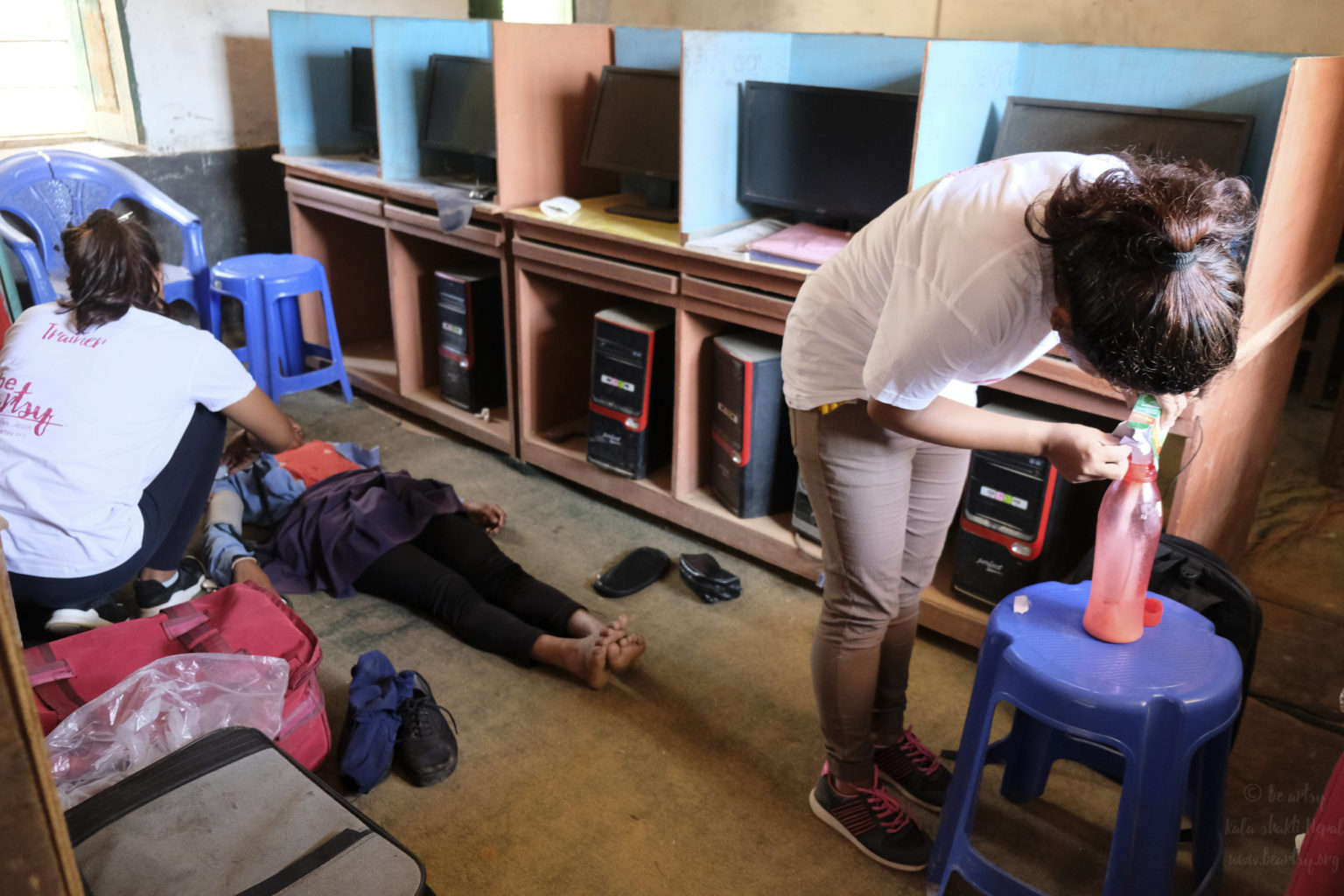
    On the first day at one of the schools we visited during the Spring 2018/2075 Rato Baltin project, when we came back from teaching class 10 boys and girls, we found a woman in the computer room where we kept our materials holding what we were thinking was an unconscious girl from class 9.

    One of our Nurses, Anju, took her vitals signs and she said she was not totally unconscious because she was responding to the environment. Afterwards, Anju asked the woman, who was the girl’s mother, about her history. She told us that it was a recurrent incident, caused when a menstruating girl touched her daughter.

    We asked if when the girl is menstruating has these kinds of episodes, and the mother told us ‘no’. It only happened when she was touched by another menstruating girl.

    We tried to give the girl Oral Rehydration Solution (ORS), but she was holding her jaw closed. We were therefore unable to give her the ORS. The mother explained that usually when she had these kinds of episodes, they would give her some drops of cow’s urine and she would wake up a moment later…

    Anju asked the mother to bring the cow urine drop’s to see what would occur, as she couldn’t find any normal explanation for the girl’s state.

    The mother arrived with some cow urine and grass. After asking for the assistance of a small girl on the school grounds who was not menstruating (Kumari, 8 years old), the girl spilt the urine soaked grass on top of the unconscious girl, who began to open her eyes. Anju asked the girl her name, which she answered correctly. She was completely back to normal.

    The pressure of beliefs from both families and wider society is so strong and convincing that girls really think that if they don’t practice chhaupadi, something wrong will occur. In this case, the girl really believes that she loses consciousness when a menstruating girl touches her.

    Written and photo © by Clara Go. Correction by Kristy Davies

    The girl that could not be touched by a menstruating girl

    Now you can contribute for paying one month salary to the nurse, or for some hygiene kit : https://www.gofundme.com/menstrual-cups-in-nepal-chhaupadi

    West Nepal girls need this kind of program. And we need help to continue the project!

    Or if you feel like it, you can donate via bank transfer at: Banc Sabadell IBAN: ES23 0081 0900 8200 0430 1934 BIC: BSABESBB (your recurring donation will help us have a better planning of our budget to carry out the projects undertaken).

    Or take a look to others ways to donate at http://beartsy.org/donate/

    Thank You! 🙂

  • Travel log: Oligaun, the most hard Achham

    Travel log: Oligaun, the most hard Achham

    The first week in a new village is always stressful. We have to get to know the people around us: teachers, health personnel, community leaders, and more importantly, the women, girls, and boys.

    In Oligaun it was no different, but we also had to get to know part of the new team. Tejana, one of our Mentors from Basti, and Manisha, one of our Mentors from Kunti, came with us. They have been using menstrual cups since the first Rato Baltin trip. Also with us was Uma Bista, a photojournalist that helped us a little with the photo workshop during part of our stay in town.

    In the health post at the first contact, we explained about the cup. They were really interested and we asked them some questions about women here. They explained to us that girls and women here were educated and nobody slept outside. When we left, one of our nurses told us: “Let’s see, I don’t think this is so”. I told them: “If they didn’t, it would be great news that in this part of Achham they have eradicated chhaupadi, but I have already seen Chhaugots on our way here”.

    The reality is that here chhaupadi is more normalised and more accepted. Like in other places, women are the ones that want to do it, but men don’t do anything to stop the practice. They speak about it like it is a joke. There is so much work to do here, but we were not really happy about what we felt we could do.

    The classes ran with some difficulties. Sometimes teachers seemed to not want to be involved, for them, the normal curriculum is the most important thing and girls needs come second. We learnt a lot here: the girls accepted chhaupadi, so, at the beginning they didn’t find learning about menstruation interesting. After they knew about the menstrual cup, this changed a little. In classes 10 and 9 girls weren’t really interested at the beginning, but by the end were really happy with the participative photography results and with our video from the closing ceremony.

    In the menstrual cup training we had 95 girls, but we couldn’t give one to every girls as we didn’t have enough. We could give 61 cups to the girls in school plus the women’s group.

    With the girls here we saw that there had been some changes in chhaupadi. Before they stayed in small goat sheds on the ground floor, but nowadays some of them are on the first floor. We saw too that the chhaugoats here are bigger than the ones in KuntiBandali, or the remaining ones in Basti.

    We have been trying to set up a men’s group, but this has still been unsuccessful. In some places a teacher may try to help us, but nothing works, the men did not come. Here in Oligaun it has been impossible to do it. However, we had small conversations with different groups of men, where we spoke about the importance of help from them to assist doctors and community leaders to stop the practice. We spoke openly about rape, about how many drunks have abused girls in the chhaugots, and I think that touched them. We told them that we are not from the community, that they were the ones that should do something about the problem. Let’s hope that they will try to do something.

    We will try to involve more girls, women and men in Kalagaun, our next village, but it is time to plant the rise and we are a little scared whether they will make time for us.

    Two months in the field is a really hard experience, but we try to have as much fun as we can. We are enjoying the simple life in the villages and the smiles from children – Sano Manche (small people), as our nurse Anju likes to call them.

    Written, and photos with Fujifilm XT20, © by Clara Go.
    Correction by Kristy Davies

    Now you can contribute for paying one month salary to the nurse, or for some hygiene kit : https://www.gofundme.com/menstrual-cups-in-nepal-chhaupadi

    West Nepal girls need this kind of program. And we need help to continue the project!

    Or if you feel like it, you can donate via bank transfer at: Banc Sabadell IBAN: ES23 0081 0900 8200 0430 1934 BIC: BSABESBB (your recurring donation will help us have a better planning of our budget to carry out the projects undertaken).

    Or take a look to others ways to donate at http://beartsy.org/donate/

    Thank You! 🙂

  • Travel Log – From 2073 to 2075. Again teaching in Basti

    Travel Log – From 2073 to 2075. Again teaching in Basti

    After Kunti Bandali, we went to Basti. This was Clara’s third time there. She explained to the team that going down is complicated, but that once you are there you don’t want to leave… It’s like another world. It’s a really remote (and hot) place, where life is hard but people are authentic and lovely.

    Some of the volunteers had problems on the way down like Clara had predicated, but once they reached the people, they fell in love with them. The day we left, some village girls were really sad because we were going, as well as some volunteers. The rest told the girls, “see you in September!” 🙂

    In Basti, we taught classes 6 and 7. We did the menstrual cup training to more than 20 new school girls, and 9 young women not in the school. It was a pity to see girls so young that had left school, in the best case, in class 5. When you ask them why they left, they usually answer: “Too much work to do, didi…”.

    In September we will do the follow up to these two villages (Basti and Kunti), with the rest of the villages we are teaching during the spring. We are planning to go with a big screen and projector and show some films to empower the girls, and do some playful programs for all the community. That way they can all enjoy our visit, and we can again speak in a different way about women’s rights and menstruation. We are planning a collaboration with Photo.circle for that.

    Let’s see how everything comes, but we have big expectations for this year and next years project! 🙂

    And now: Oligaun!


    Written, and photographs with Fujifilm XT20, © by Clara Go.
    Correction by Kristy Davies

    Now you can contribute for paying one month salary to the nurse, or for some hygiene kit : https://www.gofundme.com/menstrual-cups-in-nepal-chhaupadi

    West Nepal girls need this kind of program. And we need help to continue the project!

    Or if you feel like it, you can donate via bank transfer at: Banc Sabadell IBAN: ES23 0081 0900 8200 0430 1934 BIC: BSABESBB (your recurring donation will help us have a better planning of our budget to carry out the projects undertaken).

    Or take a look to others ways to donate at http://beartsy.org/donate/

    Thank You! 🙂

  • Empowering Women and Girls through MHM: Menstrual Hygiene Awareness Day

    Empowering Women and Girls through MHM: Menstrual Hygiene Awareness Day

    For many of the global population of women and girls, menstruation is time of stress and shame. Some women and girls not only have limited access to and knowledge of clean menstrual management resources and safe, private spaces to dispose of materials, but they consider both themselves and menstruation itself as dirty and shameful.

    To combat these realities and raise awareness of the challenge of menstrual health management (MHM), the 28th of May 2018 marks the fourth international Day of Menstrual Hygiene Awareness. The day was designed as a platform for the voices of individuals, organisations, businesses and the media to unite and break the silence around MHM issues faced by women and girls around the world.

    For many girls, this culture of shame combined with a lack of access to adequate resources and MHM knowledge results in issues of self-confidence and school absenteeism. Ensuring girls stay in school and fully engage in the learning process with confidence is critical to the empowerment focus within the sustainable development goals. When girls go to school and engage in the learning process, they are empowered to reach their full potential.

    In villages across Far-West Nepal where the practice of chhaupadi is still prevalent, MHM practices and the empowerment of women and girls is an important issue of focus. Chhaupadi is a deeply entrenched social practice where women and girls are considering impure during menstruation and are subject to a number of prohibitions which deprive them of their most basic needs.

    These prohibitions include being forbidden from touching food others will consume, crossing water, restricted school attendance, and entering the family home, requiring women and girls to sleep in cattle sheds or makeshift huts. Those subject to the practice risk exposure to rape, snakebites, smoke inhalation, and animal attacks. Furthermore, the restriction of girls from school during menstruation is harmful to their education. Poor MHM tools and knowledge is linked to low education outcomes, as well as broader negative effects to employment, health and overall development.

    Although the Government of Nepal declared chhaupadi illegal, the practice is deeply embedded in social norms and cultural practices. The aim of grassroots social organisations like be artsy is to empower girls in Far-West Nepal through MHM community education, and the provision of menstrual cups and hygiene kits. Ruby Cup is the donor of menstrual cups to be artsy, that also have some individual and other private donors. This approach is designed to reduce school absenteeism, improve girls’ self-confidence, and reduce the prevalence and negative impact of chhaupadi through increased knowledge of menstruation amongst communities.

    It is important that days like today exist to shine a light on the work that organisations do to enable women and girls’ empowerment through MHM education, as well as highlight what there is still left to accomplish. It is with global support and awareness combined with grassroots local engagement that true change will be achieved to the benefit of women and girls across the globe.

    We would like to remind you of the different ways to continue collaborating with us:

    Written by Kristy Davies.
  • Travel Log – From 2073 to 2075, again teaching in Kunti Bandali

    Travel Log – From 2073 to 2075, again teaching in Kunti Bandali

    After Janalibandali we travelled to Kunti Bandali, where nothing was really new. We were only there teaching for four days. The first time we came here we taught two classes at the end of 2073 (it is now the beginning of 2075).

    This time we taught classes 6 and 7, as well as a school girls group, menstrual cup training, and a young women’s group.

    The school in Kunti was (as usual) strict with or timetables and their students. In this school discipline is an everyday thing. There were three periods every day, and we had to finish on time. Something really complicated, sometimes…

    The school had finished its new building we had seen growing over our last two visits, and they now had a clean, beautiful library and hall.

    The young women’s group was really interesting, made up of young women that were not attending the school. We think the menstrual cups we buy to give to women outside of the school could get good use here. The only thing we are not happy with is that they could only join us for one day because of work, and we are quite sure that the follow up will be more complicated that usual. But both Jamuna, a nurse, and the nurse in town, took responsibility of following up on time after our phone calls.

    We completed the follow up with old users from Dashain in Jamuna’s house, which we also used to eat, sleep, and boil menstrual cups.

    Written and photographs, with Fujifilm XT20, © by Clara Go.
    Correction by Kristy Davies

    Now you can contribute for paying one month salary to the nurse, or for some hygiene kit : https://www.gofundme.com/menstrual-cups-in-nepal-chhaupadi

    West Nepal girls need this kind of program. And we need help to continue the project!

    Or if you feel like it, you can donate via bank transfer at: Banc Sabadell IBAN: ES23 0081 0900 8200 0430 1934 BIC: BSABESBB (your recurring donation will help us have a better planning of our budget to carry out the projects undertaken).

    Or take a look to others ways to donate at http://beartsy.org/donate/

    Thank You! 🙂

  • Our second week in Janalibandali was quieter than the first

    Our second week in Janalibandali was quieter than the first

    On Sunday we trained the women’s group how to use the menstrual cup. Many young married girls came to the training, but not with the profile we really wanted to target: poor girls that could not go to school because of poverty or being married.

    There are two reasons why this group may not have attended: 1 – The news did not reach them, or 2 – In this part of Achham, full of high caste people, women’s conditions are better than in other parts where we have worked.

    We had a lot of girls in the group that were studying in years 11 and 12 in Mangalsen, who were also given the menstrual cup and kit. This week, we taught years 6, 7 and 8 as well.

    On the last day, we held the photo exhibition and showed a small video with the photos the girls have produced about their menstruation over the last two weeks during the participative photography workshops. There were photos from different areas of everyday life:


    • Food and Menstruation
    • First Menstruation
    • Friendship and Menstruation
    • School and Menstruation
    • Restrictions
    • Cleanliness and Menstruation
    • Family help
    • One day in the life of a Menstruating women
    • Babies and Menstruation
    • Clothes and Menstruation


    After the photos, we showed a video about chhaupadi and encouraged girls and boys to talk with their families to try and stop the practice or at least create safer conditions.

    While the local authorities in Janalibandali have helped us a lot, they had been really worried about the message we might tell the world about the practice in this part of Accham. But at all times we told them that we would explain the reality we have seen: they expend a lot of effort to end the practice of chhaupadi, and a lot of girls just sleep in separate rooms inside of the house.

    But we have spoke to women as well as seen ourselves that many will sleep outside until the older generations within their families have passed away. We have also seen cruelties, like a girl sleeping in a “bamboo basket”.

    In Janalibandali, there are less instances of chhaupadi than in other more remote places that we have been working, but we hope that the local leaders and authorities will continue to work on the issue until no girl sleeps outside their homes while menstruating.

    For now, we did the only thing we can do: provide education and menstrual cups, to dignify their periods of menstruation overall lives.

    Written and photographs, with Fujifilm XT20, © by Clara Go.
    Correction by Kristy Davies

    Now you can contribute for paying one month salary to the nurse, or for some hygiene kit : https://www.gofundme.com/menstrual-cups-in-nepal-chhaupadi

    West Nepal girls need this kind of program. And we need help to continue the project!

    Or if you feel like it, you can donate via bank transfer at: Banc Sabadell IBAN: ES23 0081 0900 8200 0430 1934 BIC: BSABESBB (your recurring donation will help us have a better planning of our budget to carry out the projects undertaken).

    Or take a look others ways to donate at http://beartsy.org/donate/

    Thank You! 🙂

  • Travel log: First week in Janalibandali (Mangalsen 6, Achham)

    Travel log: First week in Janalibandali (Mangalsen 6, Achham)

    The first week in Janalibandali has been very intense, even too much. On arrival, we had several meetings with local liders, the nurse and the teachers.

    On Saturday they organized traditional dances and music, the lyrics of which was (like in Basti) absolutely against the Chhaupadi. We have been making groups of boys and girls from grades 10 to 8, next week we will continue with 7 and 6.

    We have around 70 in the girls group. Quite difficult to work as a team as we wanted to do this time, with the pictures. The day was somewhat chaotic, we made the groups, but the rest was very interesting. From the beginning, we noticed that the tradition, here, has started to change, they agree that is not ok (we are near the area where several deaths have happened). They explain to us that since the last three years there has been a big change, but no girl enters the kitchens… and we have discovered girls sleeping in baskets or in the open.

    We have made the biggest training ever of menstrual cups until now. 45 girls in the same class!

    We made the women group and more than 160 came up (they asked us for money for coming to the classes… as they are used to receive it from the large NGOs…). We told them no. It was a chaos, we were not expecting so many people, we did not have an appropriate place to teach them and in the end we did it in the street. Impossible to pass the videos as we lacked the necessary projector and the sound quality for such an amount of people. Whilst all of us were very happy with the girls group, none of us is with the women group.

    We were expecting around 20 or 25 for the second day, as we said that only the young girls would have a menstrual cup, and in the end (late, as usual) half the ones from the previous day appeared. Quite hectic, too.

    We have 27 cups for girls out from school and young women. The idea was having them paying 50 rupees as first choice, because if they are for free, everybody wants them. In the end, from the 160 women from the first day, of the age we had requested, there were around 35. Many tried to lie dropping down years 🙂 , but that is difficult in this area: at 34 they look like 50. Their life is very hard in this area.

    We wanted to make the training on Friday the 27th but a big storm made us leave it for the following week.

    The poor nurses are hoarse. We have requested a microphone and a loudspeaker like the one for tourist guides, to see if that way they can lower the voice. It is lear that in this area of Mangalsen the groups are very big, so we have to prepare ourselves for the areas of Oligau and Kalagaun. We have asked our “mentors” from Basti, Sunita Damai and Tejana Khanal, that they come with us as “paid volunteers” for the remaining month and a half. They have accepted gladly.

    It would be great to bring with us some local girls that have been using the menstrual cup for over a year!

    Written and photographs, with Fujifilm XT20, © by Clara Go.
    Translation by Tere Salinero

    Now you can contribute for paying one month salary to the nurse, or for some hygiene kit : https://www.gofundme.com/menstrual-cups-in-nepal-chhaupadi

    West Nepal girls need this kind of program. And we need help to continue the project!

    Or if you feel like it, you can donate via bank transfer at: Banc Sabadell IBAN: ES23 0081 0900 8200 0430 1934 BIC: BSABESBB (your recurring donation will help us have a better planning of our budget to carry out the projects undertaken).

    Or take a look others ways to donate at http://beartsy.org/donate/

    Thank You! 🙂

  • 2017 RATO BALTIN PROJECT FINANCIAL REPORT

    2017 RATO BALTIN PROJECT FINANCIAL REPORT

    This would not be possible without you, that is why we want to thank each a every one of the people who made our work possible in Nepal during the 2017.

    To continue empowering the girls and women in the remote areas of West Nepal, the raising of awareness and educating in menstrual and sexual matters in order to put an end to the Chhaupadi tradition, €9,967.71 were needed. Attached you will find the link with the information and break down of all the expenses.

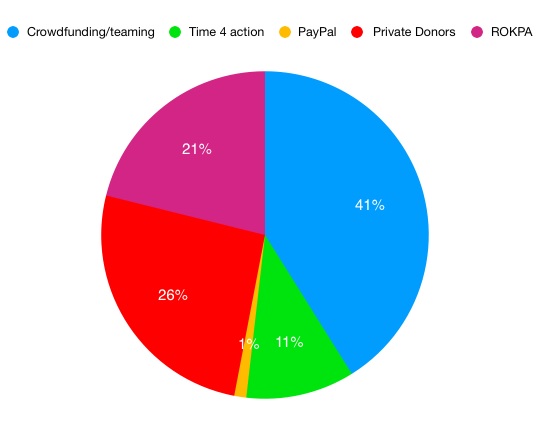
    We had the unconditional support of organisations such as ROKPA and Time 4 action, but also that of many anonymous donors. Without all of you this could not happen, so, however small, we are very grateful for all those valuable contributions.

    We are not forgetting Fujifilm España, as they donated various photographic materials (photo paper, cameras…), enabling us to undertake one of the workshops, to facilitate the communication through the pictures.

    Neither are we forgetting Ruby Cup, our strategic partner, because thanks to the donated cups, we can work with the girls in the most remote areas and make their menstrual cycles more confortable and hygienic.
    We would like to remind you of the different ways to continue collaborating with us:


    • BUDGET EVALUATION

    Description

    Pr evist Cost

    Total Cost

    Salaries – Local staff

    Rs 243.000,00

    Rs 269.280

    Supplies and workshop resources

    Rs 121.280,00

    Rs 184.967

    Utilities

    Rs 180.000,00

    Rs 299.092

    Transportation

    Rs 227.436,00

    Rs 288.741

    Total NPR

    Rs 771.716,00

    Rs 1.042.080

    Total Euro

    6.710,57 €

    9061,56 €

    General expenses – 10% of total Euro

    671,06 €

    906,15 €

    Grand Total

    7.381,63 €

    9967,71 €

    Exchange Rate: 1 Euro = 115 NPR (Rs)

    The 2017 budget exceeded the initial proposed expenditure by 2,586 Euros. This was the case for several reasons:1.b eartsy receivedanunexpectednewdonationof160menstrualcupsfromRubyCups

    2. This donation led to the doubling of the expected amount of work and needed complementary resources, particularly in terms of the menstrual kits

    3. Difficulty in finding volunteers to travel to West Nepal without financial compensation

    4. The need to provide Kathmandu-based volunteers with funds for travel and food related to be artsy activities

    5. Difficulty in contracting a staff nurse for only three to four months of the year requiring higher than expected remuneration

    Great care was taken to adjust the budget and account for the increase in work and resources required by the unexpected donation, but a substantial increase was unavoidable to deliver the new cups.

    2017

  • Malnourishment in West Nepal

    Malnourishment in West Nepal

    One significant problem that we have seen in our travels throughout West Nepal is the extent of childhood malnourishment.

    Sometimes this can be associated with very young mothers with little nutritional information support, but in other cases cannot. Though there are some nutritional programs that run throughout West Nepal, it can be difficult for mothers to provide the breadth and quantity of recommended food and vitamins when they only have direct access to the food grown in their fields.

    The districts in West Nepal with the highest rates of malnourishment in children under the age of five are:

    Humla        65.7%
    Bajhang     63.2%
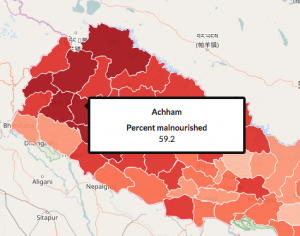
    Achham     59.2%
    Baitadi       59.2%
    Doti            57.6%
    Surkhet     57.9%
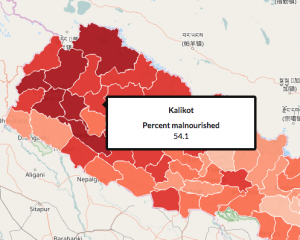
    Kalikot       54.1%
    Jumla         54.1%

    To find out the malnourishment rates of children under five in other districts, check out this interactive map:


    Maps and numbers from: www.nepalmap.org


    In Achham, for example, the amount of food grown and accessed by mothers is usually insufficient for the number of children they care for. The father is usually in India or abroad elsewhere working to send money back to their families, and women often don’t have the knowledge and resources to manage the crisis.


    My dear friend Dr Keshav Bhattarai, who passed away last December at 31 years, was the one who introduced me to the world of women in West Nepal. He was really upset because on average, every month six women in Achham committed suicide. These women had large families with many children that they were unable to provide with sufficient food, and often did not want to use contraception, or have access to the choice or relevant education about it. In this situation, women suffer a lot of stress and pressure.

    I don’t think anything has changed in the district since he left last year to work in Humla, before his death.

    Children are the foundation that the future of Nepal rests upon. Only a proper investment in today’s children will bring us to a better tomorrow.

    But a quick glance at the child nourishment data on www.nepalmap.org shows that 40% of children under the age of five in Nepal are malnourished. This means that today, almost half of children in Nepal under five do not receive a well-balanced meal, which not only hampers their development, but in turn the nations.

    In our workshops we teach the importance of proper nutrition, balanced meals, and hydration to the girls. Although this becomes increasingly essential once their menstrual periods start, proper hydration and nutrition is critical every day of the year, from early childhood into adulthood.

    And so we wait, hoping that little by little things are changing.

    Now you can contribute for paying one month salary to the nurse, or for some hygiene kit or for the menstrual cup control in September: https://www.gofundme.com/menstrual-cups-in-nepal-chhaupadi

    Written by Clara Go. Correction by Kristy Davies
    Maps and numbers from: www.nepalmap.org

    West Nepal girls need this kind of program. And we need help to continue the project!

    Or if you feel like it, you can donate via bank transfer at: Banc Sabadell IBAN: ES23 0081 0900 8200 0430 1934 BIC: BSABESBB (your recurring donation will help us have a better planning of our budget to carry out the projects undertaken).

    Or take a look others ways to donate at http://beartsy.org/donate/

    Thank You! 🙂

  • Periodically untouchable

    Periodically untouchable

    We publish the translation, in our web, of the following article – by Aditi Lamichhane, published 2017-07-05 at The Kathmandu Post– because we consider it is important for our Catalan and Spanish-speaking readers.
    —  be artsy team. Image: The Kathmandu Post

    At the age of 13, menstrual cycle, for me, was about a beautiful transition into womanhood. At the age of 14, it became a harsh reality.


    At the age of 13, my idea about the menstrual cycle was simple. For me it was the transition from being a girl to being a woman; an undeniable beautiful transition, after which I hoped that I would be treated like an adult at my home. But, that dream shattered at the age of 14, when I had my first period and got a glimpse of the harsh reality that I would have to face every time I get my period: Untouchability
     

    In just a few minutes, I went from being a kanya—a figure of purity, a form of goddess—to an impure, untouchable woman at my own home. It was nerve-wracking, how I was treated worse than an animal when my natural, biological process knocked on the door for the very first time.

    I was angry at myself. I felt a whirlwind of emotions like confusion, disgrace and rage and it was all too intense for me to figure out. It was all too much to take. When I questioned, “Why am I being treated like this?” The people around me had the audacity to tell me that it is our ‘tradition’; it is our ‘culture’.

    In South India, Hindu girls who experience their menstruation for the first time are given presents. They have a celebration just to mark this special occasion. Buddhists across the world view menstruation as a ‘natural physical excretion that women have to go through on a monthly basis, nothing more or less’.

    Guru Nanak, the founder of Sikhism, condemned the practice of treating women as impure while menstruating. He made it very clear to his followers that the menstrual cycle is a ‘god-given’ process.

    There are many such examples where the biggest of spiritual and religious gurus have clearly mentioned that girls are not impure during their periods. Rather it is just an excuse, in the name of religion, to oppress women.

    When I shared my knowledge on the taboo to my parents, they blamed me for being an atheist and causing unwanted trouble for them. Here’s the thing: I am not an atheist.

    I believe in god. And I believe that god loves us and would not humiliate us.


    There is a phrase in Manusmriti—a legal ancient text of Hinduism—that reads:

    “Yatra naryastu pujyante ramante tatra devata?|

    Yatraitastu na pujyante sarva statraphalakriya|”

    It translates to: Divine lives in that house where women are respected. In a house where women are not respected, no good deed will add up to reap good results.

    Why and for what reasons then is there this hypocrisy that surrounds menstruation? Why then are women shown utter disrespect during their most natural processes?


    There is a familiar shloka:

    Janani janma-bhoomi-scha

    swargadapi gariyasi—which translates to the mother and the birthplace are the sources of happiness that surpasses even the joys and luxuries of heaven.

    My argument now is that isn’t menstruation where motherhood stems from? Doesn’t menstruation mark a girl’s ability to become a mother? Isn’t mother everything—a goddess of sorts? How then does menstruation make one impure and untouchable?

    I am definitely not the only victim of the menstrual taboo. There are many examples around me that dishearten me on realising that I live in such a prejudiced society. If we don’t progress as a family or a community, how are we going to progress as a country?

    Nepal is home to wonder-women like Pasang Lhamu Sherpa, Mira Rai, Jhamak Ghimire and Anuradha Koirala among others. It is such a shame that the very same country is also home to ignorance on menstrual health and hygiene alongside the taboo.

    Yes, I am aware that what I go through during my period compares nothing to what girls in the rural villages go through. But, being an urban resident doesn’t come with any privilege when it comes to menstruation.

    At 13, I was told that upon menstruating I was not supposed to see my father or the sun, and I was not supposed to touch any food or utensils. Entering kitchen would be as bad as stepping onto a minefield. I was confined to my room and the bathroom. I felt alienated and nobody even bothered to ask me how I felt about the whole situation.

    I still cringe when I look back at the time. I was alone. I would cry all night, and cover my sniffles with my bare hands during the day. I was traumatised and I wished that no girl ever had to go through it.

    I was beyond happy when my little sister had her first period in a hostel. After all, no girl in the world deserves to go through those feelings of insecurity and loneliness as she enters her womanhood.

    It is high time to do everything possible to break the taboo that does nothing but develop inferiority complex in young girls. It is high time that we say ‘no’ to the malpractice of telling girls what to see, what to touch and where to sleep during menstruation. We are humans and we should be allowed to do what we wish to do.

    Lamichhane is an A-Level student from Budhanilkantha School


    West Nepal girls need this kind of program. And we need help to continue the project!

    Now you can donate for paying one month salary to the nurse, or for some hygiene kit or for the menstrual cup control in September: http://beartsy.org/get-involved-with-rato-baltin

    Or if you feel like it, you can donate via bank transfer at: Banc Sabadell IBAN: ES23 0081 0900 8200 0430 1934 BIC: BSABESBB (your recurring donation will help us have a better planning of our budget to carry out the projects undertaken).

    Or take a look others ways to donate in http://beartsy.org/donate/

    Thank You! 🙂